 Add to Chrome
 Add to Firefox
 Add to Edge
Beyond Fixed Luminance: Towards Panchromatic and Orthochromatic Image Colorization
Aug 12, 2026
Most image colorization systems operate in $Lab$ space by predicting chroma ($ab$) while preserving an input-derived luminance channel ($L$). While effective on standard benchmarks, this fixed-luminance design restricts brightness changes and becomes unreliable when grayscale formation deviates from natural-image luminance, as in historical orthochromatic photography. We propose a luminance-agnostic colorization framework that formulates colorization as full-RGB image editing using a foundation image-editing model. To bridge modern panchromatic and historical orthochromatic conditions, we introduce a mixed grayscale objective that trains the model under both standard luminance grayscale and a red-insensitive grayscale formation. Experiments on COCO, ImageNet, and a multi-instance benchmark show that our method is competitive on standard grayscale inputs and substantially more robust under orthochromatic inputs, with qualitative comparisons and a human study indicating fewer visible color artifacts.

Swift Sampling: Selecting Temporal Surprises via Taylor Series
May 21, 2026While most frames in long-form video are redundant, the critical information resides in temporal surprises: moments where the actual visual features deviate from their predicted evolution. Inspired by the human brain's predictive coding, we introduce Swift Sampling, an elegant, training-free frame selection algorithm that automatically identifies high-information moments in a video. Specifically, we model a video as a differentiable trajectory in the visual latent space and compute the velocity and acceleration of its features. Then, we apply Taylor expansion to project the expected path of subsequent frames. Frames that diverge sharply from this predicted manifold are identified as temporally surprising frames and selected for sampling. Unlike prior training-free methods that rely on auxiliary networks or video-specific hyperparameter tuning, Swift Sampling is incredibly lightweight, adding only 0.02x additional computational cost over baseline making it 30x cheaper overhead than leading baselines. Across three long-video question answering benchmarks and 10 different downstream tasks, Swift Sampling outperforms uniform sampling and prior query-agnostic baselines. It is especially powerful for long videos with limited frame budgets improving accuracy by up to +12.5 points.
A Nash Equilibrium Framework For Training-Free Multimodal Step Verification
May 19, 2026Multimodal large language models often generate reasoning chains containing subtle errors that lead to incorrect answers. Current verification approaches have notable limitations. Learned critics need extensive labeled data and show inconsistent performance across different tasks. Meanwhile, existing training-free methods simply average scores from different sources, missing a key insight: when these scores disagree, that disagreement itself carries important information about whether a reasoning step is truly valid or not. We propose a training-free verification approach that treats step-wise verification as a coordination problem among specialized judges. We formalize these judges' interaction as a Nash equilibrium game where agreement signals valid steps while disagreement reveals instability. Our method computes equilibrium scores through a closed-form solution, enabling both disagreement-aware filtering and stability-conscious ranking of reasoning steps. Evaluated across six benchmarks, our approach achieves consistent improvements of 2.4% to 5.2% over baseline models and shows competitive performance against learned critics, demonstrating that cross-modal agreement (not just average confidence) provides robust verification signals without task-specific adaptation.
Unifying Scientific Communication: Fine-Grained Correspondence Across Scientific Media
May 07, 2026The communication of scientific knowledge has become increasingly multimodal, spanning text, visuals, and speech through materials such as research papers, slides, and recorded presentations. These different representations collectively convey a study's reasoning, results, and insights, offering complementary perspectives that enrich understanding. However, despite their shared purpose, such materials are rarely connected in a structured way. The absence of explicit links across formats makes it difficult to trace how concepts, visuals, and explanations correspond, limiting unified exploration and analysis of research content. To address this gap, we introduce the Multimodal Conference Dataset (MCD), the first benchmark that integrates research papers, presentation videos, explanatory videos, and slides from the same works. We evaluate a range of embedding-based and vision-language models to assess their ability to discover fine-grained cross-format correspondences, establishing the first systematic benchmark for this task. Our results show that vision-language models are robust but struggle with fine-grained alignment, while embedding-based models capture text-visual correspondences well but equations and symbolic content form distinct clusters in the embedding space. These findings highlight both the strengths and limitations of current approaches and point to key directions for future research in multimodal scientific understanding. To ensure reproducibility, we release the resources for MCD at https://github.com/meghamariamkm2002/MCD
$\oslash$ Source Models Leak What They Shouldn't $ rightarrow$: Unlearning Zero-Shot Transfer in Domain Adaptation Through Adversarial Optimization
Apr 09, 2026The increasing adaptation of vision models across domains, such as satellite imagery and medical scans, has raised an emerging privacy risk: models may inadvertently retain and leak sensitive source-domain specific information in the target domain. This creates a compelling use case for machine unlearning to protect the privacy of sensitive source-domain data. Among adaptation techniques, source-free domain adaptation (SFDA) calls for an urgent need for machine unlearning (MU), where the source data itself is protected, yet the source model exposed during adaptation encodes its influence. Our experiments reveal that existing SFDA methods exhibit strong zero-shot performance on source-exclusive classes in the target domain, indicating they inadvertently leak knowledge of these classes into the target domain, even when they are not represented in the target data. We identify and address this risk by proposing an MU setting called SCADA-UL: Unlearning Source-exclusive ClAsses in Domain Adaptation. Existing MU methods do not address this setting as they are not designed to handle data distribution shifts. We propose a new unlearning method, where an adversarially generated forget class sample is unlearned by the model during the domain adaptation process using a novel rescaled labeling strategy and adversarial optimization. We also extend our study to two variants: a continual version of this problem setting and to one where the specific source classes to be forgotten may be unknown. Alongside theoretical interpretations, our comprehensive empirical results show that our method consistently outperforms baselines in the proposed setting while achieving retraining-level unlearning performance on benchmark datasets. Our code is available at https://github.com/D-Arnav/SCADA
interwhen: A Generalizable Framework for Verifiable Reasoning with Test-time Monitors
Feb 05, 2026We present a test-time verification framework, interwhen, that ensures that the output of a reasoning model is valid wrt. a given set of verifiers. Verified reasoning is an important goal in high-stakes scenarios such as deploying agents in the physical world or in domains such as law and finance. However, current techniques either rely on the generate-test paradigm that verifies only after the final answer is produced, or verify partial output through a step-extraction paradigm where the task execution is externally broken down into structured steps. The former is inefficient while the latter artificially restricts a model's problem solving strategies. Instead, we propose to verify a model's reasoning trace as-is, taking full advantage of a model's reasoning capabilities while verifying and steering the model's output only when needed. The key idea is meta-prompting, identifying the verifiable properties that any partial solution should satisfy and then prompting the model to follow a custom format in its trace such that partial outputs can be easily parsed and checked. We consider both self-verification and external verification and find that interwhen provides a useful abstraction to provide feedback and steer reasoning models in each case. Using self-verification, interwhen obtains state-of-the-art results on early stopping reasoning models, without any loss in accuracy. Using external verifiers, interwhen obtains 10 p.p. improvement in accuracy over test-time scaling methods, while ensuring 100% soundness and being 4x more efficient. The code for interwhen is available at https://github.com/microsoft/interwhen
Where does an LLM begin computing an instruction?
Nov 19, 2025Following an instruction involves distinct sub-processes, such as reading content, reading the instruction, executing it, and producing an answer. We ask where, along the layer stack, instruction following begins, the point where reading gives way to doing. We introduce three simple datasets (Key-Value, Quote Attribution, Letter Selection) and two hop compositions of these tasks. Using activation patching on minimal-contrast prompt pairs, we measure a layer-wise flip rate that indicates when substituting selected residual activations changes the predicted answer. Across models in the Llama family, we observe an inflection point, which we term onset, where interventions that change predictions before this point become largely ineffective afterward. Multi-hop compositions show a similar onset location. These results provide a simple, replicable way to locate where instruction following begins and to compare this location across tasks and model sizes.
BiasConnect: Investigating Bias Interactions in Text-to-Image Models
Mar 12, 2025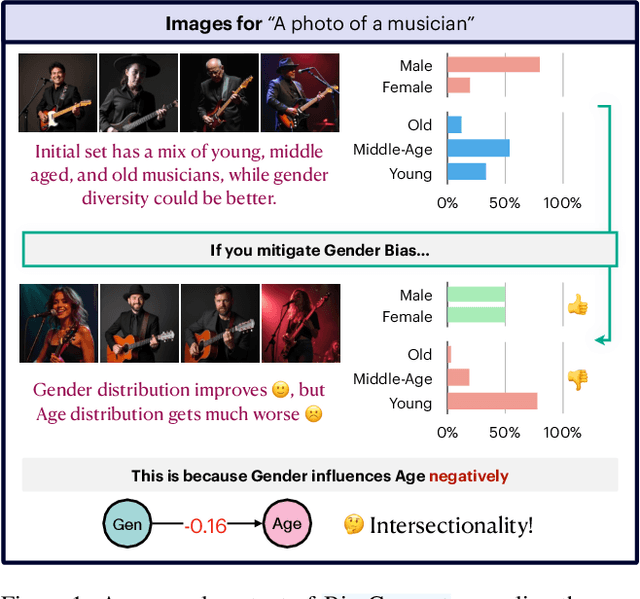
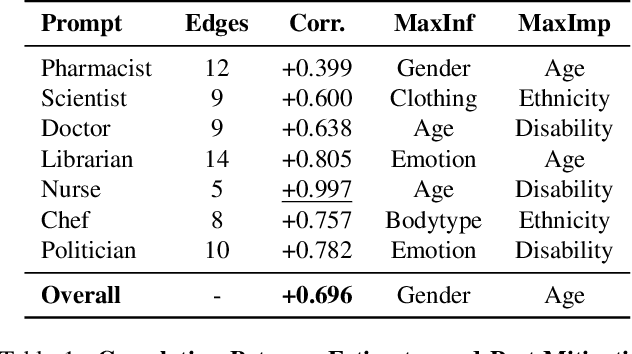
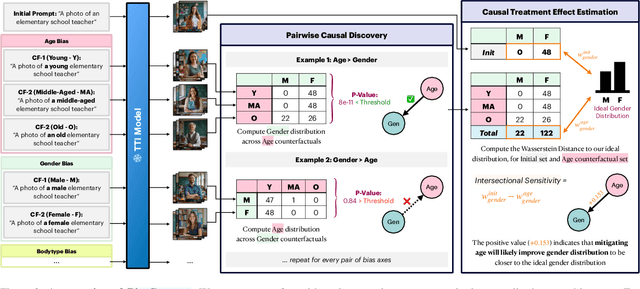
The biases exhibited by Text-to-Image (TTI) models are often treated as if they are independent, but in reality, they may be deeply interrelated. Addressing bias along one dimension, such as ethnicity or age, can inadvertently influence another dimension, like gender, either mitigating or exacerbating existing disparities. Understanding these interdependencies is crucial for designing fairer generative models, yet measuring such effects quantitatively remains a challenge. In this paper, we aim to address these questions by introducing BiasConnect, a novel tool designed to analyze and quantify bias interactions in TTI models. Our approach leverages a counterfactual-based framework to generate pairwise causal graphs that reveals the underlying structure of bias interactions for the given text prompt. Additionally, our method provides empirical estimates that indicate how other bias dimensions shift toward or away from an ideal distribution when a given bias is modified. Our estimates have a strong correlation (+0.69) with the interdependency observations post bias mitigation. We demonstrate the utility of BiasConnect for selecting optimal bias mitigation axes, comparing different TTI models on the dependencies they learn, and understanding the amplification of intersectional societal biases in TTI models.
Walking the Web of Concept-Class Relationships in Incrementally Trained Interpretable Models
Feb 27, 2025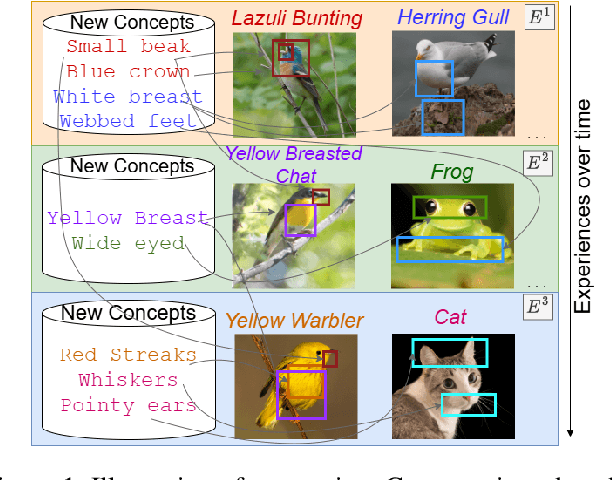
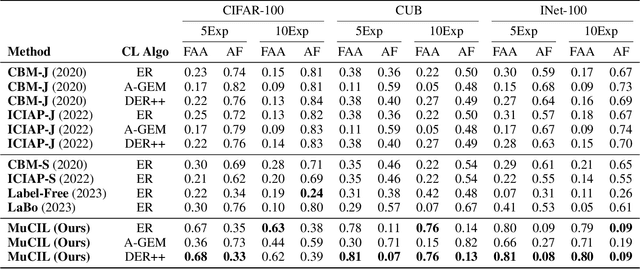
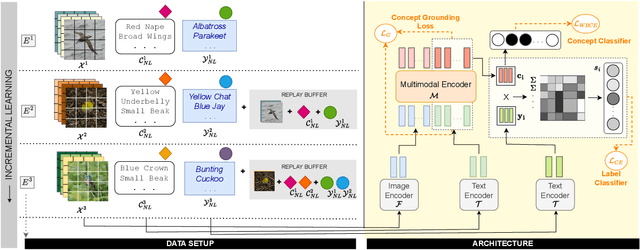
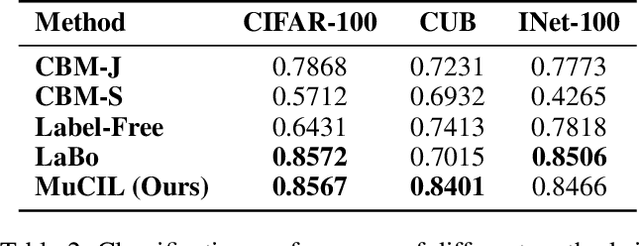
Concept-based methods have emerged as a promising direction to develop interpretable neural networks in standard supervised settings. However, most works that study them in incremental settings assume either a static concept set across all experiences or assume that each experience relies on a distinct set of concepts. In this work, we study concept-based models in a more realistic, dynamic setting where new classes may rely on older concepts in addition to introducing new concepts themselves. We show that concepts and classes form a complex web of relationships, which is susceptible to degradation and needs to be preserved and augmented across experiences. We introduce new metrics to show that existing concept-based models cannot preserve these relationships even when trained using methods to prevent catastrophic forgetting, since they cannot handle forgetting at concept, class, and concept-class relationship levels simultaneously. To address these issues, we propose a novel method - MuCIL - that uses multimodal concepts to perform classification without increasing the number of trainable parameters across experiences. The multimodal concepts are aligned to concepts provided in natural language, making them interpretable by design. Through extensive experimentation, we show that our approach obtains state-of-the-art classification performance compared to other concept-based models, achieving over 2$\times$ the classification performance in some cases. We also study the ability of our model to perform interventions on concepts, and show that it can localize visual concepts in input images, providing post-hoc interpretations.
Learning Causal Attributions in Neural Networks: Beyond Direct Effects
Mar 24, 2023

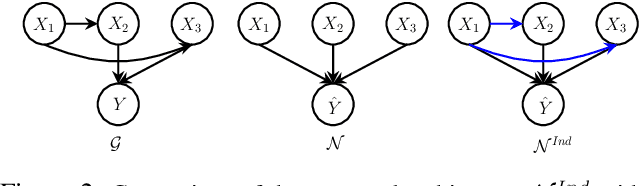
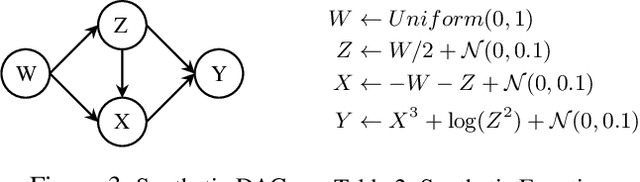
There has been a growing interest in capturing and maintaining causal relationships in Neural Network (NN) models in recent years. We study causal approaches to estimate and maintain input-output attributions in NN models in this work. In particular, existing efforts in this direction assume independence among input variables (by virtue of the NN architecture), and hence study only direct causal effects. Viewing an NN as a structural causal model (SCM), we instead focus on going beyond direct effects, introduce edges among input features, and provide a simple yet effective methodology to capture and maintain direct and indirect causal effects while training an NN model. We also propose effective approximation strategies to quantify causal attributions in high dimensional data. Our wide range of experiments on synthetic and real-world datasets show that the proposed ante-hoc method learns causal attributions for both direct and indirect causal effects close to the ground truth effects.