 Add to Chrome
 Add to Firefox
 Add to Edge
MosaicMem: Hybrid Spatial Memory for Controllable Video World Models
Mar 17, 2026
Video diffusion models are moving beyond short, plausible clips toward world simulators that must remain consistent under camera motion, revisits, and intervention. Yet spatial memory remains a key bottleneck: explicit 3D structures can improve reprojection-based consistency but struggle to depict moving objects, while implicit memory often produces inaccurate camera motion even with correct poses. We propose Mosaic Memory (MosaicMem), a hybrid spatial memory that lifts patches into 3D for reliable localization and targeted retrieval, while exploiting the model's native conditioning to preserve prompt-following generation. MosaicMem composes spatially aligned patches in the queried view via a patch-and-compose interface, preserving what should persist while allowing the model to inpaint what should evolve. With PRoPE camera conditioning and two new memory alignment methods, experiments show improved pose adherence compared to implicit memory and stronger dynamic modeling than explicit baselines. MosaicMem further enables minute-level navigation, memory-based scene editing, and autoregressive rollout.

Walking the Web of Concept-Class Relationships in Incrementally Trained Interpretable Models
Feb 27, 2025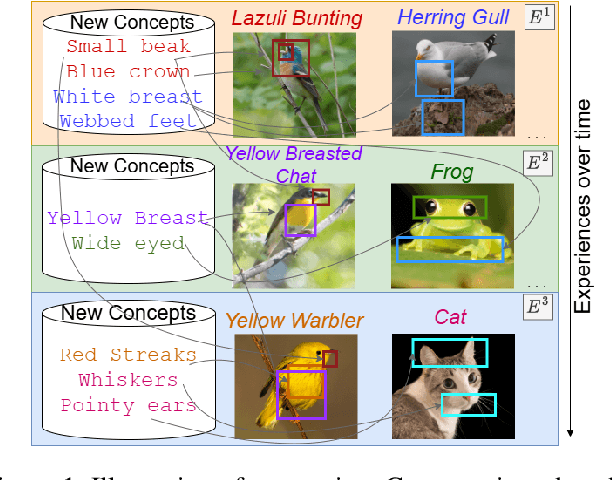
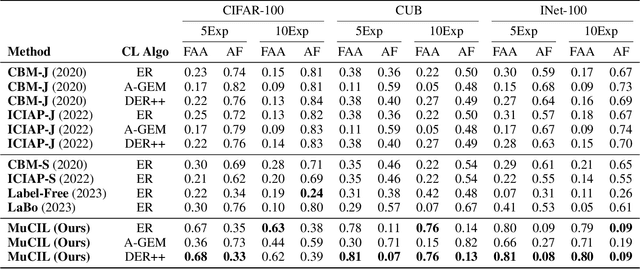
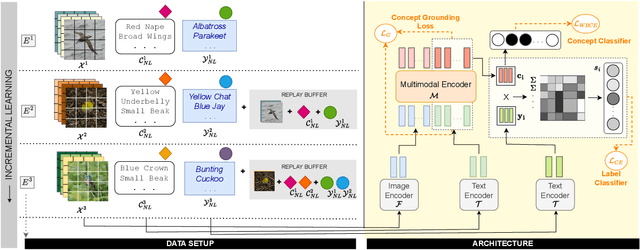
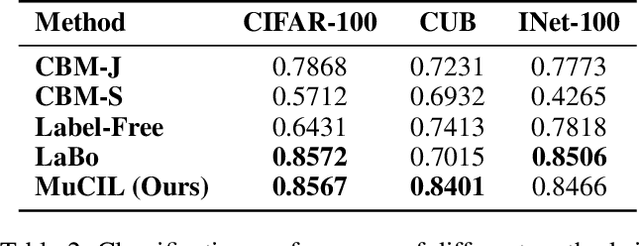
Concept-based methods have emerged as a promising direction to develop interpretable neural networks in standard supervised settings. However, most works that study them in incremental settings assume either a static concept set across all experiences or assume that each experience relies on a distinct set of concepts. In this work, we study concept-based models in a more realistic, dynamic setting where new classes may rely on older concepts in addition to introducing new concepts themselves. We show that concepts and classes form a complex web of relationships, which is susceptible to degradation and needs to be preserved and augmented across experiences. We introduce new metrics to show that existing concept-based models cannot preserve these relationships even when trained using methods to prevent catastrophic forgetting, since they cannot handle forgetting at concept, class, and concept-class relationship levels simultaneously. To address these issues, we propose a novel method - MuCIL - that uses multimodal concepts to perform classification without increasing the number of trainable parameters across experiences. The multimodal concepts are aligned to concepts provided in natural language, making them interpretable by design. Through extensive experimentation, we show that our approach obtains state-of-the-art classification performance compared to other concept-based models, achieving over 2$\times$ the classification performance in some cases. We also study the ability of our model to perform interventions on concepts, and show that it can localize visual concepts in input images, providing post-hoc interpretations.