 Add to Chrome
 Add to Firefox
 Add to Edge
Swift Sampling: Selecting Temporal Surprises via Taylor Series
May 21, 2026
While most frames in long-form video are redundant, the critical information resides in temporal surprises: moments where the actual visual features deviate from their predicted evolution. Inspired by the human brain's predictive coding, we introduce Swift Sampling, an elegant, training-free frame selection algorithm that automatically identifies high-information moments in a video. Specifically, we model a video as a differentiable trajectory in the visual latent space and compute the velocity and acceleration of its features. Then, we apply Taylor expansion to project the expected path of subsequent frames. Frames that diverge sharply from this predicted manifold are identified as temporally surprising frames and selected for sampling. Unlike prior training-free methods that rely on auxiliary networks or video-specific hyperparameter tuning, Swift Sampling is incredibly lightweight, adding only 0.02x additional computational cost over baseline making it 30x cheaper overhead than leading baselines. Across three long-video question answering benchmarks and 10 different downstream tasks, Swift Sampling outperforms uniform sampling and prior query-agnostic baselines. It is especially powerful for long videos with limited frame budgets improving accuracy by up to +12.5 points.

FAGER: Factually Grounded Evaluation and Refinement of Text-to-Image Models
May 18, 2026Existing text-to-image (T2I) evaluation metrics mainly assess whether generated images align with information explicitly stated in the prompt, but often fail to capture factual requirements that are implicit, externally grounded, or identity-defining. As a result, they are not well suited for evaluating factual correctness in prompts involving scientific knowledge, historical facts, products, or culture-specific concepts. We propose FActually Grounded Evaluation and Refinement (FAGER), an agentic framework that evaluates whether generated images correctly reflect visually verifiable facts grounded in or implied by the prompt, while also providing actionable feedback for improvement. FAGER first constructs a structured factual rubric by combining LLM-based fact proposal with reference-guided visual fact extraction and verification, then converts the rubric into question-answer pairs for VLM-based evaluation. To validate FAGER as a factuality metric, we introduce a Factual A/B test, which measures whether a metric prefers factual reference images over corresponding generated images. Across five datasets spanning science, history, products, culture, and knowledge-intensive concepts, FAGER consistently outperforms prior metrics on this test. We further show that FAGER can be used to refine T2I outputs in a fully training-free manner, yielding substantial factuality gains across datasets.
FuTCR: Future-Targeted Contrast and Repulsion for Continual Panoptic Segmentation
May 12, 2026Continual Panoptic Segmentation (CPS) requires methods that can quickly adapt to new categories over time. The nature of this dense prediction task means that training images may contain a mix of labeled and unlabeled objects. As nothing is known about these unlabeled objects a priori, existing methods often simply group any unlabeled pixel into a single "background" class during training. In effect, during training, they repeatedly tell the model that all the different background categories are the same (even when they aren't). This makes learning to identify different background categories as they are added challenging since these new categories may require using information the model was previously told was unimportant and ignored. Thus, we propose a Future-Targeted Contrastive and Repulsive (FuTCR) framework that addresses this limitation by restructuring representations before new classes are introduced. FuTCR first discovers confident future-like regions by grouping model-predicted masks whose pixels are consistently classified as background but exhibit non-background logits. Next, FuTCR applies pixel-to-region contrast to build coherent prototypes from these unlabeled regions, while simultaneously repelling background features away from known-class prototypes to explicitly reserve representational space for future categories. Experiments across six CPS settings and a range of dataset sizes show FuTCR improves relative new-class panoptic quality over the state-of-the-art by up to 28%, while preserving or improving base-class performance with gains up to 4%.
A Systematic Study of Cross-Modal Typographic Attacks on Audio-Visual Reasoning
Apr 05, 2026As audio-visual multi-modal large language models (MLLMs) are increasingly deployed in safety-critical applications, understanding their vulnerabilities is crucial. To this end, we introduce Multi-Modal Typography, a systematic study examining how typographic attacks across multiple modalities adversely influence MLLMs. While prior work focuses narrowly on unimodal attacks, we expose the cross-modal fragility of MLLMs. We analyze the interactions between audio, visual, and text perturbations and reveal that coordinated multi-modal attack creates a significantly more potent threat than single-modality attacks (attack success rate = $83.43\%$ vs $34.93\%$).Our findings across multiple frontier MLLMs, tasks, and common-sense reasoning and content moderation benchmarks establishes multi-modal typography as a critical and underexplored attack strategy in multi-modal reasoning. Code and data will be publicly available.
Semantic Richness or Geometric Reasoning? The Fragility of VLM's Visual Invariance
Apr 02, 2026This work investigates the fundamental fragility of state-of-the-art Vision-Language Models (VLMs) under basic geometric transformations. While modern VLMs excel at semantic tasks such as recognizing objects in canonical orientations and describing complex scenes, they exhibit systematic failures at a more fundamental level: lack of robust spatial invariance and equivariance required to reliably determine object identity under simple rotations, scaling, and identity transformations. We demonstrate this limitation through a systematic evaluation across diverse visual domains, including symbolic sketches, natural photographs, and abstract art. Performance drops sharply as semantic content becomes sparse, and this behavior is observed across architectures, model capacities, and prompting strategies. Overall, our results reveal a systematic gap between semantic understanding and spatial reasoning in current VLMs, highlighting the need for stronger geometric grounding in future multimodal systems.
Seeing Isn't Orienting: A Cognitively Grounded Benchmark Reveals Systematic Orientation Failures in MLLMs Supplementary
Mar 12, 2026Humans learn object orientation progressively, from recognizing which way an object faces, to mentally rotating it, to reasoning about orientations between objects. Current vision-language benchmarks largely conflate orientation with position and general scene understanding. We introduce Discriminative Orientation Reasoning Intelligence (DORI), a cognitively grounded hierarchical benchmark that makes object orientation the primary target. Inspired by stages of human orientation cognition, DORI decomposes orientation into four dimensions, each evaluated at coarse (categorical) and granular (metric) levels. Composed from 13,652 images across 14 sources, DORI provides 33,656 multiple-choice questions covering 67 object categories in real-world and synthetic settings. Its coarse-to-granular design isolates orientation from confounds such as object recognition difficulty, scene clutter, and linguistic ambiguity via bounding-box isolation, standardized spatial reference frames, and structured prompts. Evaluating 24 state-of-the-art vision-language models shows a clear pattern: models that perform well on general spatial benchmarks are near-random on object-centric orientation tasks. The best models reach only 54.2% on coarse and 45.0% on granular judgments, with largest failures on compound rotations and shifts in inter-object reference frames. Large coarse-to-granular gaps reveal reliance on categorical heuristics rather than geometric reasoning, a limitation hidden by existing benchmarks. These results identify orientation understanding as an unsolved challenge for multimodal systems, with implications for robotic manipulation, 3D scene reconstruction, and human-AI interaction.
DDiT: Dynamic Patch Scheduling for Efficient Diffusion Transformers
Feb 19, 2026Diffusion Transformers (DiTs) have achieved state-of-the-art performance in image and video generation, but their success comes at the cost of heavy computation. This inefficiency is largely due to the fixed tokenization process, which uses constant-sized patches throughout the entire denoising phase, regardless of the content's complexity. We propose dynamic tokenization, an efficient test-time strategy that varies patch sizes based on content complexity and the denoising timestep. Our key insight is that early timesteps only require coarser patches to model global structure, while later iterations demand finer (smaller-sized) patches to refine local details. During inference, our method dynamically reallocates patch sizes across denoising steps for image and video generation and substantially reduces cost while preserving perceptual generation quality. Extensive experiments demonstrate the effectiveness of our approach: it achieves up to $3.52\times$ and $3.2\times$ speedup on FLUX-1.Dev and Wan $2.1$, respectively, without compromising the generation quality and prompt adherence.
Right Side Up? Disentangling Orientation Understanding in MLLMs with Fine-grained Multi-axis Perception Tasks
May 29, 2025Object orientation understanding represents a fundamental challenge in visual perception critical for applications like robotic manipulation and augmented reality. Current vision-language benchmarks fail to isolate this capability, often conflating it with positional relationships and general scene understanding. We introduce DORI (Discriminative Orientation Reasoning Intelligence), a comprehensive benchmark establishing object orientation perception as a primary evaluation target. DORI assesses four dimensions of orientation comprehension: frontal alignment, rotational transformations, relative directional relationships, and canonical orientation understanding. Through carefully curated tasks from 11 datasets spanning 67 object categories across synthetic and real-world scenarios, DORI provides insights on how multi-modal systems understand object orientations. Our evaluation of 15 state-of-the-art vision-language models reveals critical limitations: even the best models achieve only 54.2% accuracy on coarse tasks and 33.0% on granular orientation judgments, with performance deteriorating for tasks requiring reference frame shifts or compound rotations. These findings demonstrate the need for dedicated orientation representation mechanisms, as models show systematic inability to perform precise angular estimations, track orientation changes across viewpoints, and understand compound rotations - suggesting limitations in their internal 3D spatial representations. As the first diagnostic framework specifically designed for orientation awareness in multimodal systems, DORI offers implications for improving robotic control, 3D scene reconstruction, and human-AI interaction in physical environments. DORI data: https://huggingface.co/datasets/appledora/DORI-Benchmark
Improving Physical Object State Representation in Text-to-Image Generative Systems
May 04, 2025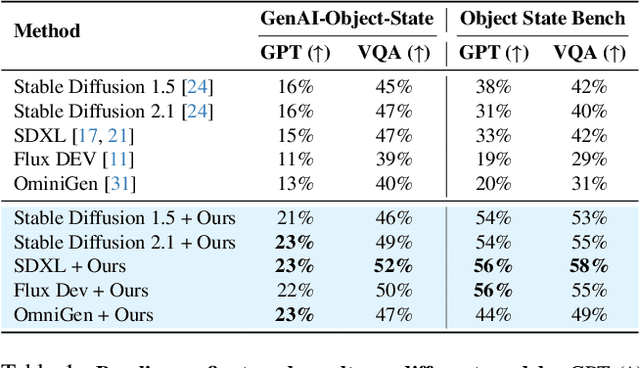
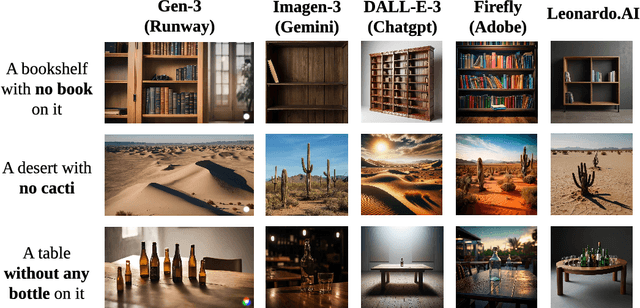
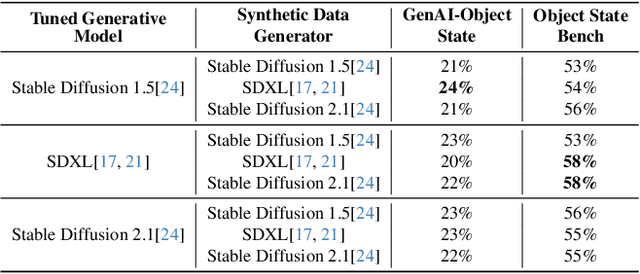
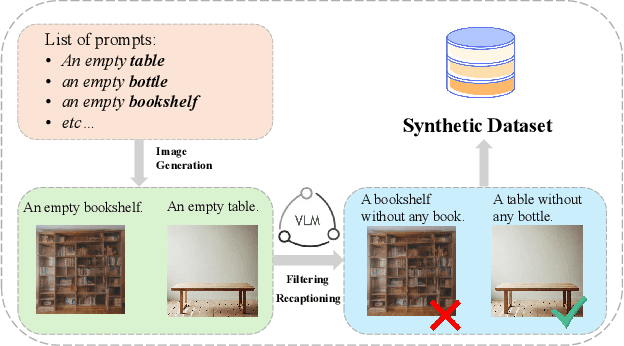
Current text-to-image generative models struggle to accurately represent object states (e.g., "a table without a bottle," "an empty tumbler"). In this work, we first design a fully-automatic pipeline to generate high-quality synthetic data that accurately captures objects in varied states. Next, we fine-tune several open-source text-to-image models on this synthetic data. We evaluate the performance of the fine-tuned models by quantifying the alignment of the generated images to their prompts using GPT4o-mini, and achieve an average absolute improvement of 8+% across four models on the public GenAI-Bench dataset. We also curate a collection of 200 prompts with a specific focus on common objects in various physical states. We demonstrate a significant improvement of an average of 24+% over the baseline on this dataset. We release all evaluation prompts and code.
What's in a Latent? Leveraging Diffusion Latent Space for Domain Generalization
Mar 09, 2025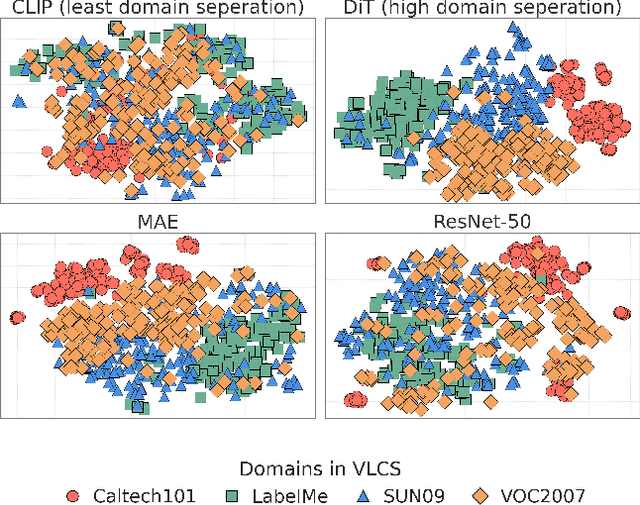

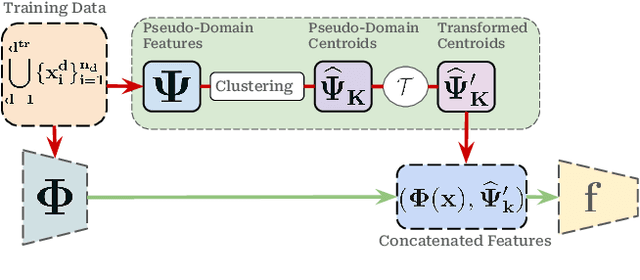
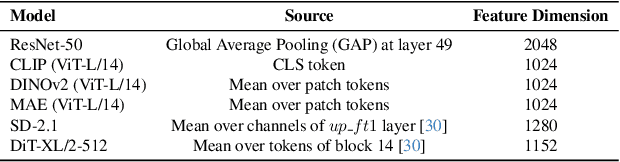
Domain Generalization aims to develop models that can generalize to novel and unseen data distributions. In this work, we study how model architectures and pre-training objectives impact feature richness and propose a method to effectively leverage them for domain generalization. Specifically, given a pre-trained feature space, we first discover latent domain structures, referred to as pseudo-domains, that capture domain-specific variations in an unsupervised manner. Next, we augment existing classifiers with these complementary pseudo-domain representations making them more amenable to diverse unseen test domains. We analyze how different pre-training feature spaces differ in the domain-specific variances they capture. Our empirical studies reveal that features from diffusion models excel at separating domains in the absence of explicit domain labels and capture nuanced domain-specific information. On 5 datasets, we show that our very simple framework improves generalization to unseen domains by a maximum test accuracy improvement of over 4% compared to the standard baseline Empirical Risk Minimization (ERM). Crucially, our method outperforms most algorithms that access domain labels during training.