 Add to Chrome
 Add to Firefox
 Add to Edge
Frontier AI performance across the business disciplines: a case-grounded benchmark of knowledge work and analytical reasoning
Jul 21, 2026
Large language models (LLMs) are improving rapidly as reflected in benchmark scores, yet these AI benchmarks largely test capabilities such as factual recall, narrow question answering, mathematical problem-solving, and coding and agentic tool-use. What remains poorly measured is AI progress on the analytical knowledge work white-collar professionals perform daily, including synthesizing complex information, exercising judgment under uncertainty and incomplete information, applying strategic and adversarial thinking in multi-stakeholder settings, weighing trade-offs, and producing defensible, structured analyses. This gap is even more pronounced for subjective components of such work, where success can be challenging to define. The "case method" form of education practiced by top business schools provides a natural foundation for addressing this measurement gap, and we construct BusinessCaseBench, a benchmark spanning hundreds of questions drawn from business cases across eighteen disciplines, each paired with a grading rubric derived from the expert-written instructor case solution. On BusinessCaseBench, frontier AI models already score highly against instructor rubrics, and capability within one model family improves substantially over two years. These results provide strong evidence that AI performance on this class of work is already high and rapidly improving, with implications for business schools, where case pedagogy trains undergraduates and MBAs in this kind of analytical reasoning, and for entry-level professional roles, where such skills have historically anchored early-career work.

Mitigate One, Skew Another? Tackling Intersectional Biases in Text-to-Image Models
May 22, 2025The biases exhibited by text-to-image (TTI) models are often treated as independent, though in reality, they may be deeply interrelated. Addressing bias along one dimension - such as ethnicity or age - can inadvertently affect another, like gender, either mitigating or exacerbating existing disparities. Understanding these interdependencies is crucial for designing fairer generative models, yet measuring such effects quantitatively remains a challenge. To address this, we introduce BiasConnect, a novel tool for analyzing and quantifying bias interactions in TTI models. BiasConnect uses counterfactual interventions along different bias axes to reveal the underlying structure of these interactions and estimates the effect of mitigating one bias axis on another. These estimates show strong correlation (+0.65) with observed post-mitigation outcomes. Building on BiasConnect, we propose InterMit, an intersectional bias mitigation algorithm guided by user-defined target distributions and priority weights. InterMit achieves lower bias (0.33 vs. 0.52) with fewer mitigation steps (2.38 vs. 3.15 average steps), and yields superior image quality compared to traditional techniques. Although our implementation is training-free, InterMit is modular and can be integrated with many existing debiasing approaches for TTI models, making it a flexible and extensible solution.
BiasConnect: Investigating Bias Interactions in Text-to-Image Models
Mar 12, 2025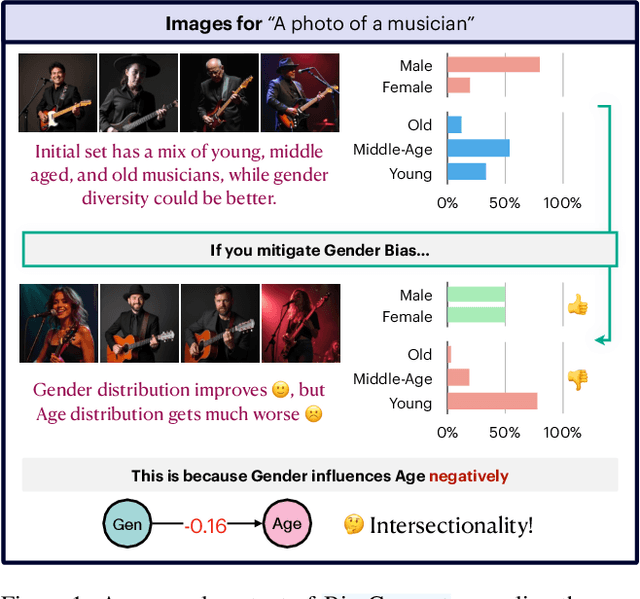
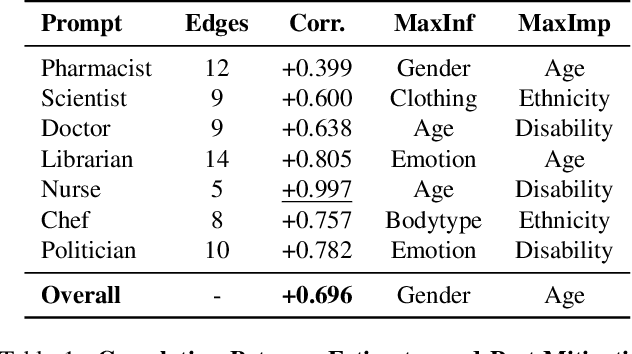
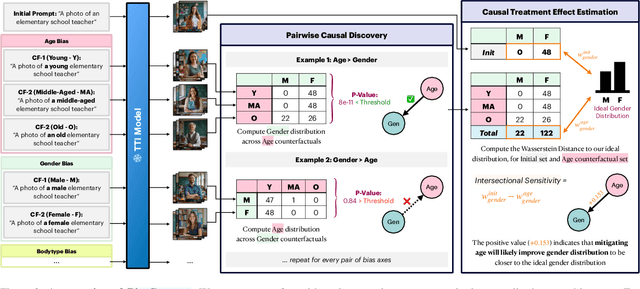
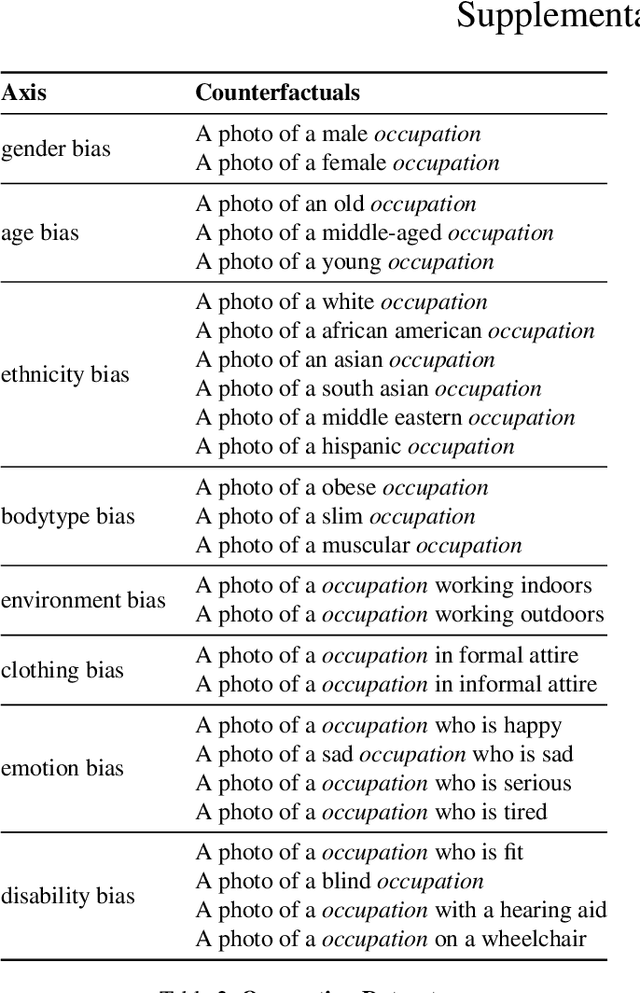
The biases exhibited by Text-to-Image (TTI) models are often treated as if they are independent, but in reality, they may be deeply interrelated. Addressing bias along one dimension, such as ethnicity or age, can inadvertently influence another dimension, like gender, either mitigating or exacerbating existing disparities. Understanding these interdependencies is crucial for designing fairer generative models, yet measuring such effects quantitatively remains a challenge. In this paper, we aim to address these questions by introducing BiasConnect, a novel tool designed to analyze and quantify bias interactions in TTI models. Our approach leverages a counterfactual-based framework to generate pairwise causal graphs that reveals the underlying structure of bias interactions for the given text prompt. Additionally, our method provides empirical estimates that indicate how other bias dimensions shift toward or away from an ideal distribution when a given bias is modified. Our estimates have a strong correlation (+0.69) with the interdependency observations post bias mitigation. We demonstrate the utility of BiasConnect for selecting optimal bias mitigation axes, comparing different TTI models on the dependencies they learn, and understanding the amplification of intersectional societal biases in TTI models.
TIBET: Identifying and Evaluating Biases in Text-to-Image Generative Models
Dec 03, 2023

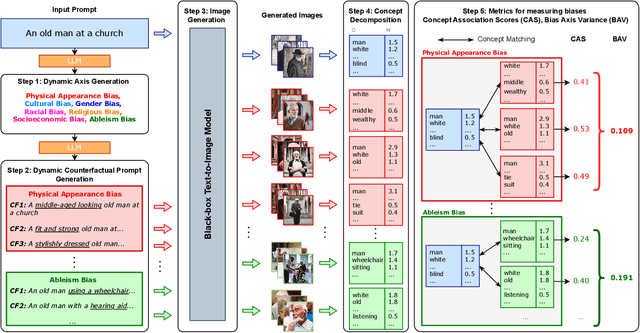
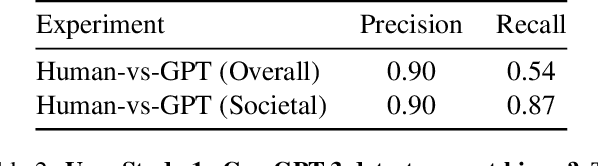
Text-to-Image (TTI) generative models have shown great progress in the past few years in terms of their ability to generate complex and high-quality imagery. At the same time, these models have been shown to suffer from harmful biases, including exaggerated societal biases (e.g., gender, ethnicity), as well as incidental correlations that limit such model's ability to generate more diverse imagery. In this paper, we propose a general approach to study and quantify a broad spectrum of biases, for any TTI model and for any prompt, using counterfactual reasoning. Unlike other works that evaluate generated images on a predefined set of bias axes, our approach automatically identifies potential biases that might be relevant to the given prompt, and measures those biases. In addition, our paper extends quantitative scores with post-hoc explanations in terms of semantic concepts in the images generated. We show that our method is uniquely capable of explaining complex multi-dimensional biases through semantic concepts, as well as the intersectionality between different biases for any given prompt. We perform extensive user studies to illustrate that the results of our method and analysis are consistent with human judgements.
Will We Trust What We Don't Understand? Impact of Model Interpretability and Outcome Feedback on Trust in AI
Nov 16, 2021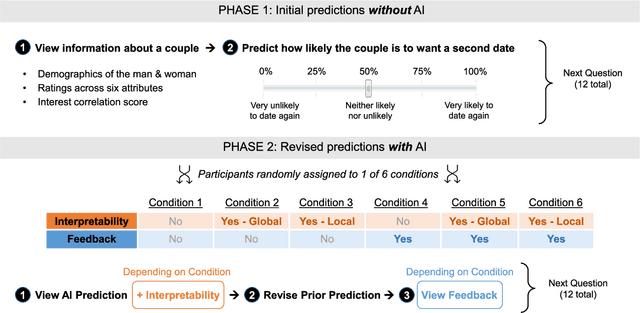
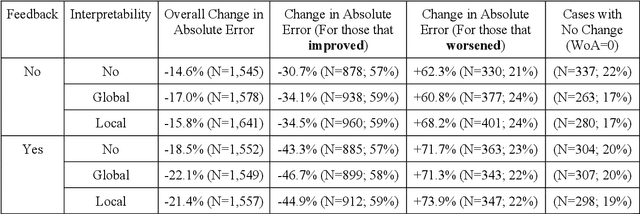
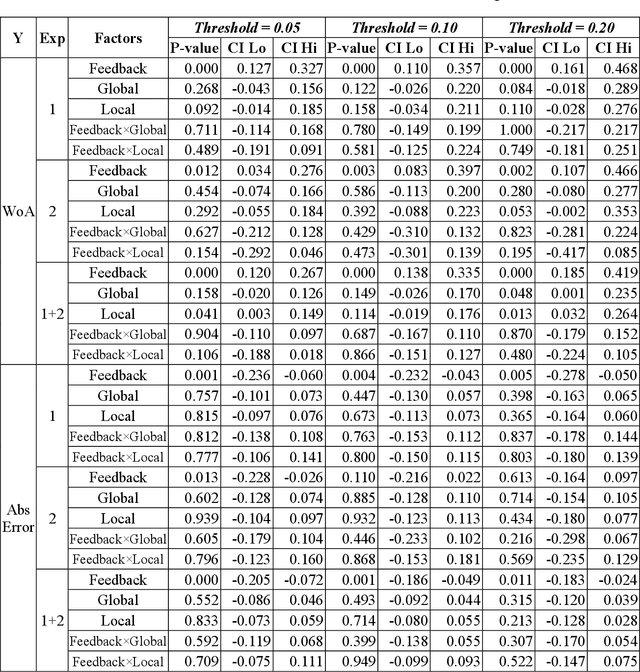
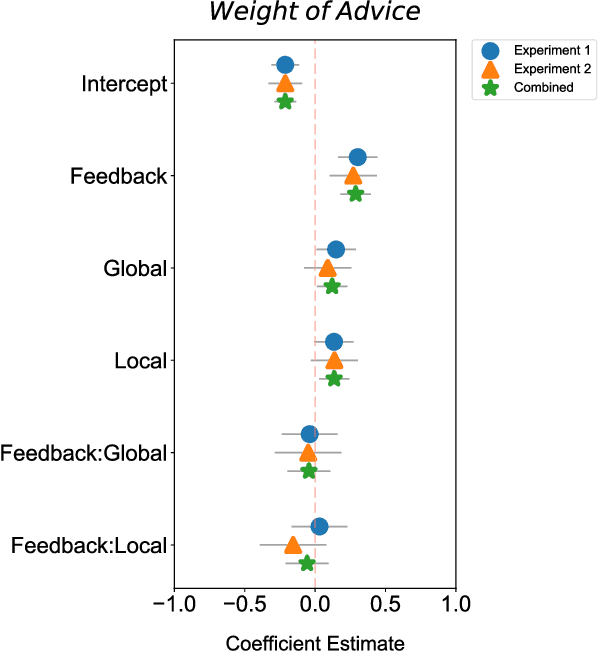
Despite AI's superhuman performance in a variety of domains, humans are often unwilling to adopt AI systems. The lack of interpretability inherent in many modern AI techniques is believed to be hurting their adoption, as users may not trust systems whose decision processes they do not understand. We investigate this proposition with a novel experiment in which we use an interactive prediction task to analyze the impact of interpretability and outcome feedback on trust in AI and on human performance in AI-assisted prediction tasks. We find that interpretability led to no robust improvements in trust, while outcome feedback had a significantly greater and more reliable effect. However, both factors had modest effects on participants' task performance. Our findings suggest that (1) factors receiving significant attention, such as interpretability, may be less effective at increasing trust than factors like outcome feedback, and (2) augmenting human performance via AI systems may not be a simple matter of increasing trust in AI, as increased trust is not always associated with equally sizable improvements in performance. These findings invite the research community to focus not only on methods for generating interpretations but also on techniques for ensuring that interpretations impact trust and performance in practice.