 Add to Chrome
 Add to Firefox
 Add to Edge
Swift Sampling: Selecting Temporal Surprises via Taylor Series
May 21, 2026
While most frames in long-form video are redundant, the critical information resides in temporal surprises: moments where the actual visual features deviate from their predicted evolution. Inspired by the human brain's predictive coding, we introduce Swift Sampling, an elegant, training-free frame selection algorithm that automatically identifies high-information moments in a video. Specifically, we model a video as a differentiable trajectory in the visual latent space and compute the velocity and acceleration of its features. Then, we apply Taylor expansion to project the expected path of subsequent frames. Frames that diverge sharply from this predicted manifold are identified as temporally surprising frames and selected for sampling. Unlike prior training-free methods that rely on auxiliary networks or video-specific hyperparameter tuning, Swift Sampling is incredibly lightweight, adding only 0.02x additional computational cost over baseline making it 30x cheaper overhead than leading baselines. Across three long-video question answering benchmarks and 10 different downstream tasks, Swift Sampling outperforms uniform sampling and prior query-agnostic baselines. It is especially powerful for long videos with limited frame budgets improving accuracy by up to +12.5 points.

Phase-Informed Tool Segmentation for Manual Small-Incision Cataract Surgery
Nov 25, 2024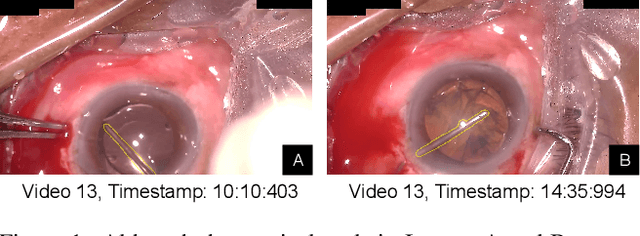


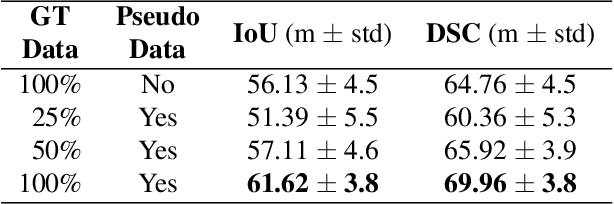
Cataract surgery is the most common surgical procedure globally, with a disproportionately higher burden in developing countries. While automated surgical video analysis has been explored in general surgery, its application to ophthalmic procedures remains limited. Existing works primarily focus on Phaco cataract surgery, an expensive technique not accessible in regions where cataract treatment is most needed. In contrast, Manual Small-Incision Cataract Surgery (MSICS) is the preferred low-cost, faster alternative in high-volume settings and for challenging cases. However, no dataset exists for MSICS. To address this gap, we introduce Cataract-MSICS, the first comprehensive dataset containing 53 surgical videos annotated for 18 surgical phases and 3,527 frames with 13 surgical tools at the pixel level. We benchmark this dataset on state-of-the-art models and present ToolSeg, a novel framework that enhances tool segmentation by introducing a phase-conditional decoder and a simple yet effective semi-supervised setup leveraging pseudo-labels from foundation models. Our approach significantly improves segmentation performance, achieving a $23.77\%$ to $38.10\%$ increase in mean Dice scores, with a notable boost for tools that are less prevalent and small. Furthermore, we demonstrate that ToolSeg generalizes to other surgical settings, showcasing its effectiveness on the CaDIS dataset.
CataractBot: An LLM-Powered Expert-in-the-Loop Chatbot for Cataract Patients
Feb 07, 2024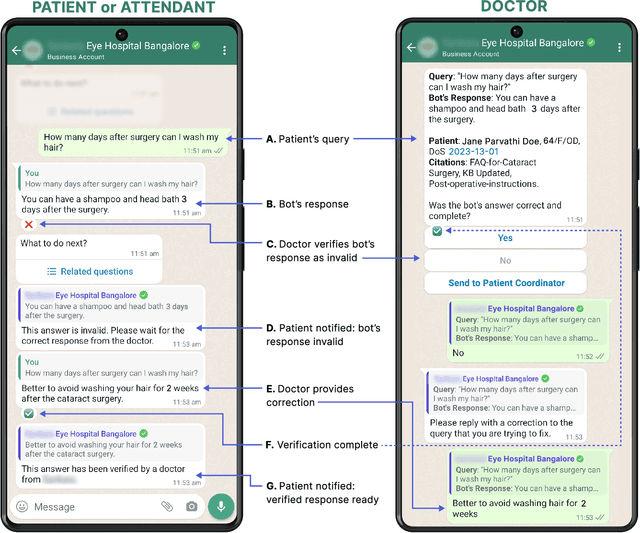
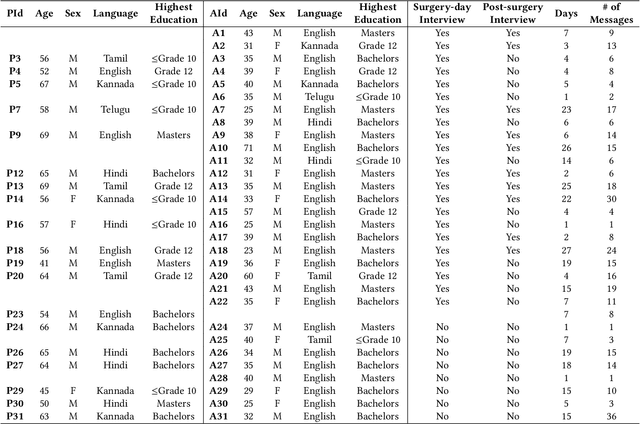
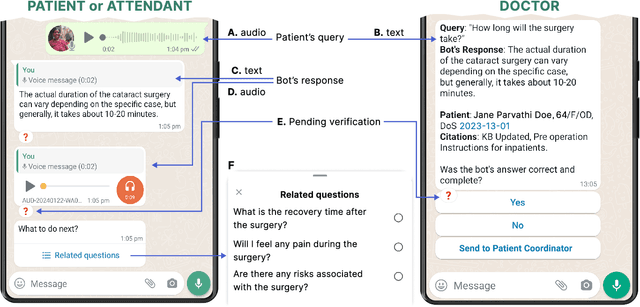

The healthcare landscape is evolving, with patients seeking more reliable information about their health conditions, treatment options, and potential risks. Despite the abundance of information sources, the digital age overwhelms individuals with excess, often inaccurate information. Patients primarily trust doctors and hospital staff, highlighting the need for expert-endorsed health information. However, the pressure on experts has led to reduced communication time, impacting information sharing. To address this gap, we propose CataractBot, an experts-in-the-loop chatbot powered by large language models (LLMs). Developed in collaboration with a tertiary eye hospital in India, CataractBot answers cataract surgery related questions instantly by querying a curated knowledge base, and provides expert-verified responses asynchronously. CataractBot features multimodal support and multilingual capabilities. In an in-the-wild deployment study with 49 participants, CataractBot proved valuable, providing anytime accessibility, saving time, and accommodating diverse literacy levels. Trust was established through expert verification. Broadly, our results could inform future work on designing expert-mediated LLM bots.