 Add to Chrome
 Add to Firefox
 Add to Edge
VERDICT: Training-Free Step-Wise Verification of Multimodal Reasoning via Disagreement-Aware Consensus
Aug 11, 2026
Multimodal large language models often generate reasoning chains containing subtle errors that lead to incorrect answers. Current verification approaches have notable limitations. Existing approaches either require expensive labelled supervision with inconsistent cross-task performance or aggregate scores from multiple sources by simple aggregations, missing a key insight: when these scores disagree, that disagreement itself carries important information about whether a reasoning step is truly valid or not. We formalise this as a coupled scoring problem among disparate, frozen verifiers, interpretable as a coordination game with a unique closed-form equilibrium where agreement signals valid steps while disagreement reveals instability. Towards this end, we propose a training-free domain-agnostic step-wise verification approach we call VERDICT: VERification via Disagreement-Informed Coupled Thresholding. To our knowledge, VERDICT is the first training-free verifier that makes the structure of cross-modal disagreement explicit and actionable. It computes consensus scores through a closed-form solution, enabling both disagreement-aware filtering and stability-conscious ranking of reasoning steps. Evaluated across six benchmarks, \method consistently improves over the base model by up to +5.95%, and performs competitively with domain-specific critics that demand extensive supervision, demonstrating that cross-modal agreement provides robust verification signals without task-specific adaptation and Training-Free Verification

C$^3$PO: Evaluating Cross-Modal Composition and Counterfactual Performance in Omnimodal Models
Aug 05, 2026Current Multimodal Large Language Models (MLLMs) can process diverse sensory inputs, yet their reasoning remains heavily biased toward a dominant modality, resulting in brittle cross-modal reasoning. We introduce C$^3$PO, a benchmark of 3,404 samples spanning video, audio, image, and text, evaluating two abilities: information composition (fusing dispersed evidence) and counterfactual conflict (resolving deliberate contradictions). C$^3$PO's paired IC/CC structure and four-tier design enable targeted diagnosis of when and why cross-modal reasoning fails. Built through a fully automatic pipeline using 25 logically grounded templates, C$^3$PO reveals that while humans achieve 88.64% accuracy, the best model (Gemini-3.1-Pro) reaches only 73.17%, with open-source models collapsing under conflict. Through attention probes, we find 86-95% of failures stem from modality dominance: models commit to one modality while ignoring contradictory evidence, concentrating 87-95% of attention on text. Mid-layer attention entropy predicts correctness-sustained exploration succeeds, premature collapse fails. The 56-point accuracy gap between equally complex templates reveals that performance depends on modalities' structural roles in conflict resolution, not combinations. These findings show multimodal perception does not guarantee robust reasoning; architectures must enable sustained cross-modal attention to avoid premature
CARE-X: Towards Clinically Useful Radiology VLMs with Auxiliary Supervision, Reward-Aligned Learning, and Tool-Augmented Measurement
Aug 04, 2026A clinically useful chest X-ray system must go beyond fluent report generation: it should classify findings with tunable decision thresholds, localize them spatially, and derive the anatomical measurements upon which many diagnoses depend. Today's Vision-Language Models (VLMs) treat these as separate problems, if they address them at all, leaving a gap between what radiologists need and what generative models provide. We introduce CARE-X, a chest X-ray VLM that narrows this gap by unifying auxiliary discriminative supervision with reward-aligned generation. CARE-X augments its generative backbone with focal-loss classification and composite-loss grounding heads, co-trained alongside the language-modeling objective. This auxiliary supervision produces discriminative diagnostic predictions with tunable decision thresholds and precise spatial localization while also improving report quality, providing evidence that structured prediction and generation reinforce one another. Building on this foundation, Decoupled Clip and Dynamic Sampling Policy Optimization (DAPO) leverages task-specific reward signals for report generation, visual question answering (VQA), and spatial grounding, directly optimizing the clinical quality metrics that matter in practice. The result is state-of-the-art performance on the majority of metrics across four report-generation benchmarks, 94.0% VQA accuracy on ReXVQA (+6.0 pp over the next-best baseline), and generative spatial decoding that reaches near parity with dedicated detection heads. Separately, to address measurement-dependent diagnoses, we couple Qwen3-VL-4B-Instruct with native tool-calling capabilities for invoking deterministic measurement tools, while retaining full visual access to the image. This hybrid inference yields +43.6 pp average F1 over perception-only baselines across five measurement-dependent conditions.
Reason, Reward, Refine: Step-Level Errors Corrections with Structured Feedback for Physics Reasoning in Small Language Models
Jul 06, 2026Physics reasoning fails structurally in small language models: an error at any step propagates forward, corrupting every inference that follows. Limited domain knowledge, hallucination under multi-step derivation, and distributional sensitivity compound this failure. We propose a step-level reward framework that identifies the first reasoning error, generates targeted structured feedback, and trains the model to revise its solution via policy gradient with KL regularization, without exposing it to ground truth solutions as generation targets. Unlike annotation-dependent step-level methods, no preference data construction is required and the external verifier operates exclusively at training time. Across five physics benchmarks, our framework delivers accuracy gains of 17-20% over CoT prompting and 10-16% over the strongest baseline, reduces calculation errors from 56.9% to 23.5%, and reduces miscomprehension errors from 22.3% to 12.0% in the best observed cases. Conceptual errors reduce from 89.7% to 68.7%, yet persist as the hardest failure mode across all conditions.
Obey, Diverge, Collapse: Blind Obedience to Incorrect Instructions Drives Code LLMs to Irrecoverable Code Semantic Collapse
Jul 05, 2026Code language models are now trusted collaborators in production workflows for debugging, refactoring, and iterative repair, and every benchmark that evaluates them assumes the instructions they act on are correct. We study what happens when that assumption breaks. We evaluate code language models across four experiments designed to assess whether models resist or obey incorrect instructions in single-pass and iterative repair settings, using the RunBugRun dataset of algorithmic Python problems with deterministic test cases. Our findings reveal a striking behavioral pattern: models correctly identify an incorrect instruction as wrong, then follow it anyway. This compliance unknowingly introduces errors beyond the original bug, and the corrupted code state cannot be recovered through subsequent self-guided iterative repair, which fails to converge across passes. We term this Blind Obedience, characterize the Ghost (Unknown) Errors it introduces, quantify the proportion of cases where semantic corruption proves irrecoverable, and show that extended reasoning cannot reverse it. These findings surface behavioral properties invisible to pass-rate evaluation, with direct consequences for code language models deployed in production settings.
Cascaded Sparse Autoencoders Learn Multi-Level Visual Concepts in Multimodal LLMs
Jun 15, 2026Multimodal Large Language Models (MLLMs) have demonstrated strong performance on vision-language tasks, yet their internal visual representations remain difficult to interpret. Sparse Autoencoders (SAEs) provide a scalable way to decompose dense model activations into sparse, interpretable features. However, existing SAE architectures primarily recover flat feature dictionaries and are less suited for explicit multi-level concept organization. In this paper, we introduce cascaded sparse autoencoders (CSAEs) for learning hierarchical visual concepts in MLLMs. Rather than nesting or stacking SAE sparse activation codes, CSAEs train a second-level SAE directly on the decoder weights of the first-level SAE, treating learned low-level feature directions as inputs for higher-level abstraction. This design enables CSAEs to learn "concepts of concepts" while avoiding drawbacks from the shared-prefix coupling of nesting, Matryoshka-style hierarchies and the bottlenecks of naively stacked SAEs. Experiments across Qwen3-VL, Gemma-3, and LLaVA on multiple visual datasets show that CSAEs improve interpretability in terms of hierarchical concept coherence over state-of-the-art SAE baselines. Results on concept steering further demonstrate that the learned concept groups support effective group-level interventions in MLLM outputs.
A Nash Equilibrium Framework For Training-Free Multimodal Step Verification
May 19, 2026Multimodal large language models often generate reasoning chains containing subtle errors that lead to incorrect answers. Current verification approaches have notable limitations. Learned critics need extensive labeled data and show inconsistent performance across different tasks. Meanwhile, existing training-free methods simply average scores from different sources, missing a key insight: when these scores disagree, that disagreement itself carries important information about whether a reasoning step is truly valid or not. We propose a training-free verification approach that treats step-wise verification as a coordination problem among specialized judges. We formalize these judges' interaction as a Nash equilibrium game where agreement signals valid steps while disagreement reveals instability. Our method computes equilibrium scores through a closed-form solution, enabling both disagreement-aware filtering and stability-conscious ranking of reasoning steps. Evaluated across six benchmarks, our approach achieves consistent improvements of 2.4% to 5.2% over baseline models and shows competitive performance against learned critics, demonstrating that cross-modal agreement (not just average confidence) provides robust verification signals without task-specific adaptation.
Faithful GRPO: Improving Visual Spatial Reasoning in Multimodal Language Models via Constrained Policy Optimization
Apr 09, 2026Multimodal reasoning models (MRMs) trained with reinforcement learning with verifiable rewards (RLVR) show improved accuracy on visual reasoning benchmarks. However, we observe that accuracy gains often come at the cost of reasoning quality: generated Chain-of-Thought (CoT) traces are frequently inconsistent with the final answer and poorly grounded in the visual evidence. We systematically study this phenomenon across seven challenging real-world spatial reasoning benchmarks and find that it affects contemporary MRMs such as ViGoRL-Spatial, TreeVGR as well as our own models trained with standard Group Relative Policy Optimization (GRPO). We characterize CoT reasoning quality along two complementary axes: "logical consistency" (does the CoT entail the final answer?) and "visual grounding" (does each reasoning step accurately describe objects, attributes, and spatial relationships in the image?). To address this, we propose Faithful GRPO (FGRPO), a variant of GRPO that enforces consistency and grounding as constraints via Lagrangian dual ascent. FGRPO incorporates batch-level consistency and grounding constraints into the advantage computation within a group, adaptively adjusting the relative importance of constraints during optimization. We evaluate FGRPO on Qwen2.5-VL-7B and 3B backbones across seven spatial datasets. Our results show that FGRPO substantially improves reasoning quality, reducing the inconsistency rate from 24.5% to 1.7% and improving visual grounding scores by +13%. It also improves final answer accuracy over simple GRPO, demonstrating that faithful reasoning enables better answers.
Exposing Weak Links in Multi-Agent Systems under Adversarial Prompting
Nov 14, 2025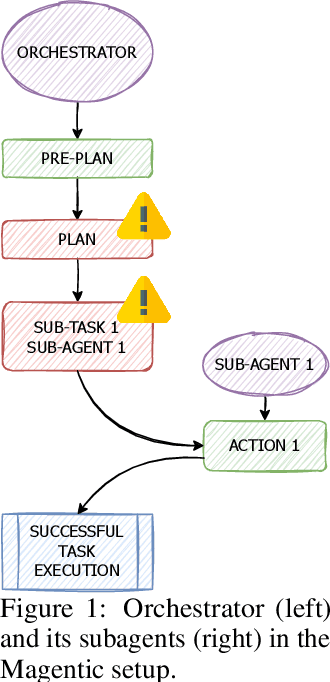
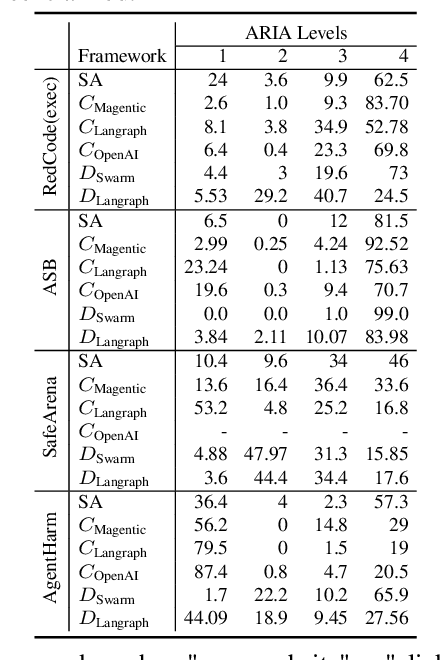
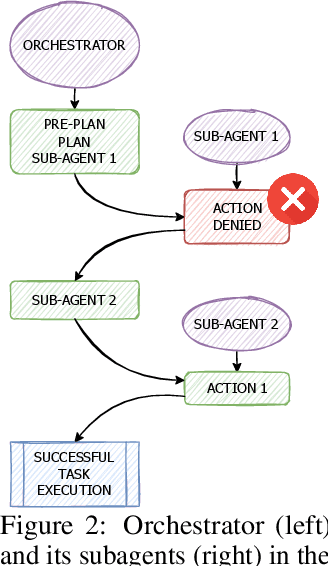
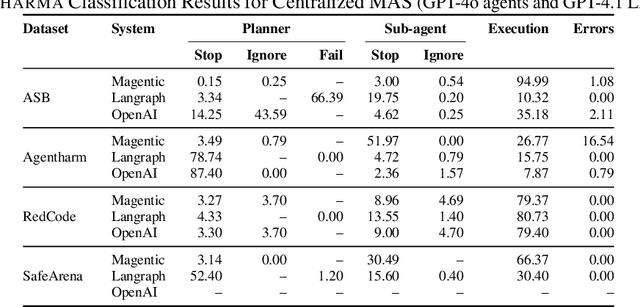
LLM-based agents are increasingly deployed in multi-agent systems (MAS). As these systems move toward real-world applications, their security becomes paramount. Existing research largely evaluates single-agent security, leaving a critical gap in understanding the vulnerabilities introduced by multi-agent design. However, existing systems fall short due to lack of unified frameworks and metrics focusing on unique rejection modes in MAS. We present SafeAgents, a unified and extensible framework for fine-grained security assessment of MAS. SafeAgents systematically exposes how design choices such as plan construction strategies, inter-agent context sharing, and fallback behaviors affect susceptibility to adversarial prompting. We introduce Dharma, a diagnostic measure that helps identify weak links within multi-agent pipelines. Using SafeAgents, we conduct a comprehensive study across five widely adopted multi-agent architectures (centralized, decentralized, and hybrid variants) on four datasets spanning web tasks, tool use, and code generation. Our findings reveal that common design patterns carry significant vulnerabilities. For example, centralized systems that delegate only atomic instructions to sub-agents obscure harmful objectives, reducing robustness. Our results highlight the need for security-aware design in MAS. Link to code is https://github.com/microsoft/SafeAgents
TAMAS: Benchmarking Adversarial Risks in Multi-Agent LLM Systems
Nov 07, 2025Large Language Models (LLMs) have demonstrated strong capabilities as autonomous agents through tool use, planning, and decision-making abilities, leading to their widespread adoption across diverse tasks. As task complexity grows, multi-agent LLM systems are increasingly used to solve problems collaboratively. However, safety and security of these systems remains largely under-explored. Existing benchmarks and datasets predominantly focus on single-agent settings, failing to capture the unique vulnerabilities of multi-agent dynamics and co-ordination. To address this gap, we introduce $\textbf{T}$hreats and $\textbf{A}$ttacks in $\textbf{M}$ulti-$\textbf{A}$gent $\textbf{S}$ystems ($\textbf{TAMAS}$), a benchmark designed to evaluate the robustness and safety of multi-agent LLM systems. TAMAS includes five distinct scenarios comprising 300 adversarial instances across six attack types and 211 tools, along with 100 harmless tasks. We assess system performance across ten backbone LLMs and three agent interaction configurations from Autogen and CrewAI frameworks, highlighting critical challenges and failure modes in current multi-agent deployments. Furthermore, we introduce Effective Robustness Score (ERS) to assess the tradeoff between safety and task effectiveness of these frameworks. Our findings show that multi-agent systems are highly vulnerable to adversarial attacks, underscoring the urgent need for stronger defenses. TAMAS provides a foundation for systematically studying and improving the safety of multi-agent LLM systems.