 Add to Chrome
 Add to Firefox
 Add to Edge
Video-XL: Extra-Long Vision Language Model for Hour-Scale Video Understanding
Sep 24, 2024
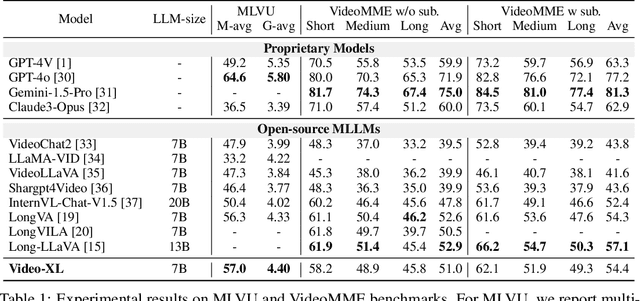
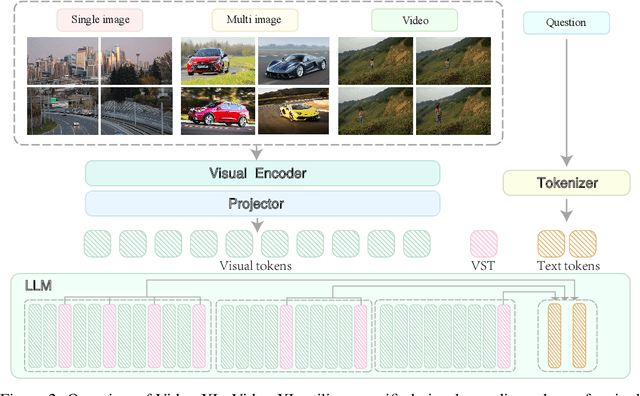

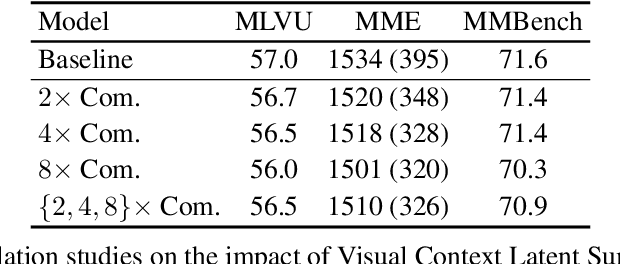
Although current Multi-modal Large Language Models (MLLMs) demonstrate promising results in video understanding, processing extremely long videos remains an ongoing challenge. Typically, MLLMs struggle with handling thousands of tokens that exceed the maximum context length of LLMs, and they experience reduced visual clarity due to token aggregation. Another challenge is the high computational cost stemming from the large number of video tokens. To tackle these issues, we propose Video-XL, an extra-long vision language model designed for efficient hour-scale video understanding. Specifically, we argue that LLMs can be adapted as effective visual condensers and introduce Visual Context Latent Summarization, which condenses visual contexts into highly compact forms. Extensive experiments demonstrate that our model achieves promising results on popular long video understanding benchmarks, despite being trained on limited image data. Moreover, Video-XL strikes a promising balance between efficiency and effectiveness, processing 1024 frames on a single 80GB GPU while achieving nearly 100\% accuracy in the Needle-in-a-Haystack evaluation. We envision Video-XL becoming a valuable tool for long video applications such as video summarization, surveillance anomaly detection, and Ad placement identification.

OmniGen: Unified Image Generation
Sep 17, 2024
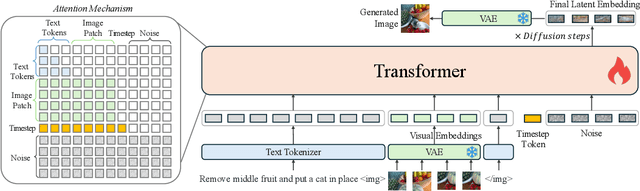
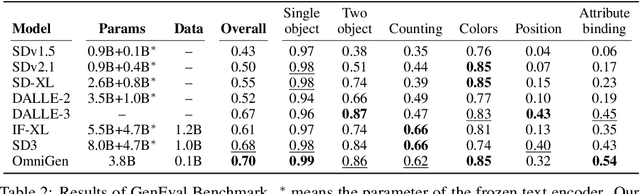
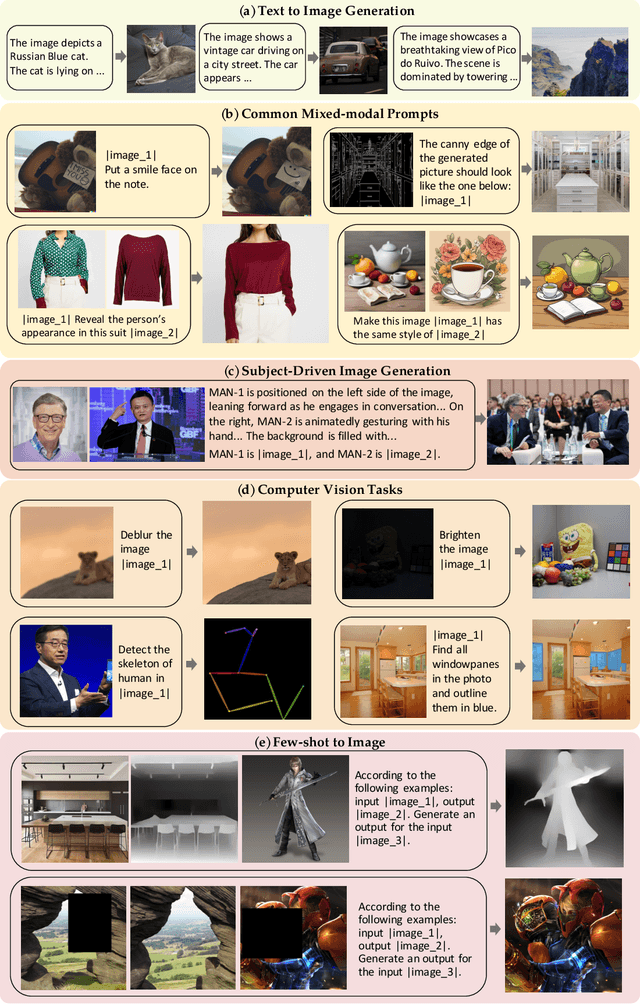
In this work, we introduce OmniGen, a new diffusion model for unified image generation. Unlike popular diffusion models (e.g., Stable Diffusion), OmniGen no longer requires additional modules such as ControlNet or IP-Adapter to process diverse control conditions. OmniGenis characterized by the following features: 1) Unification: OmniGen not only demonstrates text-to-image generation capabilities but also inherently supports other downstream tasks, such as image editing, subject-driven generation, and visual-conditional generation. Additionally, OmniGen can handle classical computer vision tasks by transforming them into image generation tasks, such as edge detection and human pose recognition. 2) Simplicity: The architecture of OmniGen is highly simplified, eliminating the need for additional text encoders. Moreover, it is more user-friendly compared to existing diffusion models, enabling complex tasks to be accomplished through instructions without the need for extra preprocessing steps (e.g., human pose estimation), thereby significantly simplifying the workflow of image generation. 3) Knowledge Transfer: Through learning in a unified format, OmniGen effectively transfers knowledge across different tasks, manages unseen tasks and domains, and exhibits novel capabilities. We also explore the model's reasoning capabilities and potential applications of chain-of-thought mechanism. This work represents the first attempt at a general-purpose image generation model, and there remain several unresolved issues. We will open-source the related resources at https://github.com/VectorSpaceLab/OmniGen to foster advancements in this field.
ShapeMamba-EM: Fine-Tuning Foundation Model with Local Shape Descriptors and Mamba Blocks for 3D EM Image Segmentation
Aug 26, 2024
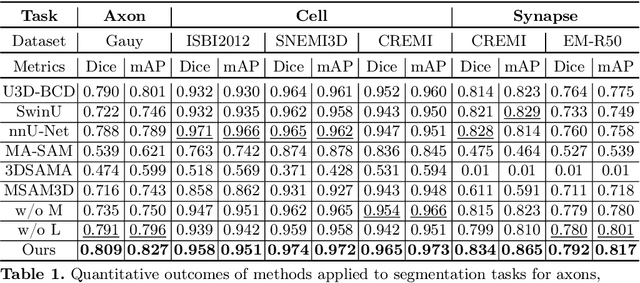
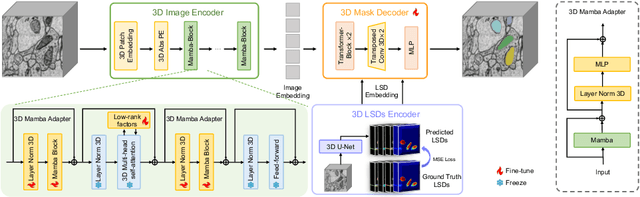
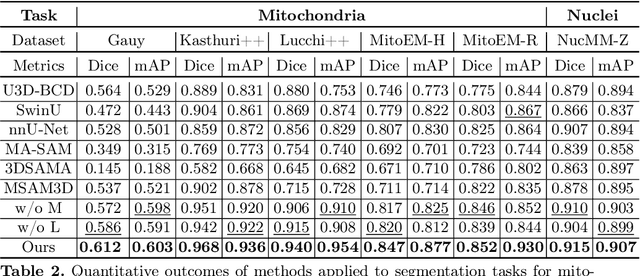
Electron microscopy (EM) imaging offers unparalleled resolution for analyzing neural tissues, crucial for uncovering the intricacies of synaptic connections and neural processes fundamental to understanding behavioral mechanisms. Recently, the foundation models have demonstrated impressive performance across numerous natural and medical image segmentation tasks. However, applying these foundation models to EM segmentation faces significant challenges due to domain disparities. This paper presents ShapeMamba-EM, a specialized fine-tuning method for 3D EM segmentation, which employs adapters for long-range dependency modeling and an encoder for local shape description within the original foundation model. This approach effectively addresses the unique volumetric and morphological complexities of EM data. Tested over a wide range of EM images, covering five segmentation tasks and 10 datasets, ShapeMamba-EM outperforms existing methods, establishing a new standard in EM image segmentation and enhancing the understanding of neural tissue architecture.
PRTGS: Precomputed Radiance Transfer of Gaussian Splats for Real-Time High-Quality Relighting
Aug 07, 2024We proposed Precomputed RadianceTransfer of GaussianSplats (PRTGS), a real-time high-quality relighting method for Gaussian splats in low-frequency lighting environments that captures soft shadows and interreflections by precomputing 3D Gaussian splats' radiance transfer. Existing studies have demonstrated that 3D Gaussian splatting (3DGS) outperforms neural fields' efficiency for dynamic lighting scenarios. However, the current relighting method based on 3DGS still struggles to compute high-quality shadow and indirect illumination in real time for dynamic light, leading to unrealistic rendering results. We solve this problem by precomputing the expensive transport simulations required for complex transfer functions like shadowing, the resulting transfer functions are represented as dense sets of vectors or matrices for every Gaussian splat. We introduce distinct precomputing methods tailored for training and rendering stages, along with unique ray tracing and indirect lighting precomputation techniques for 3D Gaussian splats to accelerate training speed and compute accurate indirect lighting related to environment light. Experimental analyses demonstrate that our approach achieves state-of-the-art visual quality while maintaining competitive training times and allows high-quality real-time (30+ fps) relighting for dynamic light and relatively complex scenes at 1080p resolution.
Multimodal Large Language Models for Bioimage Analysis
Jul 29, 2024Rapid advancements in imaging techniques and analytical methods over the past decade have revolutionized our ability to comprehensively probe the biological world at multiple scales, pinpointing the type, quantity, location, and even temporal dynamics of biomolecules. The surge in data complexity and volume presents significant challenges in translating this wealth of information into knowledge. The recently emerged Multimodal Large Language Models (MLLMs) exhibit strong emergent capacities, such as understanding, analyzing, reasoning, and generalization. With these capabilities, MLLMs hold promise to extract intricate information from biological images and data obtained through various modalities, thereby expediting our biological understanding and aiding in the development of novel computational frameworks. Previously, such capabilities were mostly attributed to humans for interpreting and summarizing meaningful conclusions from comprehensive observations and analysis of biological images. However, the current development of MLLMs shows increasing promise in serving as intelligent assistants or agents for augmenting human researchers in biology research
SpikeGS: 3D Gaussian Splatting from Spike Streams with High-Speed Camera Motion
Jul 14, 2024Novel View Synthesis plays a crucial role by generating new 2D renderings from multi-view images of 3D scenes. However, capturing high-speed scenes with conventional cameras often leads to motion blur, hindering the effectiveness of 3D reconstruction. To address this challenge, high-frame-rate dense 3D reconstruction emerges as a vital technique, enabling detailed and accurate modeling of real-world objects or scenes in various fields, including Virtual Reality or embodied AI. Spike cameras, a novel type of neuromorphic sensor, continuously record scenes with an ultra-high temporal resolution, showing potential for accurate 3D reconstruction. Despite their promise, existing approaches, such as applying Neural Radiance Fields (NeRF) to spike cameras, encounter challenges due to the time-consuming rendering process. To address this issue, we make the first attempt to introduce the 3D Gaussian Splatting (3DGS) into spike cameras in high-speed capture, providing 3DGS as dense and continuous clues of views, then constructing SpikeGS. Specifically, to train SpikeGS, we establish computational equations between the rendering process of 3DGS and the processes of instantaneous imaging and exposing-like imaging of the continuous spike stream. Besides, we build a very lightweight but effective mapping process from spikes to instant images to support training. Furthermore, we introduced a new spike-based 3D rendering dataset for validation. Extensive experiments have demonstrated our method possesses the high quality of novel view rendering, proving the tremendous potential of spike cameras in modeling 3D scenes.
SpikeGS: Reconstruct 3D scene via fast-moving bio-inspired sensors
Jul 04, 2024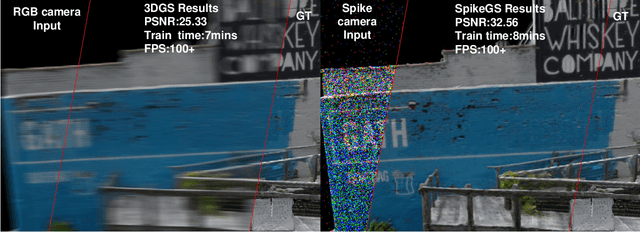
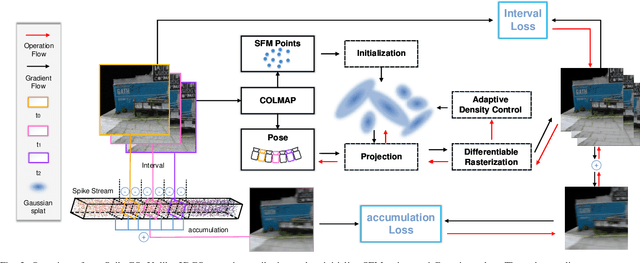
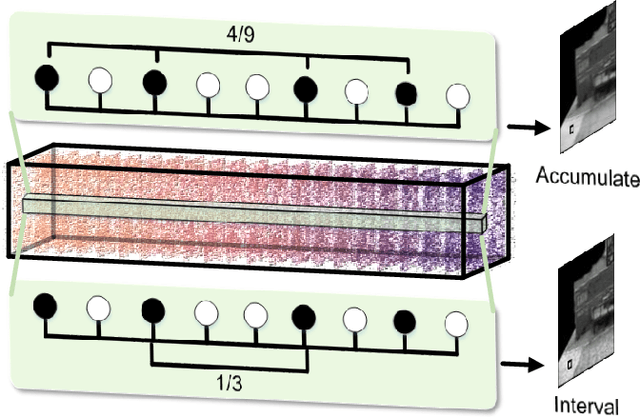
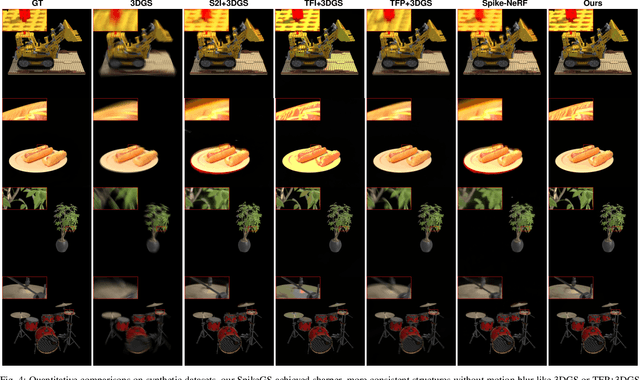
3D Gaussian Splatting (3DGS) demonstrates unparalleled superior performance in 3D scene reconstruction. However, 3DGS heavily relies on the sharp images. Fulfilling this requirement can be challenging in real-world scenarios especially when the camera moves fast, which severely limits the application of 3DGS. To address these challenges, we proposed Spike Gausian Splatting (SpikeGS), the first framework that integrates the spike streams into 3DGS pipeline to reconstruct 3D scenes via a fast-moving bio-inspired camera. With accumulation rasterization, interval supervision, and a specially designed pipeline, SpikeGS extracts detailed geometry and texture from high temporal resolution but texture lacking spike stream, reconstructs 3D scenes captured in 1 second. Extensive experiments on multiple synthetic and real-world datasets demonstrate the superiority of SpikeGS compared with existing spike-based and deblur 3D scene reconstruction methods. Codes and data will be released soon.
52B to 1T: Lessons Learned via Tele-FLM Series
Jul 03, 2024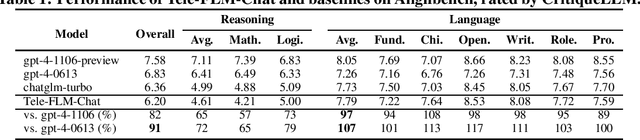



Large Language Models (LLMs) represent a significant stride toward Artificial General Intelligence. As scaling laws underscore the potential of increasing model sizes, the academic community has intensified its investigations into LLMs with capacities exceeding 50 billion parameters. This technical report builds on our prior work with Tele-FLM (also known as FLM-2), a publicly available 52-billion-parameter model. We delve into two primary areas: we first discuss our observation of Supervised Fine-tuning (SFT) on Tele-FLM-52B, which supports the "less is more" approach for SFT data construction; second, we demonstrate our experiments and analyses on the best practices for progressively growing a model from 52 billion to 102 billion, and subsequently to 1 trillion parameters. We will open-source a 1T model checkpoint, namely Tele-FLM-1T, to advance further training and research.
MLVU: A Comprehensive Benchmark for Multi-Task Long Video Understanding
Jun 06, 2024
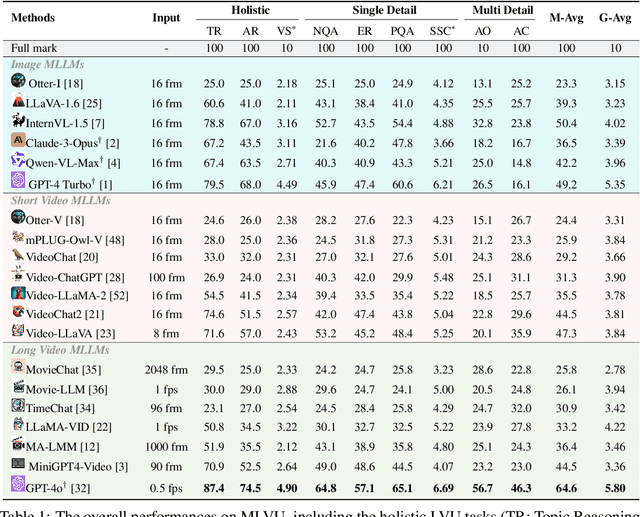
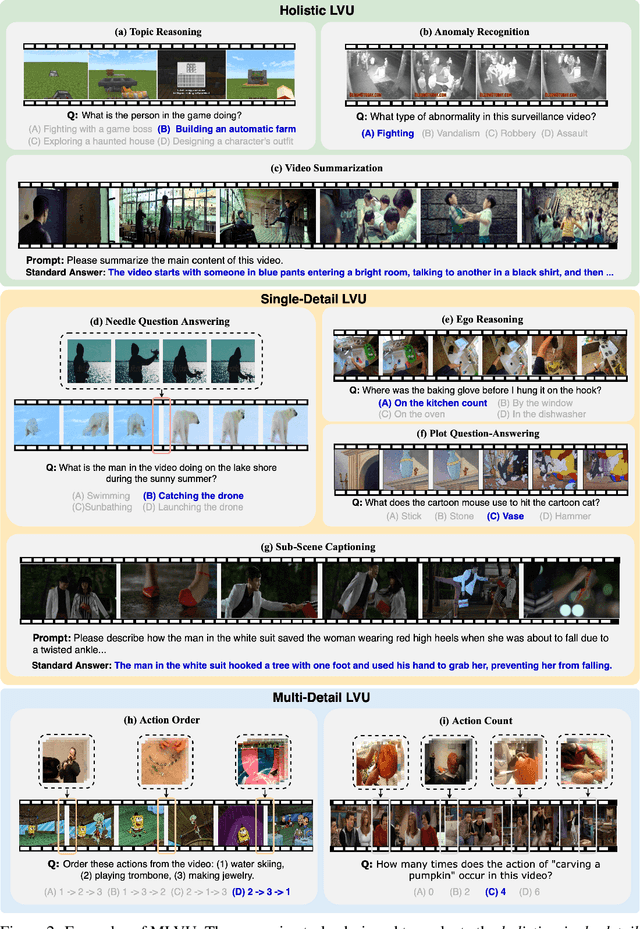
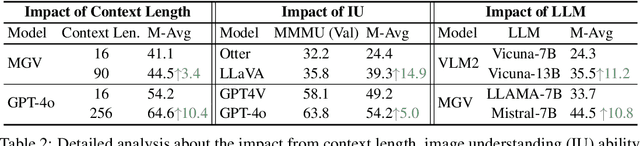
The evaluation of Long Video Understanding (LVU) performance poses an important but challenging research problem. Despite previous efforts, the existing video understanding benchmarks are severely constrained by several issues, especially the insufficient lengths of videos, a lack of diversity in video types and evaluation tasks, and the inappropriateness for evaluating LVU performances. To address the above problems, we propose a new benchmark, called MLVU (Multi-task Long Video Understanding Benchmark), for the comprehensive and in-depth evaluation of LVU. MLVU presents the following critical values: 1) The substantial and flexible extension of video lengths, which enables the benchmark to evaluate LVU performance across a wide range of durations. 2) The inclusion of various video genres, e.g., movies, surveillance footage, egocentric videos, cartoons, game videos, etc., which reflects the models' LVU performances in different scenarios. 3) The development of diversified evaluation tasks, which enables a comprehensive examination of MLLMs' key abilities in long-video understanding. The empirical study with 20 latest MLLMs reveals significant room for improvement in today's technique, as all existing methods struggle with most of the evaluation tasks and exhibit severe performance degradation when handling longer videos. Additionally, it suggests that factors such as context length, image-understanding quality, and the choice of LLM backbone can play critical roles in future advancements. We anticipate that MLVU will advance the research of long video understanding by providing a comprehensive and in-depth analysis of MLLMs.
SpikeMM: Flexi-Magnification of High-Speed Micro-Motions
Jun 01, 2024The amplification of high-speed micro-motions holds significant promise, with applications spanning fault detection in fast-paced industrial environments to refining precision in medical procedures. However, conventional motion magnification algorithms often encounter challenges in high-speed scenarios due to low sampling rates or motion blur. In recent years, spike cameras have emerged as a superior alternative for visual tasks in such environments, owing to their unique capability to capture temporal and spatial frequency domains with exceptional fidelity. Unlike conventional cameras, which operate at fixed, low frequencies, spike cameras emulate the functionality of the retina, asynchronously capturing photon changes at each pixel position using spike streams. This innovative approach comprehensively records temporal and spatial visual information, rendering it particularly suitable for magnifying high-speed micro-motions.This paper introduces SpikeMM, a pioneering spike-based algorithm tailored specifically for high-speed motion magnification. SpikeMM integrates multi-level information extraction, spatial upsampling, and motion magnification modules, offering a self-supervised approach adaptable to a wide range of scenarios. Notably, SpikeMM facilitates seamless integration with high-performance super-resolution and motion magnification algorithms. We substantiate the efficacy of SpikeMM through rigorous validation using scenes captured by spike cameras, showcasing its capacity to magnify motions in real-world high-frequency settings.