 Add to Chrome
 Add to Firefox
 Add to Edge
TBSG-Net: Temporal Bipartite Scene Graph Network for Fine-Grained Video Moment Retrieval
Aug 03, 2026
Recent advances in proposal-free Video Moment Retrieval (VMR) have highlighted the effectiveness of Static Scene Graphs (SSGs). By modeling objects and their relations at the frame level, SSGs enrich retrieval-oriented video representations. However, integrating SSGs into VMR remains constrained by two inherent limitations: (1) Lack of Temporal Dynamics. SSGs fail to model how objects and their relationships evolve over time, leading to the loss of essential temporal dependencies in video representation; and (2) Lack of Explicit Temporal Span Encoding. SSGs do not explicitly encode the duration of relationships, making precise localization challenging. To address these limitations, we propose Temporal Bipartite Scene Graph Network (TBSG-Net)---to the best of our knowledge, the first Dynamic Scene Graph (DSG) based proposal-free VMR model. Specifically, TBSG-Net leverages DSGs to extract event-centric graph representations of the input video, enabling the modeling of object interactions over time and thus addressing limitation (1). These DSGs are then processed by a novel Dynamic Scene Graph Embedding (DSG-E) module to capture both Temporal Span and spatio-temporal information. First, DSG-E utilizes a TBSG Constructor to transform DSGs into TBSGs, explicitly encoding objects, relationships, and time spans to tackle limitation (2). Second, the resultant TBSGs are passed into a hybrid TBSG Encoder that integrates a Transformer variant for global event modeling and a Graph Convolutional Network for detailed relational reasoning, ultimately producing a more comprehensive spatio-temporal representation. Our experiments demonstrate substantial improvements of TBSG-Net over all baselines.

Latent World Recovery for Multimodal Learning with Missing Modalities
Jun 10, 2026We study multimodal learning under missing modalities, with particular motivation from bioscience applications in which heterogeneous modalities are often only partially available when decisions need to be made. We propose Latent World Recovery (LWR), a framework built on two key ideas: (i) modality-specific embeddings from different modalities are aligned in a shared latent space, and (ii) a unified representation is constructed by fusing only the embeddings of the modalities that are actually available at both training and inference time. Rather than imputing missing modalities or requiring a fixed modality set, LWR treats each modality as a partial perception of an underlying latent state and performs availability-aware representation learning directly from the observed modalities. This combination of neighbor-based latent alignment and availability-aware modality fusion enables robust multimodal prediction under partial observation, while avoiding error propagation from explicit reconstruction of missing modalities. We evaluate the proposed framework on real-world incomplete multi-omics benchmarks and demonstrate that it provides an effective approach to downstream tasks such as cancer phenotype classification and survival prediction.
Dissociating spatial frequency reliance from adversarial robustness advantages in neurally guided deep convolutional neural networks
May 06, 2026Deep convolutional neural networks (DCNNs) have rivaled humans on many visual tasks, yet they remain vulnerable to near-imperceptible perturbations generated by adversarial attacks. Recent work shows that aligning DCNN representations with human visual cortex activity improves adversarial robustness, but the mechanisms driving this advantage are unclear. One hypothesis suggests that neural alignment confers robustness by biasing models away from brittle high-frequency details and towards the low spatial frequencies (LSF). However, recent work shows that human object recognition critically depends on a narrow, mid-frequency "human channel". Interestingly, this band was partially preserved in prior LSF-focused studies. Here, we investigate whether a spectral bias towards the LSF or the human channel is the primary driver of the adversarial robustness observed in neurally aligned DCNNs. We first show that DCNNs aligned to higher-order regions of the human ventral visual stream systematically increase reliance on both LSF and the human channel. However, directly steering DCNNs towards these bands revealed a clear dissociation. Biasing models towards the human channel, either alone or together with LSF, does not improve robustness and even impairs it. LSF bias produced some robustness gains, but such improvements are modest despite inducing much larger shifts in spatial-frequency reliance than neurally aligned models. Spatial-frequency-biased models overall show little, if any, increase in similarity to human neural representational geometry. Together, our results suggest that altered spatial-frequency reliance is likely an emergent property of learning more human-like representations rather than the primary mechanism by which neural alignment confers adversarial robustness, and motivate the need for future research examining representational properties beyond spatial-frequency profiles.
Contact-Safe Reinforcement Learning with ProMP Reparameterization and Energy Awareness
Nov 17, 2025Reinforcement learning (RL) approaches based on Markov Decision Processes (MDPs) are predominantly applied in the robot joint space, often relying on limited task-specific information and partial awareness of the 3D environment. In contrast, episodic RL has demonstrated advantages over traditional MDP-based methods in terms of trajectory consistency, task awareness, and overall performance in complex robotic tasks. Moreover, traditional step-wise and episodic RL methods often neglect the contact-rich information inherent in task-space manipulation, especially considering the contact-safety and robustness. In this work, contact-rich manipulation tasks are tackled using a task-space, energy-safe framework, where reliable and safe task-space trajectories are generated through the combination of Proximal Policy Optimization (PPO) and movement primitives. Furthermore, an energy-aware Cartesian Impedance Controller objective is incorporated within the proposed framework to ensure safe interactions between the robot and the environment. Our experimental results demonstrate that the proposed framework outperforms existing methods in handling tasks on various types of surfaces in 3D environments, achieving high success rates as well as smooth trajectories and energy-safe interactions.
Learning a Shape-adaptive Assist-as-needed Rehabilitation Policy from Therapist-informed Input
Oct 06, 2025Therapist-in-the-loop robotic rehabilitation has shown great promise in enhancing rehabilitation outcomes by integrating the strengths of therapists and robotic systems. However, its broader adoption remains limited due to insufficient safe interaction and limited adaptation capability. This article proposes a novel telerobotics-mediated framework that enables therapists to intuitively and safely deliver assist-as-needed~(AAN) therapy based on two primary contributions. First, our framework encodes the therapist-informed corrective force into via-points in a latent space, allowing the therapist to provide only minimal assistance while encouraging patient maintaining own motion preferences. Second, a shape-adaptive ANN rehabilitation policy is learned to partially and progressively deform the reference trajectory for movement therapy based on encoded patient motion preferences and therapist-informed via-points. The effectiveness of the proposed shape-adaptive AAN strategy was validated on a telerobotic rehabilitation system using two representative tasks. The results demonstrate its practicality for remote AAN therapy and its superiority over two state-of-the-art methods in reducing corrective force and improving movement smoothness.
Safe-Construct: Redefining Construction Safety Violation Recognition as 3D Multi-View Engagement Task
Apr 15, 2025Recognizing safety violations in construction environments is critical yet remains underexplored in computer vision. Existing models predominantly rely on 2D object detection, which fails to capture the complexities of real-world violations due to: (i) an oversimplified task formulation treating violation recognition merely as object detection, (ii) inadequate validation under realistic conditions, (iii) absence of standardized baselines, and (iv) limited scalability from the unavailability of synthetic dataset generators for diverse construction scenarios. To address these challenges, we introduce Safe-Construct, the first framework that reformulates violation recognition as a 3D multi-view engagement task, leveraging scene-level worker-object context and 3D spatial understanding. We also propose the Synthetic Indoor Construction Site Generator (SICSG) to create diverse, scalable training data, overcoming data limitations. Safe-Construct achieves a 7.6% improvement over state-of-the-art methods across four violation types. We rigorously evaluate our approach in near-realistic settings, incorporating four violations, four workers, 14 objects, and challenging conditions like occlusions (worker-object, worker-worker) and variable illumination (back-lighting, overexposure, sunlight). By integrating 3D multi-view spatial understanding and synthetic data generation, Safe-Construct sets a new benchmark for scalable and robust safety monitoring in high-risk industries. Project Website: https://Safe-Construct.github.io/Safe-Construct
KunPeng: A Global Ocean Environmental Model
Apr 07, 2025Inspired by the similarity of the atmosphere-ocean physical coupling mechanism, this study innovatively migrates meteorological large-model techniques to the ocean domain, constructing the KunPeng global ocean environmental prediction model. Aimed at the discontinuous characteristics of marine space, we propose a terrain-adaptive mask constraint mechanism to mitigate effectively training divergence caused by abrupt gradients at land-sea boundaries. To fully integrate far-, medium-, and close-range marine features, a longitude-cyclic deformable convolution network (LC-DCN) is employed to enhance the dynamic receptive field, achieving refined modeling of multi-scale oceanic characteristics. A Deformable Convolution-enhanced Multi-Step Prediction module (DC-MTP) is employed to strengthen temporal dependency feature extraction capabilities. Experimental results demonstrate that this model achieves an average ACC of 0.80 in 15-day global predictions at 0.25$^\circ$ resolution, outperforming comparative models by 0.01-0.08. The average mean squared error (MSE) is 0.41 (representing a 5%-31% reduction) and the average mean absolute error (MAE) is 0.44 (0.6%-21% reduction) compared to other models. Significant improvements are particularly observed in sea surface parameter prediction, deep-sea region characterization, and current velocity field forecasting. Through a horizontal comparison of the applicability of operators at different scales in the marine domain, this study reveals that local operators significantly outperform global operators under slow-varying oceanic processes, demonstrating the effectiveness of dynamic feature pyramid representations in predicting marine physical parameters.
Enhancing Cooperation through Selective Interaction and Long-term Experiences in Multi-Agent Reinforcement Learning
May 04, 2024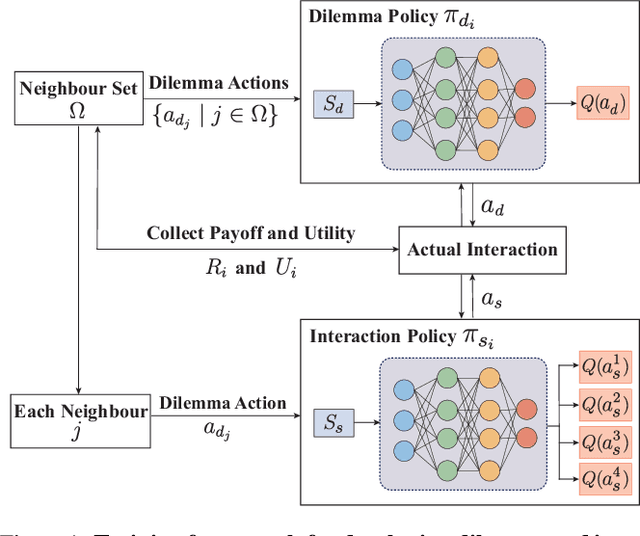

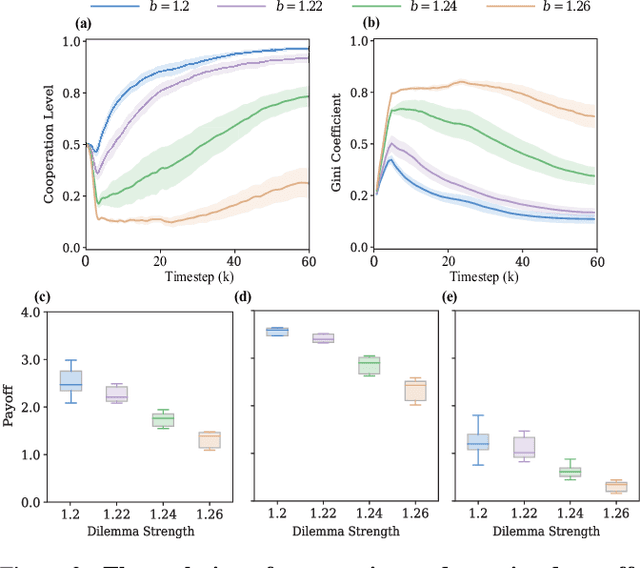
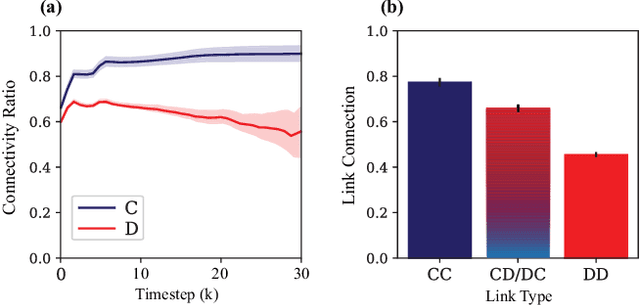
The significance of network structures in promoting group cooperation within social dilemmas has been widely recognized. Prior studies attribute this facilitation to the assortment of strategies driven by spatial interactions. Although reinforcement learning has been employed to investigate the impact of dynamic interaction on the evolution of cooperation, there remains a lack of understanding about how agents develop neighbour selection behaviours and the formation of strategic assortment within an explicit interaction structure. To address this, our study introduces a computational framework based on multi-agent reinforcement learning in the spatial Prisoner's Dilemma game. This framework allows agents to select dilemma strategies and interacting neighbours based on their long-term experiences, differing from existing research that relies on preset social norms or external incentives. By modelling each agent using two distinct Q-networks, we disentangle the coevolutionary dynamics between cooperation and interaction. The results indicate that long-term experience enables agents to develop the ability to identify non-cooperative neighbours and exhibit a preference for interaction with cooperative ones. This emergent self-organizing behaviour leads to the clustering of agents with similar strategies, thereby increasing network reciprocity and enhancing group cooperation.
Accelerating Integrated Task and Motion Planning with Neural Feasibility Checking
Mar 20, 2022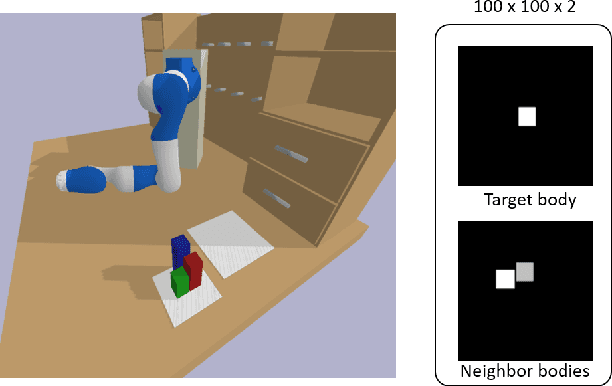
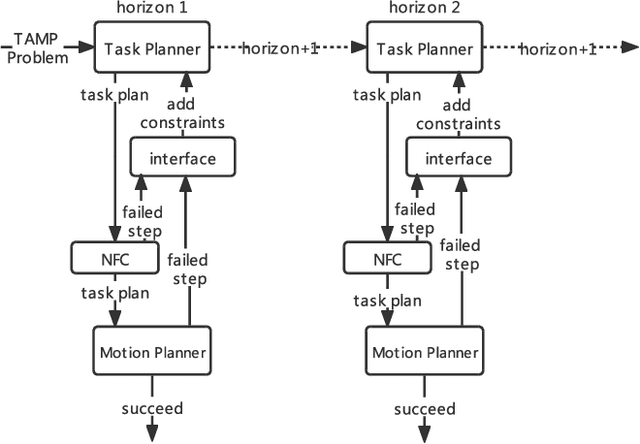
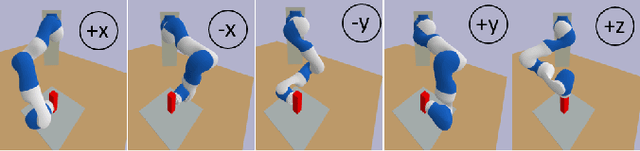
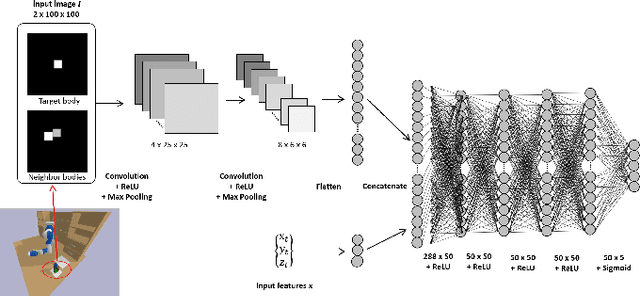
As robots play an increasingly important role in the industrial, the expectations about their applications for everyday living tasks are getting higher. Robots need to perform long-horizon tasks that consist of several sub-tasks that need to be accomplished. Task and Motion Planning (TAMP) provides a hierarchical framework to handle the sequential nature of manipulation tasks by interleaving a symbolic task planner that generates a possible action sequence, with a motion planner that checks the kinematic feasibility in the geometric world, generating robot trajectories if several constraints are satisfied, e.g., a collision-free trajectory from one state to another. Hence, the reasoning about the task plan's geometric grounding is taken over by the motion planner. However, motion planning is computationally intense and is usability as feasibility checker casts TAMP methods inapplicable to real-world scenarios. In this paper, we introduce neural feasibility classifier (NFC), a simple yet effective visual heuristic for classifying the feasibility of proposed actions in TAMP. Namely, NFC will identify infeasible actions of the task planner without the need for costly motion planning, hence reducing planning time in multi-step manipulation tasks. NFC encodes the image of the robot's workspace into a feature map thanks to convolutional neural network (CNN). We train NFC using simulated data from TAMP problems and label the instances based on IK feasibility checking. Our empirical results in different simulated manipulation tasks show that our NFC generalizes to the entire robot workspace and has high prediction accuracy even in scenes with multiple obstructions. When combined with state-of-the-art integrated TAMP, our NFC enhances its performance while reducing its planning time.
Learning Geometric Constraints in Task and Motion Planning
Jan 24, 2022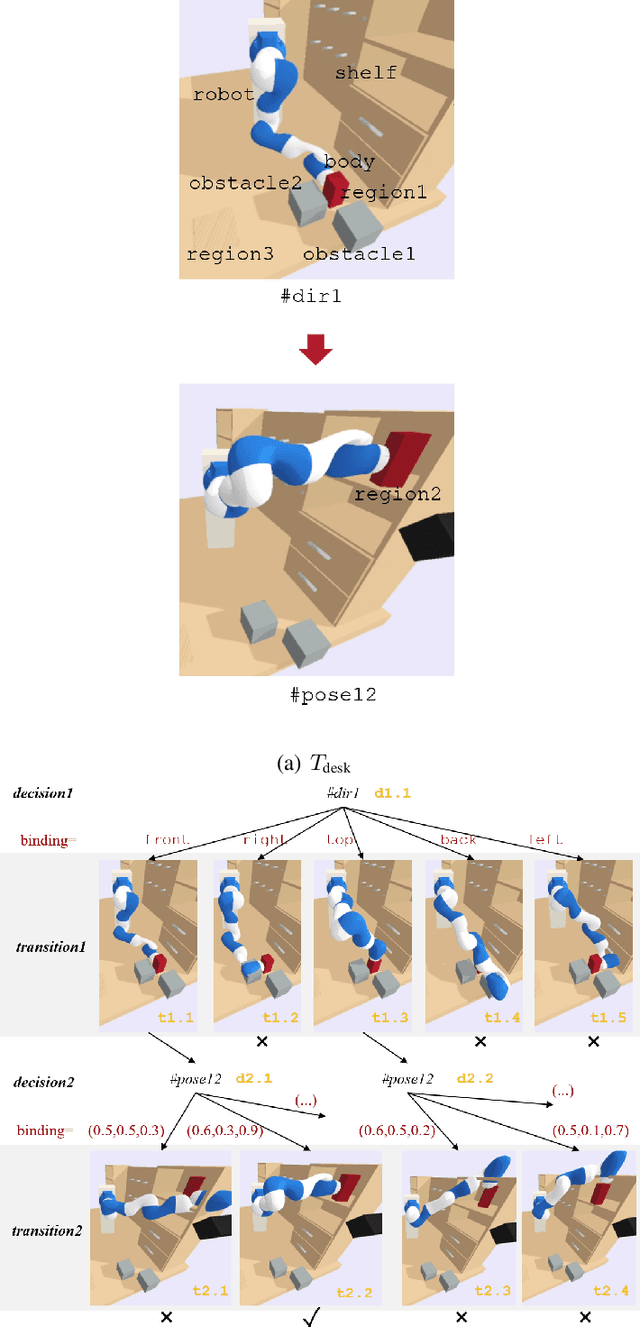
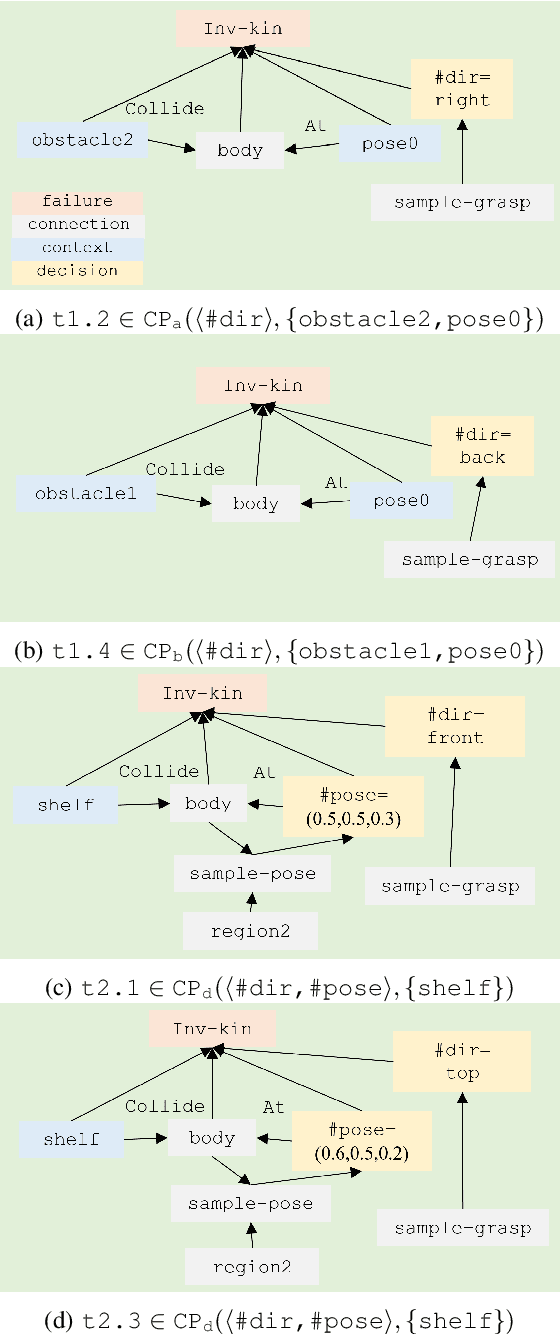
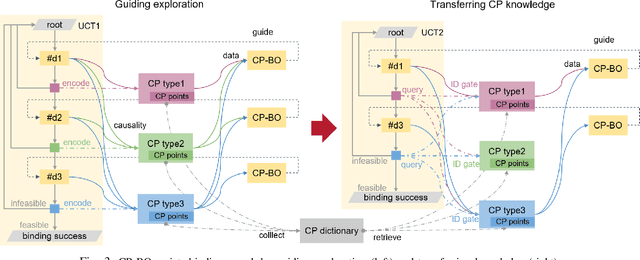
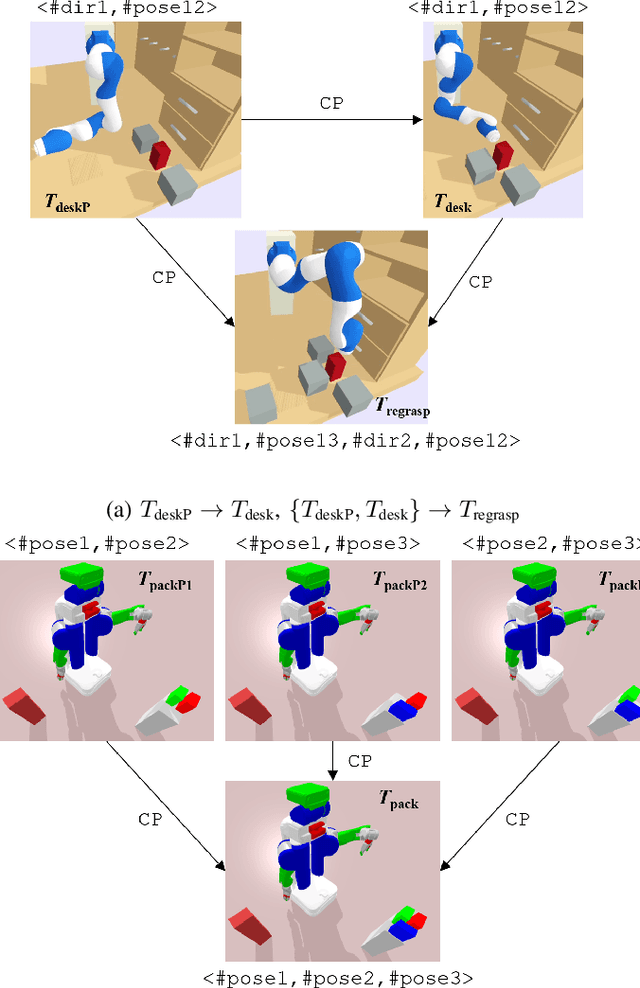
Searching for bindings of geometric parameters in task and motion planning (TAMP) is a finite-horizon stochastic planning problem with high-dimensional decision spaces. A robot manipulator can only move in a subspace of its whole range that is subjected to many geometric constraints. A TAMP solver usually takes many explorations before finding a feasible binding set for each task. It is favorable to learn those constraints once and then transfer them over different tasks within the same workspace. We address this problem by representing constraint knowledge with transferable primitives and using Bayesian optimization (BO) based on these primitives to guide binding search in further tasks. Via semantic and geometric backtracking in TAMP, we construct constraint primitives to encode the geometric constraints respectively in a reusable form. Then we devise a BO approach to efficiently utilize the accumulated constraints for guiding node expansion of an MCTS-based binding planner. We further compose a transfer mechanism to enable free knowledge flow between TAMP tasks. Results indicate that our approach reduces the expensive exploration calls in binding search by 43.60to 71.69 when compared to the baseline unguided planner.