 Add to Chrome
 Add to Firefox
 Add to Edge
DeMaVLA: A Vision-Language-Action Foundation Model for Generalizable Deformable Manipulation
May 29, 2026
Real-world household robots require Vision-Language-Action (VLA) foundation models that can acquire reusable manipulation skills across diverse objects, task conditions, and household environments. Deformable-object folding is a representative challenge, requiring robots to handle clothing items from random initial states across varying categories, geometries, materials, and scenes. However, existing VLA systems commonly train separate policies for different object categories, while naively mixed multi-task training often suffers from task interference and degraded performance. To move beyond category-specific folding policies, we introduce DeMaVLA, a VLA foundation model for generalizable Deformable Manipulation. DeMaVLA adopts a VLM backbone with an action expert and formulates continuous action generation using flow matching. To improve efficiency, the action expert is constructed by pruning every other transformer layer while preserving layer-wise alignment with the VLM backbone, reducing training and inference cost. DeMaVLA is first pre-trained on approximately 5,000 hours of selected real-world dual-arm demonstrations to acquire general manipulation priors. It is then post-trained on mixed folding data that aggregates self-collected demonstrations and corrective trajectories from real-robot failures across multiple folding tasks through a human-in-the-loop Data Aggregation~(DAgger) pipeline. Experiments show that DeMaVLA achieves competitive performance on RoboTwin and strong real-world results on our household folding benchmark. These results highlight the value of scalable real-world data, efficient action generation, and corrective learning for general-purpose VLA policies in deformable-object manipulation.

KunPeng: A Global Ocean Environmental Model
Apr 07, 2025Inspired by the similarity of the atmosphere-ocean physical coupling mechanism, this study innovatively migrates meteorological large-model techniques to the ocean domain, constructing the KunPeng global ocean environmental prediction model. Aimed at the discontinuous characteristics of marine space, we propose a terrain-adaptive mask constraint mechanism to mitigate effectively training divergence caused by abrupt gradients at land-sea boundaries. To fully integrate far-, medium-, and close-range marine features, a longitude-cyclic deformable convolution network (LC-DCN) is employed to enhance the dynamic receptive field, achieving refined modeling of multi-scale oceanic characteristics. A Deformable Convolution-enhanced Multi-Step Prediction module (DC-MTP) is employed to strengthen temporal dependency feature extraction capabilities. Experimental results demonstrate that this model achieves an average ACC of 0.80 in 15-day global predictions at 0.25$^\circ$ resolution, outperforming comparative models by 0.01-0.08. The average mean squared error (MSE) is 0.41 (representing a 5%-31% reduction) and the average mean absolute error (MAE) is 0.44 (0.6%-21% reduction) compared to other models. Significant improvements are particularly observed in sea surface parameter prediction, deep-sea region characterization, and current velocity field forecasting. Through a horizontal comparison of the applicability of operators at different scales in the marine domain, this study reveals that local operators significantly outperform global operators under slow-varying oceanic processes, demonstrating the effectiveness of dynamic feature pyramid representations in predicting marine physical parameters.
Uncovering Prototypical Knowledge for Weakly Open-Vocabulary Semantic Segmentation
Oct 29, 2023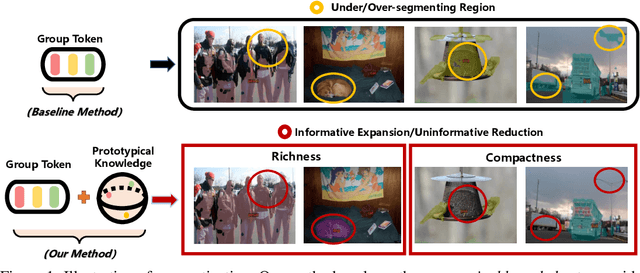
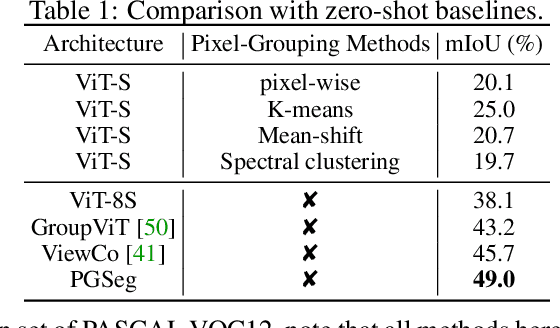
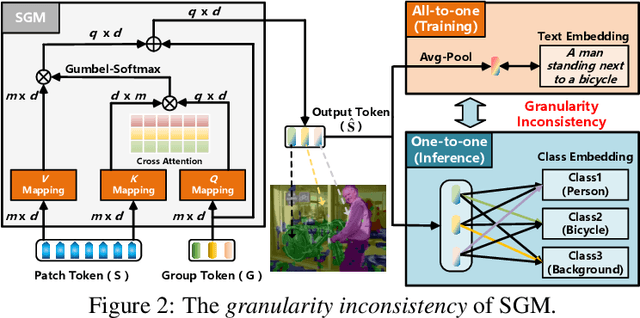
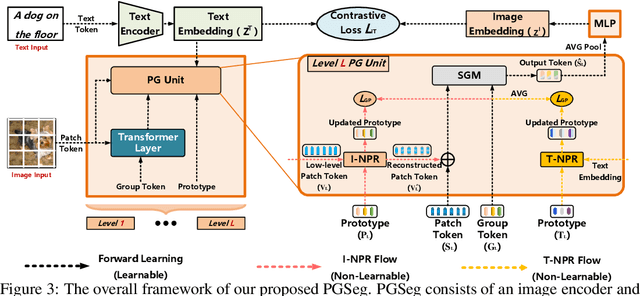
This paper studies the problem of weakly open-vocabulary semantic segmentation (WOVSS), which learns to segment objects of arbitrary classes using mere image-text pairs. Existing works turn to enhance the vanilla vision transformer by introducing explicit grouping recognition, i.e., employing several group tokens/centroids to cluster the image tokens and perform the group-text alignment. Nevertheless, these methods suffer from a granularity inconsistency regarding the usage of group tokens, which are aligned in the all-to-one v.s. one-to-one manners during the training and inference phases, respectively. We argue that this discrepancy arises from the lack of elaborate supervision for each group token. To bridge this granularity gap, this paper explores explicit supervision for the group tokens from the prototypical knowledge. To this end, this paper proposes the non-learnable prototypical regularization (NPR) where non-learnable prototypes are estimated from source features to serve as supervision and enable contrastive matching of the group tokens. This regularization encourages the group tokens to segment objects with less redundancy and capture more comprehensive semantic regions, leading to increased compactness and richness. Based on NPR, we propose the prototypical guidance segmentation network (PGSeg) that incorporates multi-modal regularization by leveraging prototypical sources from both images and texts at different levels, progressively enhancing the segmentation capability with diverse prototypical patterns. Experimental results show that our proposed method achieves state-of-the-art performance on several benchmark datasets. The source code is available at https://github.com/Ferenas/PGSeg.
K-Space Transformer for Fast MRI Reconstruction with Implicit Representation
Jun 14, 2022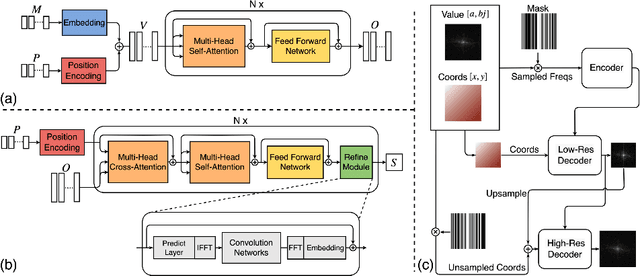
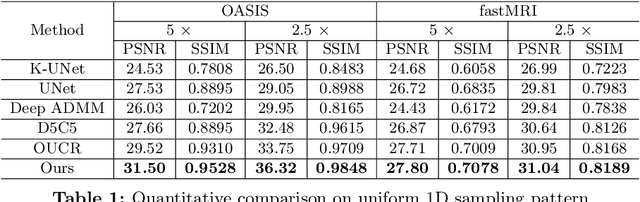
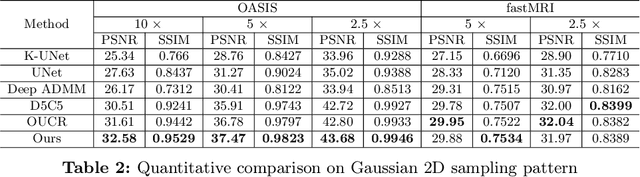
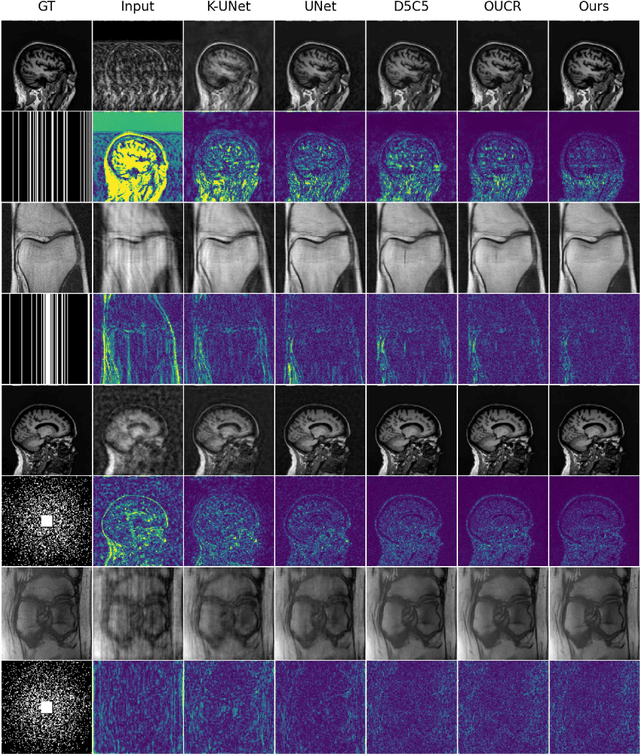
This paper considers the problem of fast MRI reconstruction. We propose a novel Transformer-based framework for directly processing the sparsely sampled signals in k-space, going beyond the limitation of regular grids as ConvNets do. We adopt an implicit representation of spectrogram, treating spatial coordinates as inputs, and dynamically query the partially observed measurements to complete the spectrogram, i.e. learning the inductive bias in k-space. To strive a balance between computational cost and reconstruction quality, we build an hierarchical structure with low-resolution and high-resolution decoders respectively. To validate the necessity of our proposed modules, we have conducted extensive experiments on two public datasets, and demonstrate superior or comparable performance over state-of-the-art approaches.