 Add to Chrome
 Add to Firefox
 Add to Edge
UniTexture: Cross-Task Universal Adversarial Textures for Vision-Language-Action Models
Aug 13, 2026
Vision-Language-Action (VLA) models have emerged as generalist robotic policies capable of following diverse language instructions and performing a wide range of manipulation tasks. However, their direct control over embodied agents also exposes them to adversarial interference that may cause unsafe physical behaviors. Existing attacks on robotic policies are typically optimized for a single task or instruction, leaving the cross-task vulnerabilities of multitask VLAs largely unexplored. We introduce UniTexture, a cross-task universal adversarial texture attack that uses a single textured 3D object to induce targeted deviations in VLA action predictions across multiple tasks. UniTexture backpropagates gradients from the policy's action outputs to surface texture parameters through a differentiable renderer. It jointly optimizes the shared texture over a distribution of tasks, instructions, states, and viewpoints using a targeted action-space objective, steering predicted actions toward attacker-defined targets without optimizing a separate texture for each task. We evaluate UniTexture on OpenVLA and $π_{0.5}$ across diverse manipulation tasks and multiple evaluation settings. UniTexture reduces the mean task success rate from 90.0% under benign conditions to 48.4% under attack, induces target-aligned action shifts, and further exhibits cross-suite and cross-model transfer without re-optimization. Together, these findings reveal shared cross-task vulnerabilities in multitask VLAs that can be systematically exploited through a single adversarial surface texture.

ActFovea: Runtime Safeguarding for VLA Policies via Spatiotemporal Visual-Action Consistency
Jul 31, 2026Vision-language-action (VLA) policies achieve strong performance in robotic manipulation but remain vulnerable to runtime disturbances that break the temporal alignment among visual observations, robot states, and executed actions. We introduce ActFovea, a plug-and-play safeguarding framework that detects and mitigates such failures without retraining or modifying the underlying VLA policy. ActFovea uses robot kinematics, proprioceptive states, and recent actions to construct action-conditioned foveated regions that retain contact-relevant areas and predicted motion corridors while suppressing task-irrelevant visual content. It detects runtime risks by evaluating whether visual motion and observation freshness remain consistent with geometric, proprioceptive, and action transitions. For recoverable disturbances, ActFovea constructs disturbance-specific candidate observations and accepts a recovery only after verifying the resulting action chunk. When stale or replayed observations make reliable recovery impossible, it invokes a bounded safe-failure procedure. In closed-loop evaluations of $π_0$ across multiple LIBERO suites, ActFovea increases success under localized visual overlays from 49.3\% to 90.3\%, closing 93.7\% of the gap to clean performance. It further improves success under action drift and visual delay by 7.0 and 9.8 percentage points, respectively, while preserving clean-task performance. Under frozen-observation replay, ActFovea triggers timely safe failure in all trials, with no unprotected failures. These results demonstrate that spatiotemporal visual-action consistency provides an effective basis for runtime safeguarding of VLA policies.
DA-PTQ: Drift-Aware Post-Training Quantization for Efficient Vision-Language-Action Models
Apr 13, 2026Vision-Language-Action models (VLAs) have demonstrated strong potential for embodied AI, yet their deployment on resource-limited robots remains challenging due to high memory and computational demands. While Post-Training Quantization (PTQ) provides an efficient solution, directly applying PTQ to VLAs often results in severe performance degradation during sequential control. We identify temporal error accumulation as a key factor, where quantization perturbations at the vision-language-to-action interface are progressively amplified, leading to kinematic drift in executed trajectories. To address this issue, we propose Drift-Aware Post-Training Quantization (DA-PTQ), which formulates quantization as a drift-aware optimization problem over sequential decision processes. DA-PTQ consists of two components: (1) Cross-Space Representation Compensation, which mitigates structured distortions between multimodal representations and action space to improve action consistency, and (2) Motion-Driven Mixed-Precision Allocation, which assigns bit-widths by minimizing trajectory-level motion errors. Extensive experiments show that DA-PTQ significantly reduces kinematic drift and achieves comparable performance to full-precision models under low-bit settings, enabling practical deployment of VLAs on resource-limited robotic platforms.
AC^2-VLA: Action-Context-Aware Adaptive Computation in Vision-Language-Action Models for Efficient Robotic Manipulation
Jan 27, 2026Vision-Language-Action (VLA) models have demonstrated strong performance in robotic manipulation, yet their closed-loop deployment is hindered by the high latency and compute cost of repeatedly running large vision-language backbones at every timestep. We observe that VLA inference exhibits structured redundancies across temporal, spatial, and depth dimensions, and that most existing efficiency methods ignore action context, despite its central role in embodied tasks. To address this gap, we propose Action-Context-aware Adaptive Computation for VLA models (AC^2-VLA), a unified framework that conditions computation on current visual observations, language instructions, and previous action states. Based on this action-centric context, AC^2-VLA adaptively performs cognition reuse across timesteps, token pruning, and selective execution of model components within a unified mechanism. To train the adaptive policy, we introduce an action-guided self-distillation scheme that preserves the behavior of the dense VLA policy while enabling structured sparsification that transfers across tasks and settings. Extensive experiments on robotic manipulation benchmarks show that AC^2-VLA achieves up to a 1.79\times speedup while reducing FLOPs to 29.4% of the dense baseline, with comparable task success.
SCRAG: Social Computing-Based Retrieval Augmented Generation for Community Response Forecasting in Social Media Environments
Apr 18, 2025This paper introduces SCRAG, a prediction framework inspired by social computing, designed to forecast community responses to real or hypothetical social media posts. SCRAG can be used by public relations specialists (e.g., to craft messaging in ways that avoid unintended misinterpretations) or public figures and influencers (e.g., to anticipate social responses), among other applications related to public sentiment prediction, crisis management, and social what-if analysis. While large language models (LLMs) have achieved remarkable success in generating coherent and contextually rich text, their reliance on static training data and susceptibility to hallucinations limit their effectiveness at response forecasting in dynamic social media environments. SCRAG overcomes these challenges by integrating LLMs with a Retrieval-Augmented Generation (RAG) technique rooted in social computing. Specifically, our framework retrieves (i) historical responses from the target community to capture their ideological, semantic, and emotional makeup, and (ii) external knowledge from sources such as news articles to inject time-sensitive context. This information is then jointly used to forecast the responses of the target community to new posts or narratives. Extensive experiments across six scenarios on the X platform (formerly Twitter), tested with various embedding models and LLMs, demonstrate over 10% improvements on average in key evaluation metrics. A concrete example further shows its effectiveness in capturing diverse ideologies and nuances. Our work provides a social computing tool for applications where accurate and concrete insights into community responses are crucial.
InfoMAE: Pair-Efficient Cross-Modal Alignment for Multimodal Time-Series Sensing Signals
Apr 13, 2025Standard multimodal self-supervised learning (SSL) algorithms regard cross-modal synchronization as implicit supervisory labels during pretraining, thus posing high requirements on the scale and quality of multimodal samples. These constraints significantly limit the performance of sensing intelligence in IoT applications, as the heterogeneity and the non-interpretability of time-series signals result in abundant unimodal data but scarce high-quality multimodal pairs. This paper proposes InfoMAE, a cross-modal alignment framework that tackles the challenge of multimodal pair efficiency under the SSL setting by facilitating efficient cross-modal alignment of pretrained unimodal representations. InfoMAE achieves \textit{efficient cross-modal alignment} with \textit{limited data pairs} through a novel information theory-inspired formulation that simultaneously addresses distribution-level and instance-level alignment. Extensive experiments on two real-world IoT applications are performed to evaluate InfoMAE's pairing efficiency to bridge pretrained unimodal models into a cohesive joint multimodal model. InfoMAE enhances downstream multimodal tasks by over 60% with significantly improved multimodal pairing efficiency. It also improves unimodal task accuracy by an average of 22%.
On the Efficiency and Robustness of Vibration-based Foundation Models for IoT Sensing: A Case Study
Apr 03, 2024
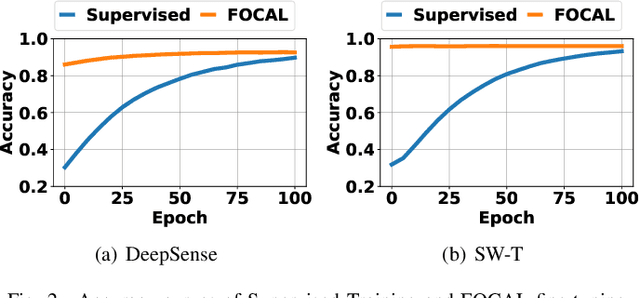

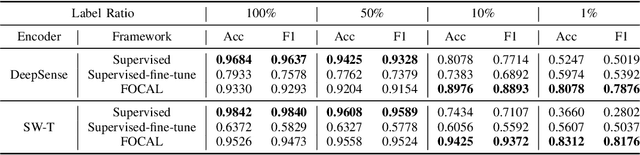
This paper demonstrates the potential of vibration-based Foundation Models (FMs), pre-trained with unlabeled sensing data, to improve the robustness of run-time inference in (a class of) IoT applications. A case study is presented featuring a vehicle classification application using acoustic and seismic sensing. The work is motivated by the success of foundation models in the areas of natural language processing and computer vision, leading to generalizations of the FM concept to other domains as well, where significant amounts of unlabeled data exist that can be used for self-supervised pre-training. One such domain is IoT applications. Foundation models for selected sensing modalities in the IoT domain can be pre-trained in an environment-agnostic fashion using available unlabeled sensor data and then fine-tuned to the deployment at hand using a small amount of labeled data. The paper shows that the pre-training/fine-tuning approach improves the robustness of downstream inference and facilitates adaptation to different environmental conditions. More specifically, we present a case study in a real-world setting to evaluate a simple (vibration-based) FM-like model, called FOCAL, demonstrating its superior robustness and adaptation, compared to conventional supervised deep neural networks (DNNs). We also demonstrate its superior convergence over supervised solutions. Our findings highlight the advantages of vibration-based FMs (and FM-inspired selfsupervised models in general) in terms of inference robustness, runtime efficiency, and model adaptation (via fine-tuning) in resource-limited IoT settings.
SudokuSens: Enhancing Deep Learning Robustness for IoT Sensing Applications using a Generative Approach
Feb 08, 2024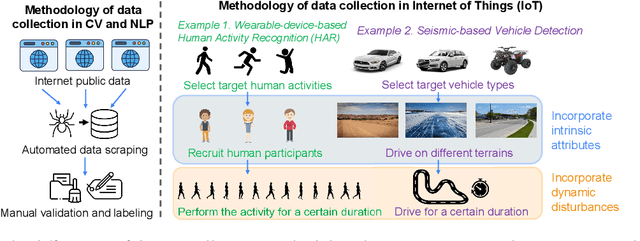
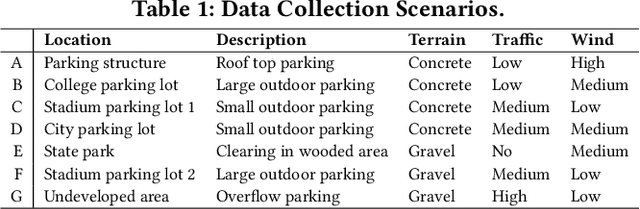
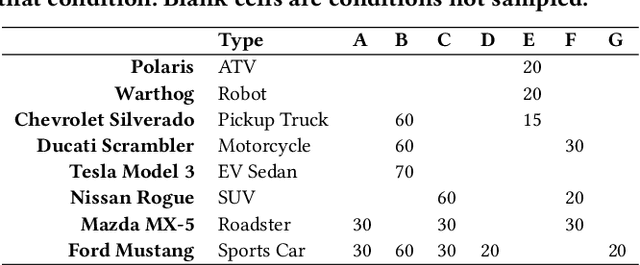
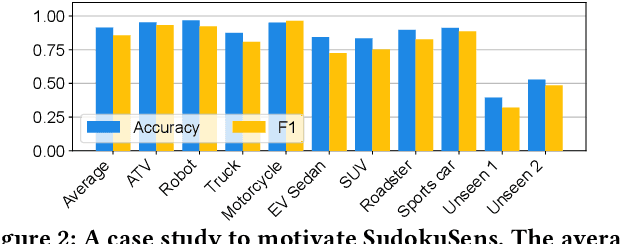
This paper introduces SudokuSens, a generative framework for automated generation of training data in machine-learning-based Internet-of-Things (IoT) applications, such that the generated synthetic data mimic experimental configurations not encountered during actual sensor data collection. The framework improves the robustness of resulting deep learning models, and is intended for IoT applications where data collection is expensive. The work is motivated by the fact that IoT time-series data entangle the signatures of observed objects with the confounding intrinsic properties of the surrounding environment and the dynamic environmental disturbances experienced. To incorporate sufficient diversity into the IoT training data, one therefore needs to consider a combinatorial explosion of training cases that are multiplicative in the number of objects considered and the possible environmental conditions in which such objects may be encountered. Our framework substantially reduces these multiplicative training needs. To decouple object signatures from environmental conditions, we employ a Conditional Variational Autoencoder (CVAE) that allows us to reduce data collection needs from multiplicative to (nearly) linear, while synthetically generating (data for) the missing conditions. To obtain robustness with respect to dynamic disturbances, a session-aware temporal contrastive learning approach is taken. Integrating the aforementioned two approaches, SudokuSens significantly improves the robustness of deep learning for IoT applications. We explore the degree to which SudokuSens benefits downstream inference tasks in different data sets and discuss conditions under which the approach is particularly effective.
Cross-Modal Retrieval: A Systematic Review of Methods and Future Directions
Aug 28, 2023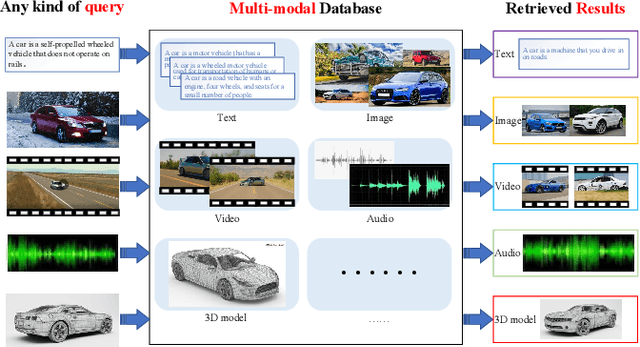
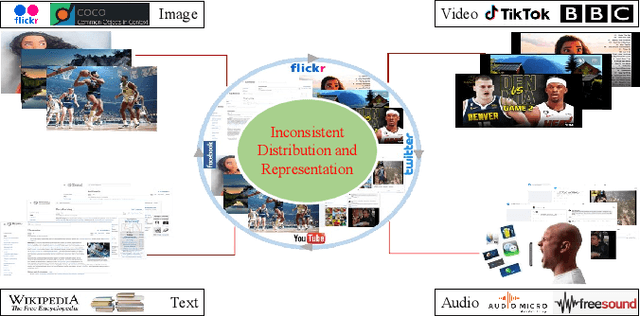
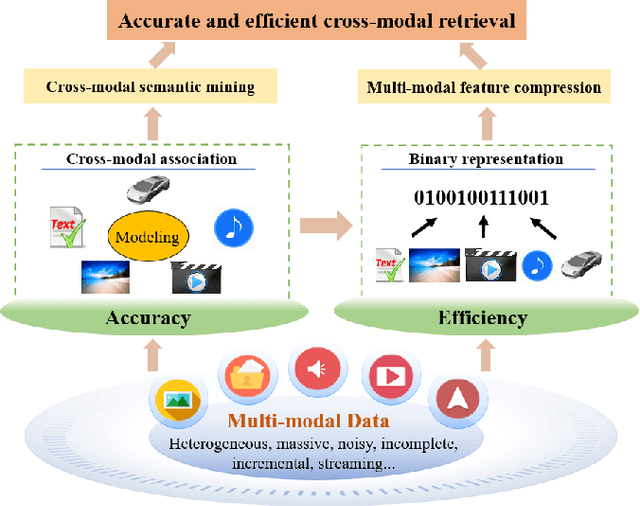
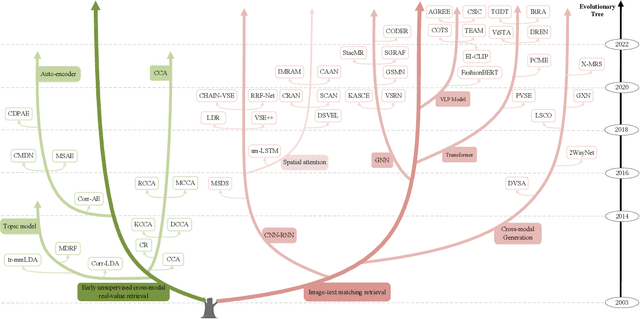
With the exponential surge in diverse multi-modal data, traditional uni-modal retrieval methods struggle to meet the needs of users demanding access to data from various modalities. To address this, cross-modal retrieval has emerged, enabling interaction across modalities, facilitating semantic matching, and leveraging complementarity and consistency between different modal data. Although prior literature undertook a review of the cross-modal retrieval field, it exhibits numerous deficiencies pertaining to timeliness, taxonomy, and comprehensiveness. This paper conducts a comprehensive review of cross-modal retrieval's evolution, spanning from shallow statistical analysis techniques to vision-language pre-training models. Commencing with a comprehensive taxonomy grounded in machine learning paradigms, mechanisms, and models, the paper then delves deeply into the principles and architectures underpinning existing cross-modal retrieval methods. Furthermore, it offers an overview of widely used benchmarks, metrics, and performances. Lastly, the paper probes the prospects and challenges that confront contemporary cross-modal retrieval, while engaging in a discourse on potential directions for further progress in the field. To facilitate the research on cross-modal retrieval, we develop an open-source code repository at https://github.com/BMC-SDNU/Cross-Modal-Retrieval.
Self-Contrastive Learning based Semi-Supervised Radio Modulation Classification
Mar 29, 2022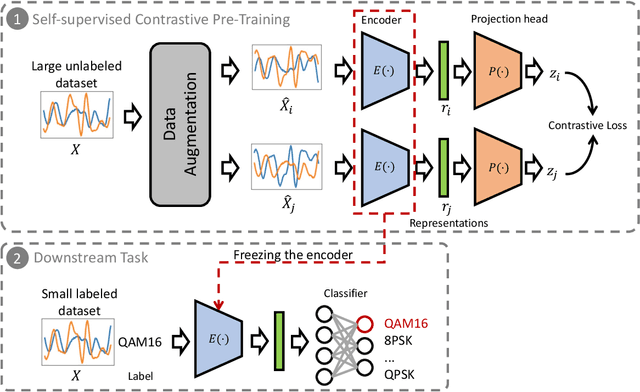
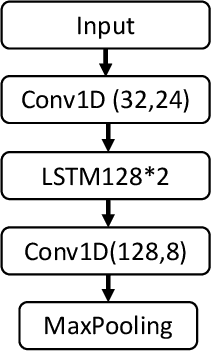
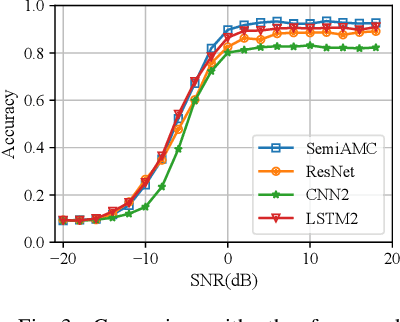
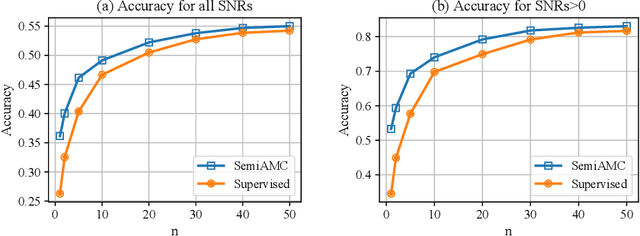
This paper presents a semi-supervised learning framework that is new in being designed for automatic modulation classification (AMC). By carefully utilizing unlabeled signal data with a self-supervised contrastive-learning pre-training step, our framework achieves higher performance given smaller amounts of labeled data, thereby largely reducing the labeling burden of deep learning. We evaluate the performance of our semi-supervised framework on a public dataset. The evaluation results demonstrate that our semi-supervised approach significantly outperforms supervised frameworks thereby substantially enhancing our ability to train deep neural networks for automatic modulation classification in a manner that leverages unlabeled data.