 Add to Chrome
 Add to Firefox
 Add to Edge
Cascaded Multi-Granularity Pruning for On-Device LLM Inference in Industrial IoT
Jun 25, 2026
Deploying large language models (LLMs) on Industrial Internet of Things (IIoT) edge devices demands extreme compression, yet existing structured pruning methods collapse at high compression ratios due to one-shot importance estimation, and their cross-architecture behavior remains unpredictable. This article presents a cascaded multi-granularity pruning framework that removes layers, attention heads, and feed-forward channels in coarse-to-fine order, with lightweight low-rank recovery between stages to re-estimate component importance. An information-theoretic analysis motivates this ordering, and the Structural Independence Assumption (SIA) is formalized as a checkable condition predicting whether per-component pruning criteria are reliable for a given architecture: Multi-Head Attention (MHA)+GELU designs satisfy the SIA, whereas Grouped Query Attention (GQA)+SwiGLU designs violate it. On bearing fault diagnosis spanning 88M to 6.25B-parameter models, the framework extends achievable compression to 13.8 times on MHA+GELU architectures with 83.82% accuracy (+3.70 percentage points (pp) over the strongest baseline), while exposing a ~74pp accuracy collapse on GQA+SwiGLU architectures that violate the SIA. Deployed on an industrial slewing bearing fault diagnosis platform with NVIDIA DGX Spark, compressed models reduce inference latency by up to 67.2% and peak memory by 62.5%, demonstrating viability for IIoT edge inference.

Digital Twin-Driven Adaptive Sim-to-Real Alignment via Reinforcement Learning for Vibration-Based Bearing Health Monitoring Under Data Scarcity
Jun 23, 2026Vibration-based health monitoring of rotating machinery requires reliable fault diagnosis under operational data constraints, yet condition assessment remains challenged by structural scarcity of fault events and heterogeneous sim-to-real gaps in digital twin-generated signals. Each fault type generates impulses with distinct periodicity, amplitude modulation, and spectral character, making feature-space discrepancies fundamentally heterogeneous across fault classes. Existing domain adaptation methods apply a class-agnostic global transformation that cannot close all fault-specific gaps without distorting inter-class separability, while uniform source-target mixing introduces distributional noise into the data-abundant Normal class. These limitations stem from treating a sequential, state-dependent alignment problem as a one-shot optimization. Each corrective transformation simultaneously reshapes all class distributions, creating state dependencies that static gradient descent cannot resolve. We formulate feature alignment as a continuous-action Markov decision process solved via Proximal Policy Optimization, where the learned policy issues fault-type-specific affine corrections responsive to the current feature-space configuration, with a dual-objective reward balancing gap minimization against separability preservation. An asymmetry-aware strategy reserves real data for the Normal class while augmenting fault classes with policy-aligned simulated samples. Validation across XJTU-SY, CWRU, and a self-built slewing bearing testbed confirms the dominant gain from reinforcement learning-driven alignment, and cross-equipment linear probing achieves 92.8% without encoder retraining, demonstrating transferable monitoring capability.
An LLM-based Two-Stage Transformer Framework for Cross-Domain Bearing Fault Diagnosis with Limited Data
Jun 23, 2026Bearing fault diagnosis faces critical challenges when dataset heterogeneity, operating condition variations, and limited labeled data occur simultaneously in industrial environments. Existing approaches address these issues in isolation and rely on implicit feature alignment, limiting effectiveness under concurrent challenges. This paper proposes a knowledge-guided two-stage transfer learning framework that employs a lightweight GPT-2-style Transformer with causal self-attention for hierarchical feature extraction from vibration signals, establishing explicit pathways where pre-trained encoder weights and fault prototype embeddings serve as knowledge carriers from multi-source pre-training to target adaptation. The framework addresses the dual-shift challenge through multi-source learning for generalizable representations, prototype-based knowledge modulation for target adaptation, and taxonomy-adaptive classification for seamless transfer across heterogeneous fault categories. Experimental validation on four real-world datasets demonstrates 92.61% average accuracy with only 10% labeled target data, outperforming state-of-the-art methods by 17.24 percentage points, establishing a practical pathway toward cost-effective predictive maintenance in Industry 4.0 applications.
Progressive Knowledge-Guided Large Language Model Framework for Bearing Fault Diagnosis
Jun 15, 2026Vibration-based bearing fault diagnosis requires resolving three interrelated measurement challenges, including the trade-off between global statistical feature efficiency and local transient signal fidelity, insufficient traceability of measurement features to underlying fault physics, and ineffective multi-source measurement information fusion across diagnostic scales. This paper presents a progressive physics-guided multi-scale vibration signal processing framework that addresses all three challenges within a unified diagnostic pipeline. An 81-dimensional measurement descriptor, derived from bearing kinematic theory and characteristic defect frequencies, establishes a physically traceable feature space enabling real-time fault screening at approximately 20 ms per sample. A fault-adaptive signal segmentation mechanism then directs analytical attention toward fault-relevant waveform regions guided by physics-based priors, without manual feature engineering. Structured fault mechanism knowledge is further encoded implicitly in model parameters during training, enabling autonomous multi-scale measurement fusion without external knowledge dependencies at inference. Validated on four public benchmark datasets under diverse operating conditions, the framework achieves 98.49% diagnostic accuracy with a 12.6-fold reduction in computational cost relative to signal-level baselines. Interpretability analysis confirms that diagnostic feature activations align with established bearing fault mechanics, supporting measurement traceability in safety-critical industrial systems.
Cascade IPG Observer for Underwater Robot State Estimation
Apr 21, 2025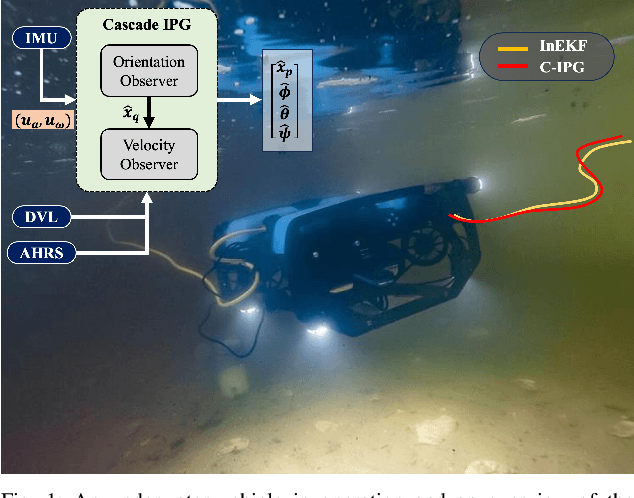
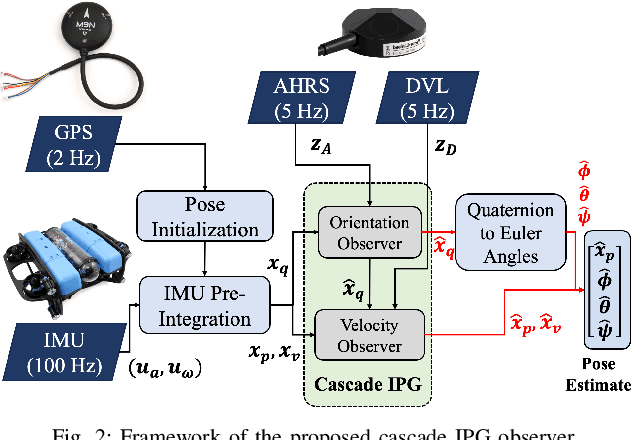
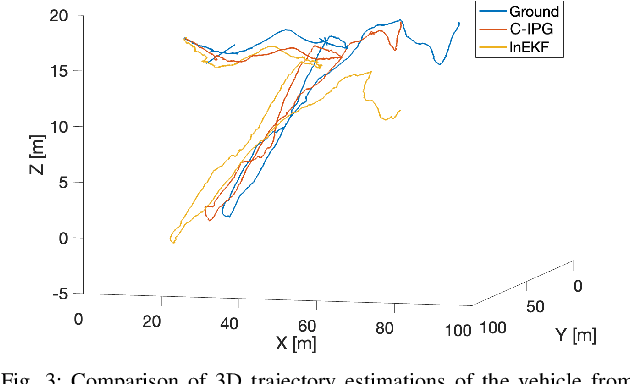

This paper presents a novel cascade nonlinear observer framework for inertial state estimation. It tackles the problem of intermediate state estimation when external localization is unavailable or in the event of a sensor outage. The proposed observer comprises two nonlinear observers based on a recently developed iteratively preconditioned gradient descent (IPG) algorithm. It takes the inputs via an IMU preintegration model where the first observer is a quaternion-based IPG. The output for the first observer is the input for the second observer, estimating the velocity and, consequently, the position. The proposed observer is validated on a public underwater dataset and a real-world experiment using our robot platform. The estimation is compared with an extended Kalman filter (EKF) and an invariant extended Kalman filter (InEKF). Results demonstrate that our method outperforms these methods regarding better positional accuracy and lower variance.
3D Water Quality Mapping using Invariant Extended Kalman Filtering for Underwater Robot Localization
Sep 17, 2024Water quality mapping for critical parameters such as temperature, salinity, and turbidity is crucial for assessing an aquaculture farm's health and yield capacity. Traditional approaches involve using boats or human divers, which are time-constrained and lack depth variability. This work presents an innovative approach to 3D water quality mapping in shallow water environments using a BlueROV2 equipped with GPS and a water quality sensor. This system allows for accurate location correction by resurfacing when errors occur. This study is being conducted at an oyster farm in the Chesapeake Bay, USA, providing a more comprehensive and precise water quality analysis in aquaculture settings.
Performance Trade-off and Joint Waveform Design for MIMO-OFDM DFRC Systems
Jan 04, 2024Dual-functional radar-communication (DFRC) has attracted considerable attention. This paper considers the frequency-selective multipath fading environment and proposes DFRC waveform design strategies based on multiple-input and multiple-output (MIMO) and orthogonal frequency division multiplexing (OFDM) techniques. In the proposed waveform design strategies, the Cramer-Rao bound (CRB) of the radar system, the inter-stream interference (ISI) and the achievable rate of the communication system, are respectively considered as the performance metrics. In this paper, we focus on the performance trade-off between the radar system and the communication system, and the optimization problems are formulated. In the ISI minimization based waveform design strategy, the optimization problem is convex and can be easily solved. In the achievable rate maximization based waveform design strategy, we propose a water-filling (WF) and sequential quadratic programming (SQP) based algorithm to derive the covariance matrix and the precoding matrix. Simulation results validate the proposed DFRC waveform designs and show that the achievable rate maximization based strategy has a better performance than the ISI minimization based strategy.
Archiving Body Movements: Collective Generation of Chinese Calligraphy
Nov 27, 2023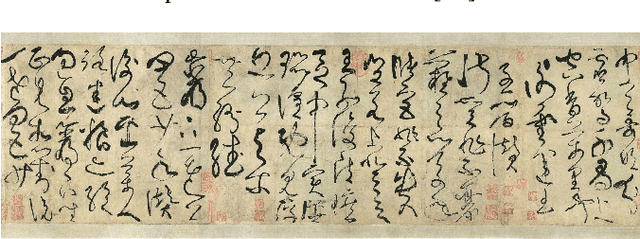
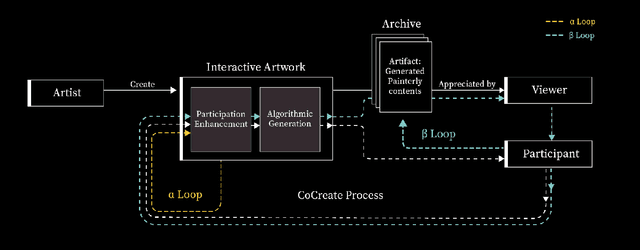
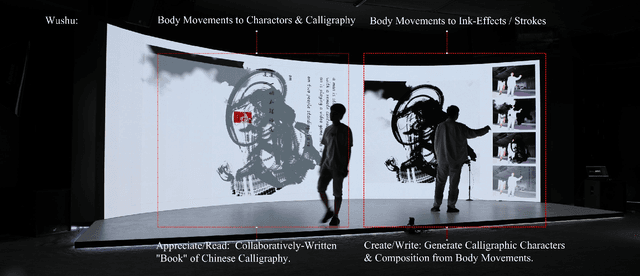
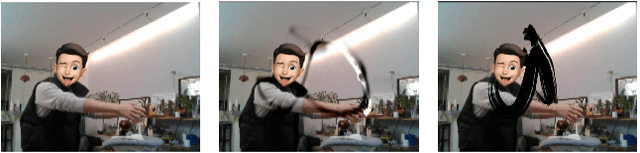
As a communication channel, body movements have been widely explored in behavioral studies and kinesics. Performing and visual arts share the same interests but focus on documenting and representing human body movements, such as for dance notation and visual work creation. This paper investigates body movements in oriental calligraphy and how to apply calligraphy principles to stimulate and archive body movements. Through an artwork (Wushu), the authors experiment with an interactive and generative approach to engage the audience's bodily participation and archive the body movements as a compendium of generated calligraphy. The audience assumes the role of both writers and readers; creating ("writing") and appreciating ("reading") the generated calligraphy becomes a cyclical process within this infinite "Book," which can motivate further attention and discussions concerning Chinese characters and calligraphy.
UIVNAV: Underwater Information-driven Vision-based Navigation via Imitation Learning
Sep 15, 2023Autonomous navigation in the underwater environment is challenging due to limited visibility, dynamic changes, and the lack of a cost-efficient accurate localization system. We introduce UIVNav, a novel end-to-end underwater navigation solution designed to drive robots over Objects of Interest (OOI) while avoiding obstacles, without relying on localization. UIVNav uses imitation learning and is inspired by the navigation strategies used by human divers who do not rely on localization. UIVNav consists of the following phases: (1) generating an intermediate representation (IR), and (2) training the navigation policy based on human-labeled IR. By training the navigation policy on IR instead of raw data, the second phase is domain-invariant -- the navigation policy does not need to be retrained if the domain or the OOI changes. We show this by deploying the same navigation policy for surveying two different OOIs, oyster and rock reefs, in two different domains, simulation, and a real pool. We compared our method with complete coverage and random walk methods which showed that our method is more efficient in gathering information for OOIs while also avoiding obstacles. The results show that UIVNav chooses to visit the areas with larger area sizes of oysters or rocks with no prior information about the environment or localization. Moreover, a robot using UIVNav compared to complete coverage method surveys on average 36% more oysters when traveling the same distances. We also demonstrate the feasibility of real-time deployment of UIVNavin pool experiments with BlueROV underwater robot for surveying a bed of oyster shells.
Iteratively Preconditioned Gradient-Descent Approach for Moving Horizon Estimation Problems
Jun 22, 2023
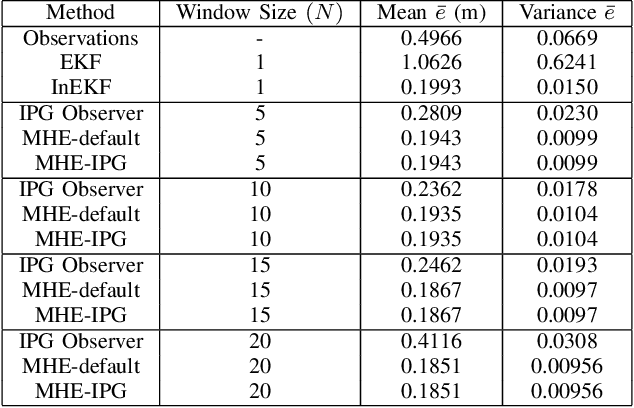
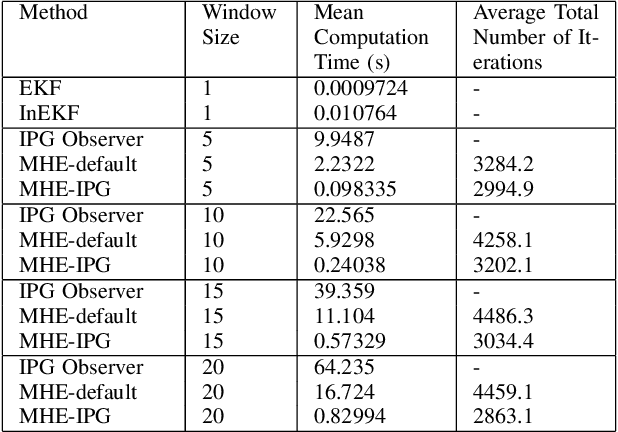
Moving horizon estimation (MHE) is a widely studied state estimation approach in several practical applications. In the MHE problem, the state estimates are obtained via the solution of an approximated nonlinear optimization problem. However, this optimization step is known to be computationally complex. Given this limitation, this paper investigates the idea of iteratively preconditioned gradient-descent (IPG) to solve MHE problem with the aim of an improved performance than the existing solution techniques. To our knowledge, the preconditioning technique is used for the first time in this paper to reduce the computational cost and accelerate the crucial optimization step for MHE. The convergence guarantee of the proposed iterative approach for a class of MHE problems is presented. Additionally, sufficient conditions for the MHE problem to be convex are also derived. Finally, the proposed method is implemented on a unicycle localization example. The simulation results demonstrate that the proposed approach can achieve better accuracy with reduced computational costs.