 Add to Chrome
 Add to Firefox
 Add to Edge
A Unifying Framework for Concept-Based Representational Similarity
Jun 08, 2026
Learned representations across models and modalities often exhibit striking structural similarities, suggesting shared underlying concept decompositions. However, concept alignment remains poorly defined: existing approaches optimize different objectives under the same terminology, obscuring what is actually aligned. We propose a unifying framework that decomposes alignment along two axes: what is aligned (representations vs. concepts) and at what level (instance-wise vs. distributional). This induces four corresponding properties -- instance-wise and distributional variants of translation and concept consistency -- and reveals precisely which of these guarantees existing methods provide. We further introduce \InterVenchA, an intervention-based benchmark that separately measures extraction quality, translation quality, and concept consistency. Through theory and experiments, we show that commonly assumed equivalences between alignment objectives fail in practice: optimizing one property does not reliably recover the others, and purely unsupervised objectives fail to recover meaningful instance-level alignment. We then propose the Coupled Sparse Autoencoder (CoSAE), which jointly enforces complementary alignment objectives. Strong alignment emerges only in this regime. Surprisingly, as little as 0.1\% paired data is sufficient to recover instance-level alignment when anchoring distributional objectives. Overall, our results show that concept alignment is fundamentally multi-objective: it must be defined, measured, and optimized as such.

Not Too Generative, Not Too Discriminative: The Human Alignment Sweet Spot
May 22, 2026A central question in computational vision is whether human-like visual representations are better explained by discriminative or generative learning. Existing comparisons, however, often confound the learning objective with architecture, scale, and training data, leaving open whether the objective itself drives alignment. We address this confound using Joint Energy-Based Models (JEMs), which interpolate continuously between discriminative and generative training within a fixed architecture. By varying a single mixing coefficient, we isolate the effect of the learning objective and evaluate the resulting models across six human-alignment benchmarks spanning perceptual similarity, gloss perception, human response uncertainty, robustness, shape-texture cue conflict, and diagnostic feature attribution. Across this diverse suite, human alignment is consistently maximized at intermediate points of the generative-discriminative continuum, rather than at either endpoint. Hybrid JEMs combine the categorical structure induced by discriminative learning with the sensitivity to input structure induced by generative learning, yielding more human-like behavior across multiple levels of vision. These results suggest that the generative-discriminative dichotomy is the wrong axis for understanding human-aligned vision: alignment emerges not from choosing one objective over the other, but from balancing both.
Cross-Modal Redundancy and the Geometry of Vision-Language Embeddings
Feb 05, 2026Vision-language models (VLMs) align images and text with remarkable success, yet the geometry of their shared embedding space remains poorly understood. To probe this geometry, we begin from the Iso-Energy Assumption, which exploits cross-modal redundancy: a concept that is truly shared should exhibit the same average energy across modalities. We operationalize this assumption with an Aligned Sparse Autoencoder (SAE) that encourages energy consistency during training while preserving reconstruction. We find that this inductive bias changes the SAE solution without harming reconstruction, giving us a representation that serves as a tool for geometric analysis. Sanity checks on controlled data with known ground truth confirm that alignment improves when Iso-Energy holds and remains neutral when it does not. Applied to foundational VLMs, our framework reveals a clear structure with practical consequences: (i) sparse bimodal atoms carry the entire cross-modal alignment signal; (ii) unimodal atoms act as modality-specific biases and fully explain the modality gap; (iii) removing unimodal atoms collapses the gap without harming performance; (iv) restricting vector arithmetic to the bimodal subspace yields in-distribution edits and improved retrieval. These findings suggest that the right inductive bias can both preserve model fidelity and render the latent geometry interpretable and actionable.
Follow the Energy, Find the Path: Riemannian Metrics from Energy-Based Models
May 23, 2025What is the shortest path between two data points lying in a high-dimensional space? While the answer is trivial in Euclidean geometry, it becomes significantly more complex when the data lies on a curved manifold -- requiring a Riemannian metric to describe the space's local curvature. Estimating such a metric, however, remains a major challenge in high dimensions. In this work, we propose a method for deriving Riemannian metrics directly from pretrained Energy-Based Models (EBMs) -- a class of generative models that assign low energy to high-density regions. These metrics define spatially varying distances, enabling the computation of geodesics -- shortest paths that follow the data manifold's intrinsic geometry. We introduce two novel metrics derived from EBMs and show that they produce geodesics that remain closer to the data manifold and exhibit lower curvature distortion, as measured by alignment with ground-truth trajectories. We evaluate our approach on increasingly complex datasets: synthetic datasets with known data density, rotated character images with interpretable geometry, and high-resolution natural images embedded in a pretrained VAE latent space. Our results show that EBM-derived metrics consistently outperform established baselines, especially in high-dimensional settings. Our work is the first to derive Riemannian metrics from EBMs, enabling data-aware geodesics and unlocking scalable, geometry-driven learning for generative modeling and simulation.
Deep Sturm--Liouville: From Sample-Based to 1D Regularization with Learnable Orthogonal Basis Functions
Apr 09, 2025Although Artificial Neural Networks (ANNs) have achieved remarkable success across various tasks, they still suffer from limited generalization. We hypothesize that this limitation arises from the traditional sample-based (0--dimensionnal) regularization used in ANNs. To overcome this, we introduce \textit{Deep Sturm--Liouville} (DSL), a novel function approximator that enables continuous 1D regularization along field lines in the input space by integrating the Sturm--Liouville Theorem (SLT) into the deep learning framework. DSL defines field lines traversing the input space, along which a Sturm--Liouville problem is solved to generate orthogonal basis functions, enforcing implicit regularization thanks to the desirable properties of SLT. These basis functions are linearly combined to construct the DSL approximator. Both the vector field and basis functions are parameterized by neural networks and learned jointly. We demonstrate that the DSL formulation naturally arises when solving a Rank-1 Parabolic Eigenvalue Problem. DSL is trained efficiently using stochastic gradient descent via implicit differentiation. DSL achieves competitive performance and demonstrate improved sample efficiency on diverse multivariate datasets including high-dimensional image datasets such as MNIST and CIFAR-10.
Archetypal SAE: Adaptive and Stable Dictionary Learning for Concept Extraction in Large Vision Models
Feb 18, 2025Sparse Autoencoders (SAEs) have emerged as a powerful framework for machine learning interpretability, enabling the unsupervised decomposition of model representations into a dictionary of abstract, human-interpretable concepts. However, we reveal a fundamental limitation: existing SAEs exhibit severe instability, as identical models trained on similar datasets can produce sharply different dictionaries, undermining their reliability as an interpretability tool. To address this issue, we draw inspiration from the Archetypal Analysis framework introduced by Cutler & Breiman (1994) and present Archetypal SAEs (A-SAE), wherein dictionary atoms are constrained to the convex hull of data. This geometric anchoring significantly enhances the stability of inferred dictionaries, and their mildly relaxed variants RA-SAEs further match state-of-the-art reconstruction abilities. To rigorously assess dictionary quality learned by SAEs, we introduce two new benchmarks that test (i) plausibility, if dictionaries recover "true" classification directions and (ii) identifiability, if dictionaries disentangle synthetic concept mixtures. Across all evaluations, RA-SAEs consistently yield more structured representations while uncovering novel, semantically meaningful concepts in large-scale vision models.
ConSim: Measuring Concept-Based Explanations' Effectiveness with Automated Simulatability
Jan 13, 2025
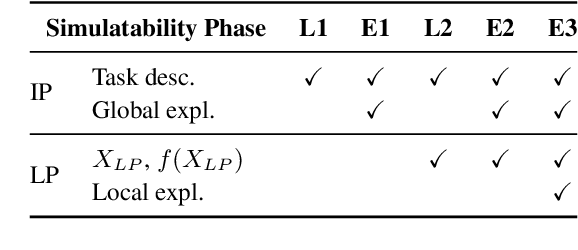
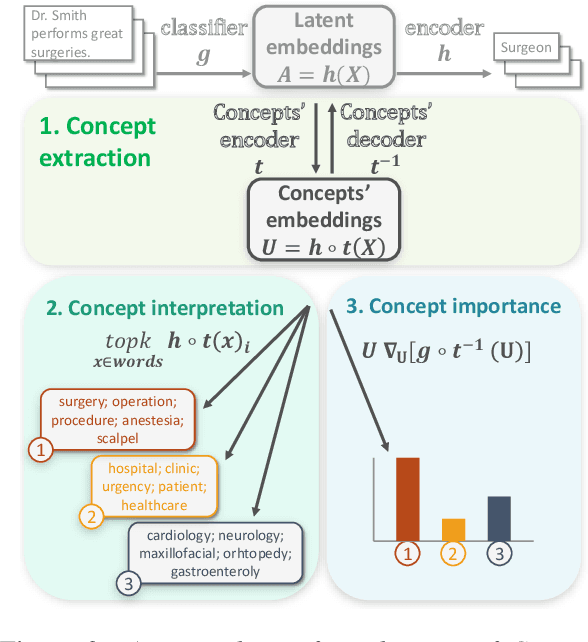
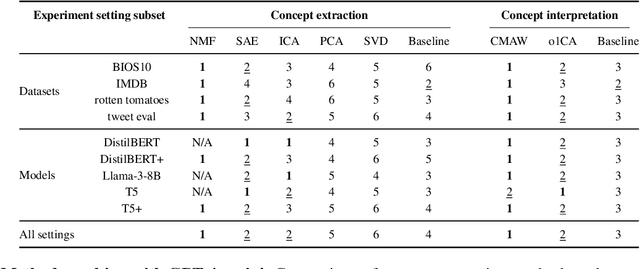
Concept-based explanations work by mapping complex model computations to human-understandable concepts. Evaluating such explanations is very difficult, as it includes not only the quality of the induced space of possible concepts but also how effectively the chosen concepts are communicated to users. Existing evaluation metrics often focus solely on the former, neglecting the latter. We introduce an evaluation framework for measuring concept explanations via automated simulatability: a simulator's ability to predict the explained model's outputs based on the provided explanations. This approach accounts for both the concept space and its interpretation in an end-to-end evaluation. Human studies for simulatability are notoriously difficult to enact, particularly at the scale of a wide, comprehensive empirical evaluation (which is the subject of this work). We propose using large language models (LLMs) as simulators to approximate the evaluation and report various analyses to make such approximations reliable. Our method allows for scalable and consistent evaluation across various models and datasets. We report a comprehensive empirical evaluation using this framework and show that LLMs provide consistent rankings of explanation methods. Code available at https://github.com/AnonymousConSim/ConSim.
Local vs distributed representations: What is the right basis for interpretability?
Nov 06, 2024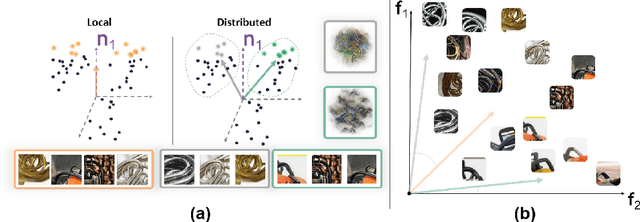
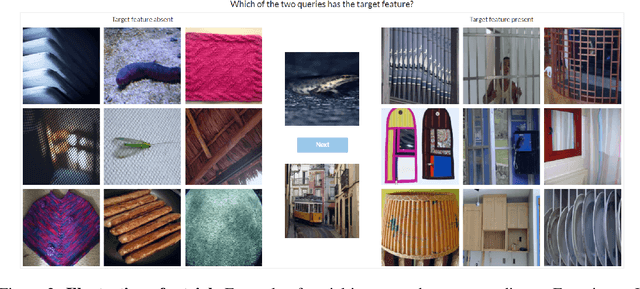
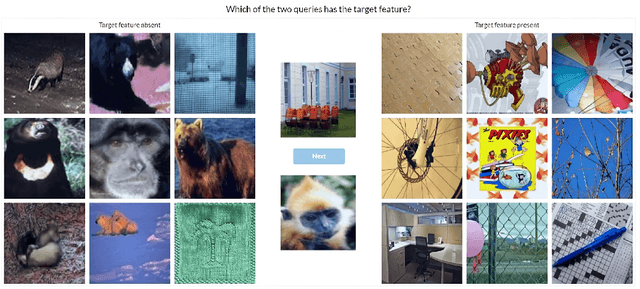
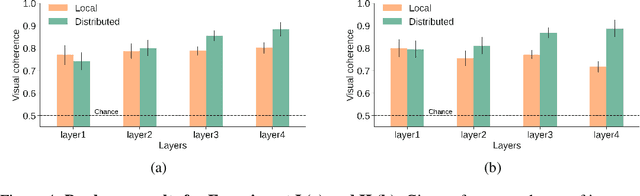
Much of the research on the interpretability of deep neural networks has focused on studying the visual features that maximally activate individual neurons. However, recent work has cast doubts on the usefulness of such local representations for understanding the behavior of deep neural networks because individual neurons tend to respond to multiple unrelated visual patterns, a phenomenon referred to as "superposition". A promising alternative to disentangle these complex patterns is learning sparsely distributed vector representations from entire network layers, as the resulting basis vectors seemingly encode single identifiable visual patterns consistently. Thus, one would expect the resulting code to align better with human perceivable visual patterns, but supporting evidence remains, at best, anecdotal. To fill this gap, we conducted three large-scale psychophysics experiments collected from a pool of 560 participants. Our findings provide (i) strong evidence that features obtained from sparse distributed representations are easier to interpret by human observers and (ii) that this effect is more pronounced in the deepest layers of a neural network. Complementary analyses also reveal that (iii) features derived from sparse distributed representations contribute more to the model's decision. Overall, our results highlight that distributed representations constitute a superior basis for interpretability, underscoring a need for the field to move beyond the interpretation of local neural codes in favor of sparsely distributed ones.
Latent Representation Matters: Human-like Sketches in One-shot Drawing Tasks
Jun 10, 2024Humans can effortlessly draw new categories from a single exemplar, a feat that has long posed a challenge for generative models. However, this gap has started to close with recent advances in diffusion models. This one-shot drawing task requires powerful inductive biases that have not been systematically investigated. Here, we study how different inductive biases shape the latent space of Latent Diffusion Models (LDMs). Along with standard LDM regularizers (KL and vector quantization), we explore supervised regularizations (including classification and prototype-based representation) and contrastive inductive biases (using SimCLR and redundancy reduction objectives). We demonstrate that LDMs with redundancy reduction and prototype-based regularizations produce near-human-like drawings (regarding both samples' recognizability and originality) -- better mimicking human perception (as evaluated psychophysically). Overall, our results suggest that the gap between humans and machines in one-shot drawings is almost closed.
Unlocking Feature Visualization for Deeper Networks with MAgnitude Constrained Optimization
Jun 11, 2023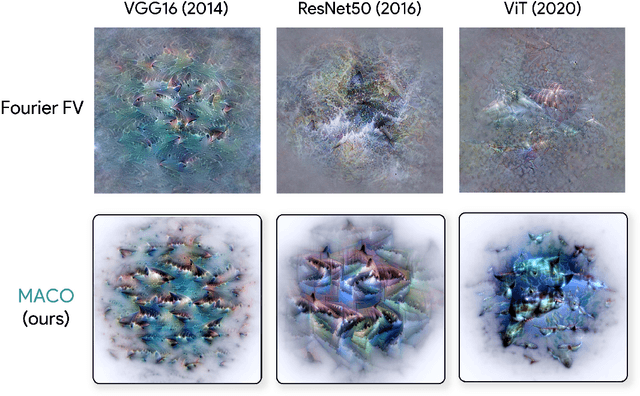
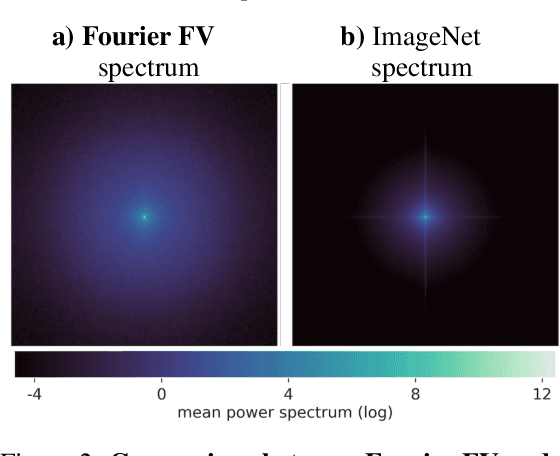

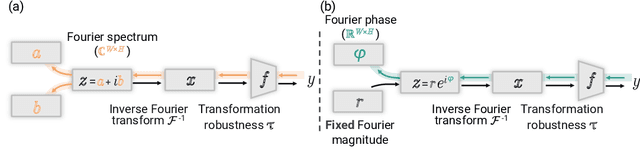
Feature visualization has gained substantial popularity, particularly after the influential work by Olah et al. in 2017, which established it as a crucial tool for explainability. However, its widespread adoption has been limited due to a reliance on tricks to generate interpretable images, and corresponding challenges in scaling it to deeper neural networks. Here, we describe MACO, a simple approach to address these shortcomings. The main idea is to generate images by optimizing the phase spectrum while keeping the magnitude constant to ensure that generated explanations lie in the space of natural images. Our approach yields significantly better results (both qualitatively and quantitatively) and unlocks efficient and interpretable feature visualizations for large state-of-the-art neural networks. We also show that our approach exhibits an attribution mechanism allowing us to augment feature visualizations with spatial importance. We validate our method on a novel benchmark for comparing feature visualization methods, and release its visualizations for all classes of the ImageNet dataset on https://serre-lab.github.io/Lens/. Overall, our approach unlocks, for the first time, feature visualizations for large, state-of-the-art deep neural networks without resorting to any parametric prior image model.