 Add to Chrome
 Add to Firefox
 Add to Edge
LiST: Lipschitz Scaling Training for Robust and Calibrated Neural Networks
Jul 08, 2026
While accuracy, robustness, and calibration are all essential for reliable neural networks, they are often studied separately; developing models that satisfy all three simultaneously remains a central challenge. Lipschitz-constrained models guarantee robustness by design, yet the manual selection of the Lipschitz constraint L governs the resulting accuracy-robustness trade-off, and their calibration properties remain largely underexplored. In this work, we highlight a theoretical and empirical link between the enforced Lipschitz constraint and Temperature Scaling, a state-of-the-art calibration method. Specifically, we find that for a given training scheme, there exists a non-trivial value L* that yields an out-of-the-box calibrated network, and that calibration acts as a principled criterion to select a well-defined operating point on the accuracy-robustness Pareto front. Leveraging these insights, we introduce Lipschitz Scaling Training (LiST), a novel training paradigm that iteratively adjusts the global Lipschitz constant to reach this operating point. Through a margin parameter in the training loss, LiST further enables the construction of a fully calibrated Pareto front, allowing users to navigate the accuracy-robustness trade-off while remaining calibrated throughout. At convergence, LiST also enables the reintegration of calibration data into training, improving sample efficiency without sacrificing calibration. We validate LiST on CIFAR-10/100 and Tiny-ImageNet, demonstrating competitive accuracy and robustness against constrained and unconstrained baselines, while remaining calibrated out of the box. Code is available at GitHub.

LipSSD: Lipschitz-Constrained Single-Shot Detection for Adversarially Robust Object Detection
Jul 06, 2026Object detectors have many applications in safety-critical systems, but they are known to be sensitive to worst-case perturbations such as adversarial attacks, which limits their applicability in real-world scenarios. Compared with classification, adversarial robustness for object detection has received less attention, and existing methods are often tied to adversarial training, whose performance may not transfer across attacks, perturbation budgets, or architectures. In this work, we introduce Lipschitz-constrained variants of object detection architectures as robust-by-design alternatives to standard detectors. We validate this approach with LipSSD, a Lipschitz-constrained Single Shot MultiBox Detector (SSD), and provide a comprehensive study of its adversarial robustness using multiple white-box adversarial attacks and datasets. We first analyze the accuracyrobustness trade-off induced by Lipschitz constraints and show that it can be controlled through a single training hyperparameter. We then demonstrate that Lipschitzconstrained detectors are complementary to adversarial training: under the same training setup on the Pascal VOC dataset, adversarially trained LipSSD improves mAP@50 on unseen attacks by up to 15 points over classical adversarially trained SSD. Finally, we use more specific safety-critical datasets such as LARD and KITTI, and show that Lipschitz-constrained detectors can improve robustness while largely preserving clean performance. These results suggest that architectural Lipschitz control is a practical and attack-agnostic direction for improving the robustness of object detectors.
Orthogonium : A Unified, Efficient Library of Orthogonal and 1-Lipschitz Building Blocks
Jan 20, 2026Orthogonal and 1-Lipschitz neural network layers are essential building blocks in robust deep learning architectures, crucial for certified adversarial robustness, stable generative models, and reliable recurrent networks. Despite significant advancements, existing implementations remain fragmented, limited, and computationally demanding. To address these issues, we introduce Orthogonium , a unified, efficient, and comprehensive PyTorch library providing orthogonal and 1-Lipschitz layers. Orthogonium provides access to standard convolution features-including support for strides, dilation, grouping, and transposed-while maintaining strict mathematical guarantees. Its optimized implementations reduce overhead on large scale benchmarks such as ImageNet. Moreover, rigorous testing within the library has uncovered critical errors in existing implementations, emphasizing the importance of standardized and reliable tools. Orthogonium thus significantly lowers adoption barriers, enabling scalable experimentation and integration across diverse applications requiring orthogonality and robust Lipschitz constraints. Orthogonium is available at https://github.com/deel-ai/orthogonium.
Efficient Robust Conformal Prediction via Lipschitz-Bounded Networks
Jun 05, 2025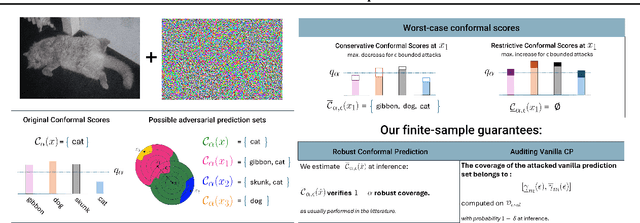
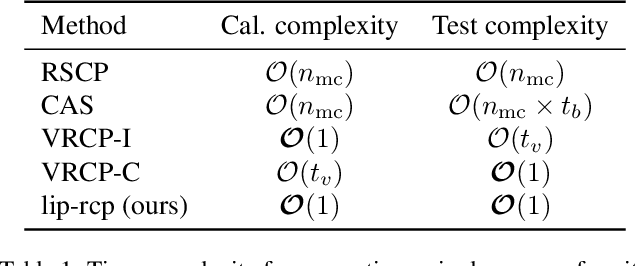
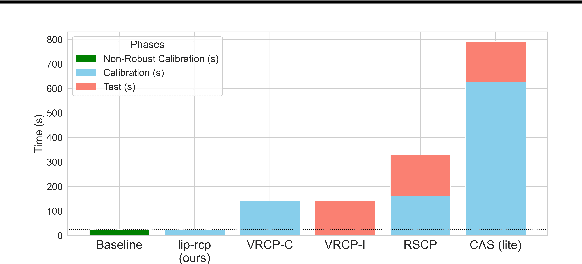
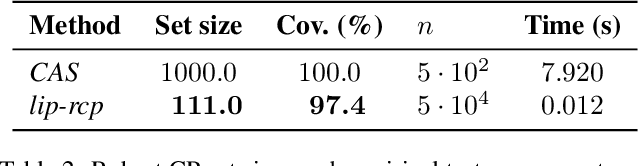
Conformal Prediction (CP) has proven to be an effective post-hoc method for improving the trustworthiness of neural networks by providing prediction sets with finite-sample guarantees. However, under adversarial attacks, classical conformal guarantees do not hold anymore: this problem is addressed in the field of Robust Conformal Prediction. Several methods have been proposed to provide robust CP sets with guarantees under adversarial perturbations, but, for large scale problems, these sets are either too large or the methods are too computationally demanding to be deployed in real life scenarios. In this work, we propose a new method that leverages Lipschitz-bounded networks to precisely and efficiently estimate robust CP sets. When combined with a 1-Lipschitz robust network, we demonstrate that our lip-rcp method outperforms state-of-the-art results in both the size of the robust CP sets and computational efficiency in medium and large-scale scenarios such as ImageNet. Taking a different angle, we also study vanilla CP under attack, and derive new worst-case coverage bounds of vanilla CP sets, which are valid simultaneously for all adversarial attack levels. Our lip-rcp method makes this second approach as efficient as vanilla CP while also allowing robustness guarantees.
An Adaptive Orthogonal Convolution Scheme for Efficient and Flexible CNN Architectures
Jan 14, 2025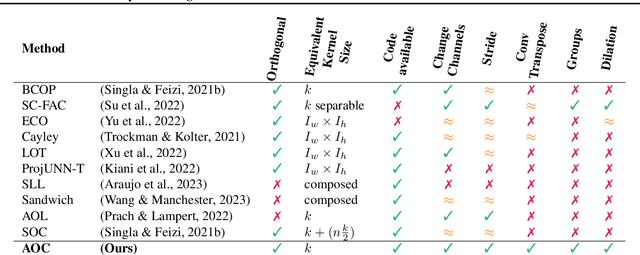
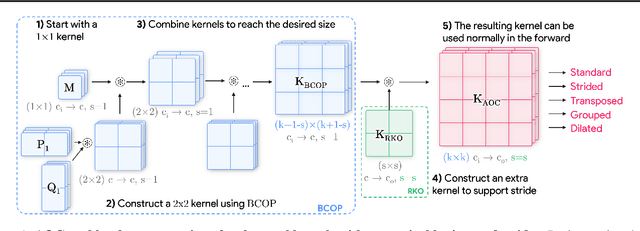
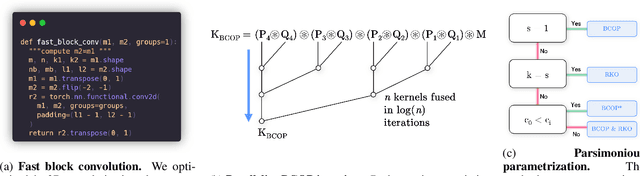
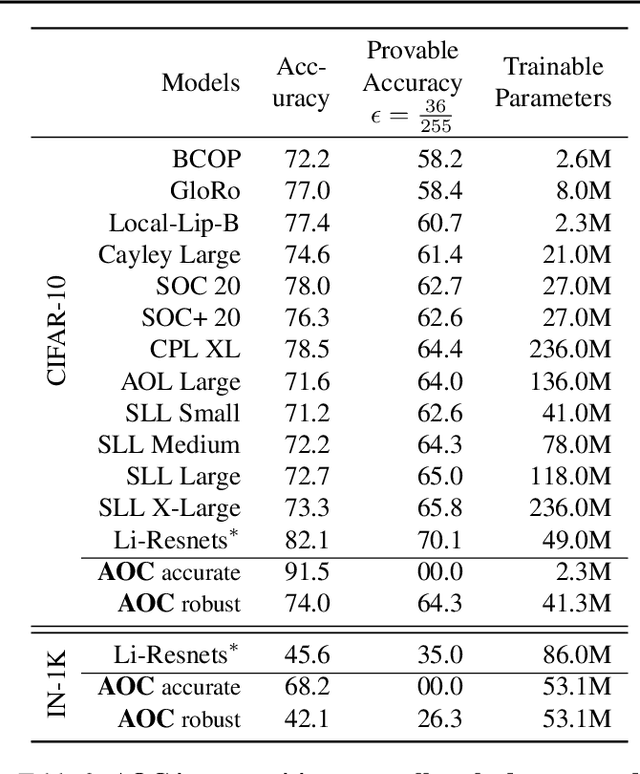
Orthogonal convolutional layers are the workhorse of multiple areas in machine learning, such as adversarial robustness, normalizing flows, GANs, and Lipschitzconstrained models. Their ability to preserve norms and ensure stable gradient propagation makes them valuable for a large range of problems. Despite their promise, the deployment of orthogonal convolution in large-scale applications is a significant challenge due to computational overhead and limited support for modern features like strides, dilations, group convolutions, and transposed convolutions.In this paper, we introduce AOC (Adaptative Orthogonal Convolution), a scalable method for constructing orthogonal convolutions, effectively overcoming these limitations. This advancement unlocks the construction of architectures that were previously considered impractical. We demonstrate through our experiments that our method produces expressive models that become increasingly efficient as they scale. To foster further advancement, we provide an open-source library implementing this method, available at https://github.com/thib-s/orthogonium.
How to design a dataset compliant with an ML-based system ODD?
Jun 20, 2024This paper focuses on a Vision-based Landing task and presents the design and the validation of a dataset that would comply with the Operational Design Domain (ODD) of a Machine-Learning (ML) system. Relying on emerging certification standards, we describe the process for establishing ODDs at both the system and image levels. In the process, we present the translation of high-level system constraints into actionable image-level properties, allowing for the definition of verifiable Data Quality Requirements (DQRs). To illustrate this approach, we use the Landing Approach Runway Detection (LARD) dataset which combines synthetic imagery and real footage, and we focus on the steps required to verify the DQRs. The replicable framework presented in this paper addresses the challenges of designing a dataset compliant with the stringent needs of ML-based systems certification in safety-critical applications.
Quantized Approximately Orthogonal Recurrent Neural Networks
Feb 05, 2024


Orthogonal recurrent neural networks (ORNNs) are an appealing option for learning tasks involving time series with long-term dependencies, thanks to their simplicity and computational stability. However, these networks often require a substantial number of parameters to perform well, which can be prohibitive in power-constrained environments, such as compact devices. One approach to address this issue is neural network quantization. The construction of such networks remains an open problem, acknowledged for its inherent instability.In this paper, we explore the quantization of the recurrent and input weight matrices in ORNNs, leading to Quantized approximately Orthogonal RNNs (QORNNs). We investigate one post-training quantization (PTQ) strategy and three quantization-aware training (QAT) algorithms that incorporate orthogonal constraints and quantized weights. Empirical results demonstrate the advantages of employing QAT over PTQ. The most efficient model achieves results similar to state-of-the-art full-precision ORNN and LSTM on a variety of standard benchmarks, even with 3-bits quantization.
DP-SGD Without Clipping: The Lipschitz Neural Network Way
May 25, 2023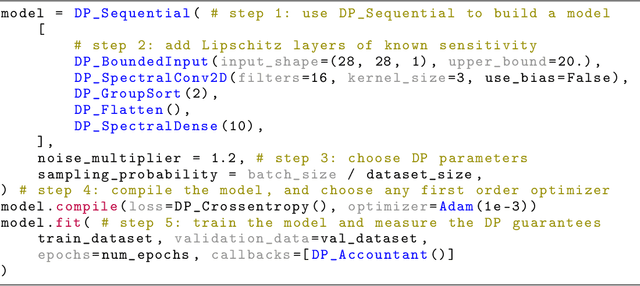


State-of-the-art approaches for training Differentially Private (DP) Deep Neural Networks (DNN) faces difficulties to estimate tight bounds on the sensitivity of the network's layers, and instead rely on a process of per-sample gradient clipping. This clipping process not only biases the direction of gradients but also proves costly both in memory consumption and in computation. To provide sensitivity bounds and bypass the drawbacks of the clipping process, our theoretical analysis of Lipschitz constrained networks reveals an unexplored link between the Lipschitz constant with respect to their input and the one with respect to their parameters. By bounding the Lipschitz constant of each layer with respect to its parameters we guarantee DP training of these networks. This analysis not only allows the computation of the aforementioned sensitivities at scale but also provides leads on to how maximize the gradient-to-noise ratio for fixed privacy guarantees. To facilitate the application of Lipschitz networks and foster robust and certifiable learning under privacy guarantees, we provide a Python package that implements building blocks allowing the construction and private training of such networks.
When adversarial attacks become interpretable counterfactual explanations
Jun 14, 2022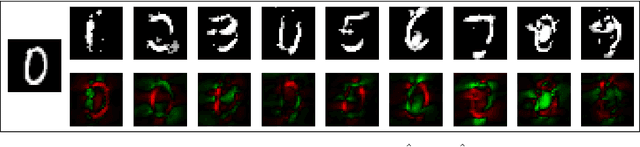
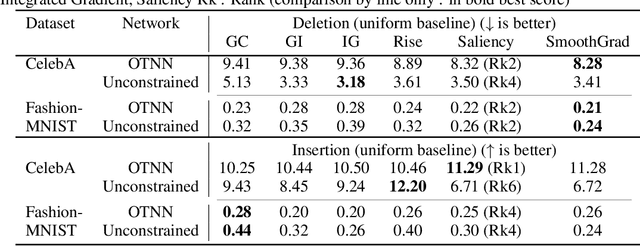
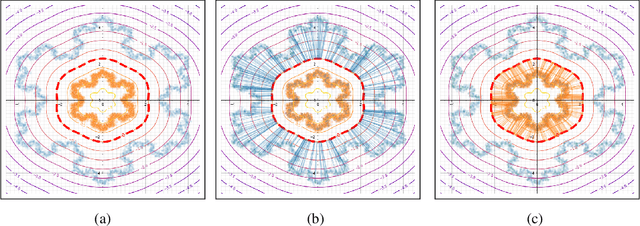
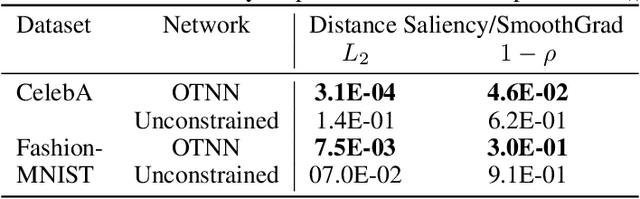
We argue that, when learning a 1-Lipschitz neural network with the dual loss of an optimal transportation problem, the gradient of the model is both the direction of the transportation plan and the direction to the closest adversarial attack. Traveling along the gradient to the decision boundary is no more an adversarial attack but becomes a counterfactual explanation, explicitly transporting from one class to the other. Through extensive experiments on XAI metrics, we find that the simple saliency map method, applied on such networks, becomes a reliable explanation, and outperforms the state-of-the-art explanation approaches on unconstrained models. The proposed networks were already known to be certifiably robust, and we prove that they are also explainable with a fast and simple method.
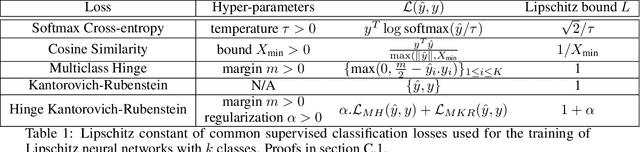
The Many Faces of 1-Lipschitz Neural Networks
Apr 13, 2021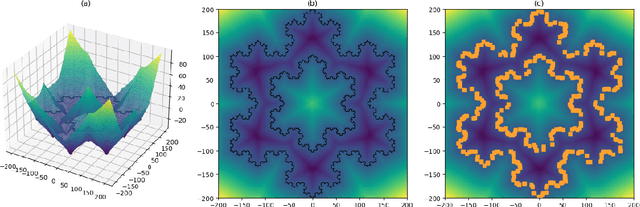
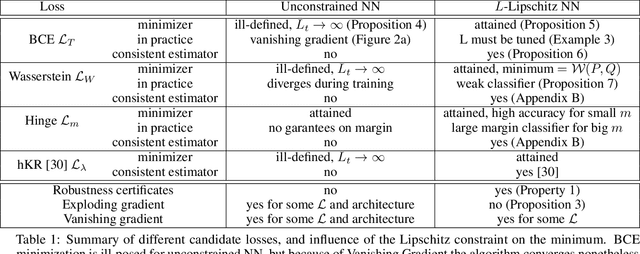
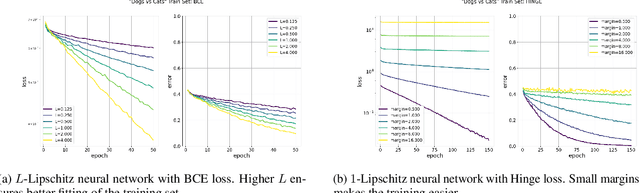
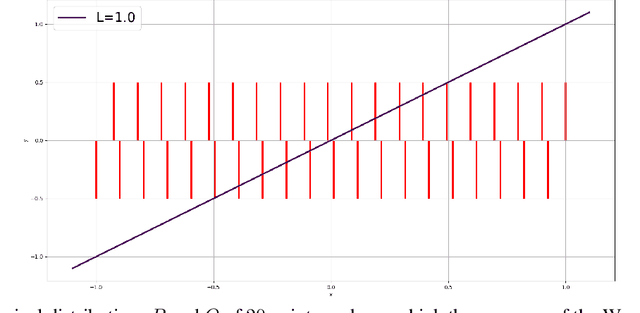
Lipschitz constrained models have been used to solve specifics deep learning problems such as the estimation of Wasserstein distance for GAN, or the training of neural networks robust to adversarial attacks. Regardless the novel and effective algorithms to build such 1-Lipschitz networks, their usage remains marginal, and they are commonly considered as less expressive and less able to fit properly the data than their unconstrained counterpart. The goal of the paper is to demonstrate that, despite being empirically harder to train, 1-Lipschitz neural networks are theoretically better grounded than unconstrained ones when it comes to classification. To achieve that we recall some results about 1-Lipschitz function in the scope of deep learning and we extend and illustrate them to derive general properties for classification. First, we show that 1-Lipschitz neural network can fit arbitrarily difficult frontier making them as expressive as classical ones. When minimizing the log loss, we prove that the optimization problem under Lipschitz constraint is well posed and have a minimum, whereas regular neural networks can diverge even on remarkably simple situations. Then, we study the link between classification with 1-Lipschitz network and optimal transport thanks to regularized versions of Kantorovich-Rubinstein duality theory. Last, we derive preliminary bounds on their VC dimension.