 Add to Chrome
 Add to Firefox
 Add to Edge
P-JEPA: Procedural Video Representation Learning via Joint Embedding Predictive Architecture
Jun 22, 2026
The increasing maturity of embodied AI platforms has driven a growing interest in procedural video representation learning to support intelligent assistance systems for complex, multi-step tasks. Leveraging large-scale latent predictive training, video foundation models capture video dynamics, enabling downstream tasks such as activity understanding, spatiotemporal localization, and predictive control. However, procedural videos include actions with long-range dependencies that these models do not support, due to the quadratic complexity of self-attention. Distinct actions, for example, may be visually similar despite appearing at different points in the procedure, such as turning the stove on versus off. Here, we propose a backbone-agnostic approach that learns long-duration video representations by reducing the problem to a dense, frame-aligned action space and predicting pooled masked latent vectors. This approach allows our Procedural Joint Embedding Predictive Architecture (P-JEPA) to ingest videos over 30 minutes long, enabling effective long-form understanding of procedural steps. We evaluate P-JEPA using features extracted with VJEPA2.1, TSM, and I3D over the EgoExo4D, EgoProceL, and Assembly101 datasets, finding that it consistently improves linear separability, streaming inference, and temporal action segmentation performance, achieving state-of-the-art results on EgoExo4D fine-grained action classification while using an order of magnitude fewer parameters than LLM-based methods and running in real time.

Prompting Diffusion Models for Zero-Shot Instance Segmentation
Jun 21, 2026Several disruptive research directions have recently emerged in computer vision, including foundation models achieving previously unseen zero-shot performance in scene understanding, even interactively, and generative models that synthesize extremely realistic images. The latter have also been shown to be highly effective in scene understanding tasks thanks to their rich priors. However, for promptable segmentation, foundation models struggle with accurately segmenting an object's region, leading to false positives and over-segmentation. Notably, early attempts that leverage generative priors use prompts only during post-processing, yielding suboptimal segments because the process is agnostic to the user input. In this paper, we target these limitations with Prompt2Seg, a spatial conditioning framework for diffusion-based segmentation. Prompt2Seg augments a frozen diffusion segmentation model with a conditioning branch. Our approach takes spatial prompts, represented as 2D Gaussians or confidence maps, as explicit input signals, training the model to respond directly to user intent. Fine-tuned on a deliberately constrained set of object categories drawn from Hypersim and Virtual KITTI 2, Prompt2Seg generalizes zero-shot to a wide range of unseen object types and visual domains. We evaluate on seven datasets ranging from standard benchmarks to more challenging domains, including paintings, egocentric views, and X-ray data. Furthermore, we demonstrate that Prompt2Seg consistently outperforms the underlying diffusion segmentation backbone across all benchmarks. Our results suggest that the rich priors encoded in generative pretraining, combined with principled spatial conditioning, offer a compelling path toward broadly generalizing interactive segmentation without large-scale mask supervision.
Future Dynamic 3D Reconstruction: A 3D World Model with Disentangled Ego-Motion
Jun 16, 2026Forecasting the evolution of dynamic environments is crucial for autonomous agents. While generative world models have recently achieved high photorealism in 2D video synthesis by mixing ego-motion and environmental dynamics within the image plane, they exhibit physical inconsistencies, such as morphing or vanishing objects, especially over long time horizons. In this paper, we propose FR3D, a world model that predicts a persistent 3D latent representation for future dynamic 3D reconstruction. Unlike prior works that treat the world as a sequence of image-based features, FR3D explicitly decouples the 3D evolution of the scene from the agent's trajectory, treating the inferred ego-motion as a latent proxy for action. This disentanglement resolves the ambiguities between self-motion and world-motion, ensuring geometric consistency into the future. Furthermore, we introduce a teacher-student distillation strategy that leverages the spatial "common sense" of off-the-shelf foundation models, leading to robust zero-shot generalization. Extensive experiments demonstrate FR3D's strong performance for future dynamic 3D reconstruction from monocular observations across multiple datasets, even 2 seconds into the future. Project page: https://fr3d-wm.github.io.
SA4Depth: Consistent Pose-Depth Scale Alignment for Self-Supervised Monocular Depth Estimation
May 27, 2026Self-supervised depth estimation from monocular sequences relies on the joint learning of a depth and a pose network. Despite abundant research done to improve the depth network, efforts on the pose remain limited. In this context, even when depth is estimated up to scale, we highlight the importance of the alignment between the scene scales estimated by the pose and depth nets. Then, we introduce SA4Depth, an approach to improve this alignment and boost the depth predictions while keeping the inference time unchanged. Our proposed method uses the depth estimated during training to reproject learnable visual features across consecutive frames and refine the pose estimates by reducing feature alignment residuals. With our method, the estimated scene scales by the separate depth and pose networks are aligned, and the prediction scale consistency is improved across different sequences. Our differentiable refinement integrates seamlessly into existing self-supervised pipelines and substantially improves their depth estimates. We demonstrate this with extensive experiments both outdoors and indoors on KITTI, Cityscapes, and NYUv2. Additionally, results on KITTI Odometry confirm the effectiveness of our pose refinement. Our code is available at https://github.com/Runningchauncey/SA4Depth .
OpenGaFF: Open-Vocabulary Gaussian Feature Field with Codebook Attention
May 07, 2026Understanding open-vocabulary 3D scenes with Gaussian-based representations remains challenging due to fragmented and spatially inconsistent semantic predictions across multi-view observations. In this paper, we present OpenGaFF, a novel framework for open-vocabulary 3D scene understanding built upon 3D Gaussian Splatting. At the core of our method is a Gaussian Feature Field that models semantics as a continuous function of Gaussian geometry and appearance. By explicitly conditioning semantic predictions on geometric structure, this formulation strengthens the coupling between geometry and semantics, leading to improved spatial coherence across similar structures in 3D space. To further enforce object-level semantic consistency, we introduce a structured codebook that serves as a set of shared semantic primitives. Furthermore, a codebook-guided attention mechanism is proposed to retrieve language features via similarity matching between query embeddings and learned codebook entries, enabling robust open-vocabulary reasoning while reducing intra-object feature variance. Extensive experiments on standard 2D and 3D open-vocabulary benchmarks demonstrate that our method consistently outperforms prior approaches, achieving improved segmentation quality, stronger 3D semantic consistency and a semantically interpretable codebook that provides insight into the learned representation.
GALA: Guided Attention with Language Alignment for Open Vocabulary Gaussian Splatting
Aug 21, 2025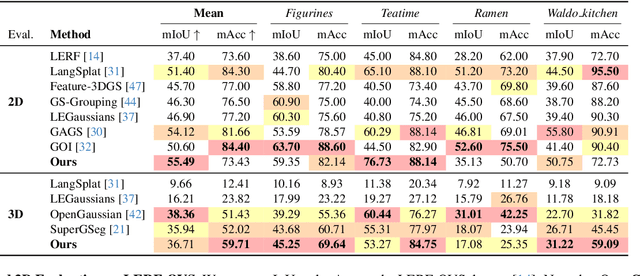
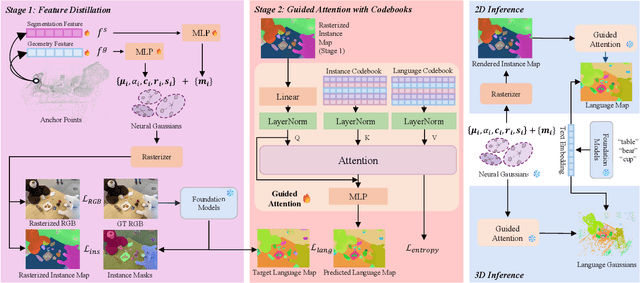
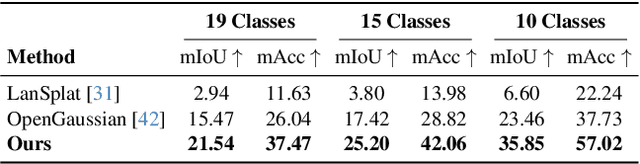
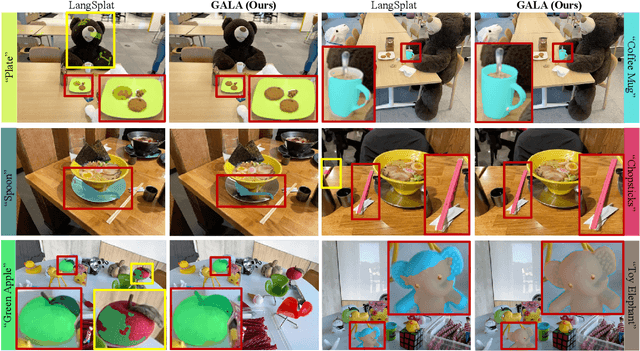
3D scene reconstruction and understanding have gained increasing popularity, yet existing methods still struggle to capture fine-grained, language-aware 3D representations from 2D images. In this paper, we present GALA, a novel framework for open-vocabulary 3D scene understanding with 3D Gaussian Splatting (3DGS). GALA distills a scene-specific 3D instance feature field via self-supervised contrastive learning. To extend to generalized language feature fields, we introduce the core contribution of GALA, a cross-attention module with two learnable codebooks that encode view-independent semantic embeddings. This design not only ensures intra-instance feature similarity but also supports seamless 2D and 3D open-vocabulary queries. It reduces memory consumption by avoiding per-Gaussian high-dimensional feature learning. Extensive experiments on real-world datasets demonstrate GALA's remarkable open-vocabulary performance on both 2D and 3D.
Prior2Former -- Evidential Modeling of Mask Transformers for Assumption-Free Open-World Panoptic Segmentation
Apr 07, 2025In panoptic segmentation, individual instances must be separated within semantic classes. As state-of-the-art methods rely on a pre-defined set of classes, they struggle with novel categories and out-of-distribution (OOD) data. This is particularly problematic in safety-critical applications, such as autonomous driving, where reliability in unseen scenarios is essential. We address the gap between outstanding benchmark performance and reliability by proposing Prior2Former (P2F), the first approach for segmentation vision transformers rooted in evidential learning. P2F extends the mask vision transformer architecture by incorporating a Beta prior for computing model uncertainty in pixel-wise binary mask assignments. This design enables high-quality uncertainty estimation that effectively detects novel and OOD objects enabling state-of-the-art anomaly instance segmentation and open-world panoptic segmentation. Unlike most segmentation models addressing unknown classes, P2F operates without access to OOD data samples or contrastive training on void (i.e., unlabeled) classes, making it highly applicable in real-world scenarios where such prior information is unavailable. Additionally, P2F can be flexibly applied to anomaly instance and panoptic segmentation. Through comprehensive experiments on the Cityscapes, COCO, SegmentMeIfYouCan, and OoDIS datasets, we demonstrate the state-of-the-art performance of P2F. It achieves the highest ranking in the OoDIS anomaly instance benchmark among methods not using OOD data in any way.
From Open-Vocabulary to Vocabulary-Free Semantic Segmentation
Feb 17, 2025Open-vocabulary semantic segmentation enables models to identify novel object categories beyond their training data. While this flexibility represents a significant advancement, current approaches still rely on manually specified class names as input, creating an inherent bottleneck in real-world applications. This work proposes a Vocabulary-Free Semantic Segmentation pipeline, eliminating the need for predefined class vocabularies. Specifically, we address the chicken-and-egg problem where users need knowledge of all potential objects within a scene to identify them, yet the purpose of segmentation is often to discover these objects. The proposed approach leverages Vision-Language Models to automatically recognize objects and generate appropriate class names, aiming to solve the challenge of class specification and naming quality. Through extensive experiments on several public datasets, we highlight the crucial role of the text encoder in model performance, particularly when the image text classes are paired with generated descriptions. Despite the challenges introduced by the sensitivity of the segmentation text encoder to false negatives within the class tagging process, which adds complexity to the task, we demonstrate that our fully automated pipeline significantly enhances vocabulary-free segmentation accuracy across diverse real-world scenarios.
SuperGSeg: Open-Vocabulary 3D Segmentation with Structured Super-Gaussians
Dec 13, 2024

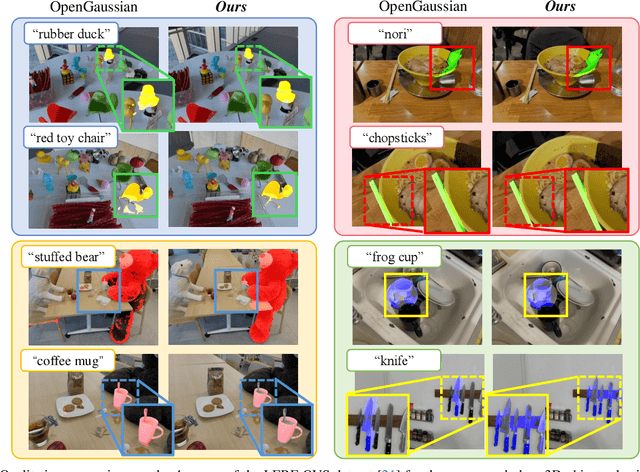
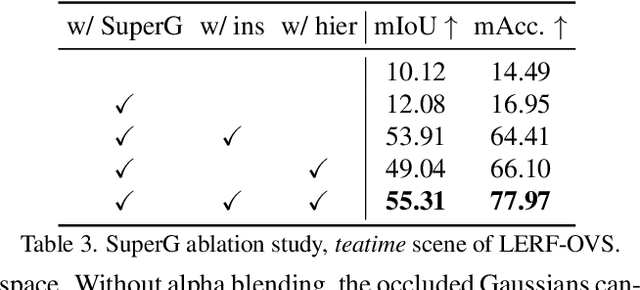
3D Gaussian Splatting has recently gained traction for its efficient training and real-time rendering. While the vanilla Gaussian Splatting representation is mainly designed for view synthesis, more recent works investigated how to extend it with scene understanding and language features. However, existing methods lack a detailed comprehension of scenes, limiting their ability to segment and interpret complex structures. To this end, We introduce SuperGSeg, a novel approach that fosters cohesive, context-aware scene representation by disentangling segmentation and language field distillation. SuperGSeg first employs neural Gaussians to learn instance and hierarchical segmentation features from multi-view images with the aid of off-the-shelf 2D masks. These features are then leveraged to create a sparse set of what we call Super-Gaussians. Super-Gaussians facilitate the distillation of 2D language features into 3D space. Through Super-Gaussians, our method enables high-dimensional language feature rendering without extreme increases in GPU memory. Extensive experiments demonstrate that SuperGSeg outperforms prior works on both open-vocabulary object localization and semantic segmentation tasks.
Zero123-6D: Zero-shot Novel View Synthesis for RGB Category-level 6D Pose Estimation
Mar 21, 2024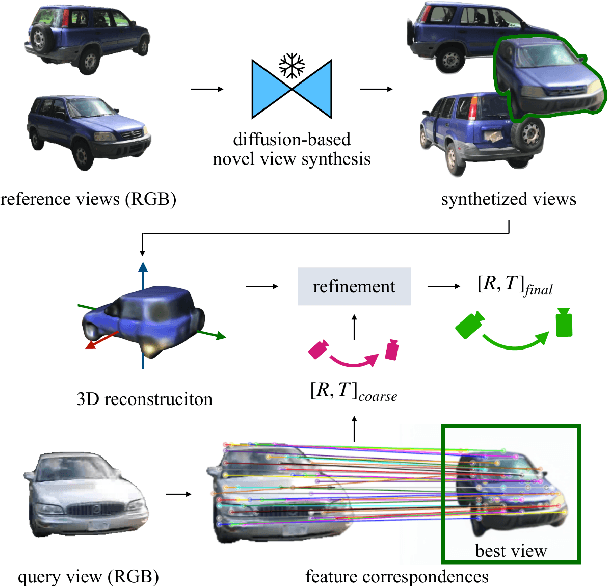
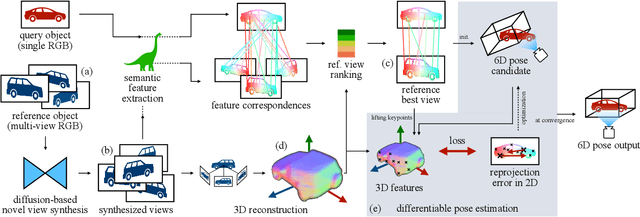
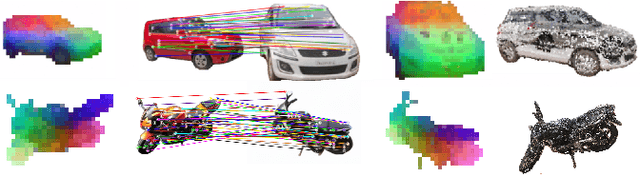
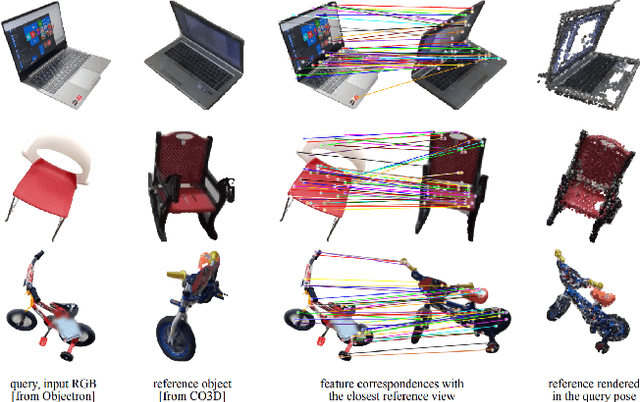
Estimating the pose of objects through vision is essential to make robotic platforms interact with the environment. Yet, it presents many challenges, often related to the lack of flexibility and generalizability of state-of-the-art solutions. Diffusion models are a cutting-edge neural architecture transforming 2D and 3D computer vision, outlining remarkable performances in zero-shot novel-view synthesis. Such a use case is particularly intriguing for reconstructing 3D objects. However, localizing objects in unstructured environments is rather unexplored. To this end, this work presents Zero123-6D to demonstrate the utility of Diffusion Model-based novel-view-synthesizers in enhancing RGB 6D pose estimation at category-level by integrating them with feature extraction techniques. The outlined method exploits such a novel view synthesizer to expand a sparse set of RGB-only reference views for the zero-shot 6D pose estimation task. Experiments are quantitatively analyzed on the CO3D dataset, showcasing increased performance over baselines, a substantial reduction in data requirements, and the removal of the necessity of depth information.