 Add to Chrome
 Add to Firefox
 Add to Edge
VOLA: Improving Open-World Driving by VLM-Based Semantic Attribute Prediction
Aug 12, 2026
Driving in the real world is open-world: a car may encounter a fallen mattress, a deer, or other objects outside its training data. Naming them is not enough. The system must know how to treat each region: can it drive over it, and how severe would a collision be? We therefore shift scene perception from category labels to dense action-relevant attributes, where each pixel is labeled by how it should affect motion rather than by object name. We instantiate this general formulation with two ordered attributes: 7-rank drivability and 5-rank vulnerability. We read Qwen3.5 image-token hidden states directly as a spatial semantic representation. A lightweight boundary-aware decoder then turns this coarse token grid into sharp full-resolution attribute maps. The whole process requires neither autoregressive text generation nor an external mask model such as SAM. We train on dense attribute labels built in CARLA and test transfer to real scenes and to novel obstacles never seen in training. We compare with vision-only segmenters trained on the same attributes and prompted VLM segmenters. Our model matches strong vision-only segmenters on familiar categories and improves transfer to real open-world anomalies, reaching 69.4% mean vulnerability-rank recall versus 57.1% for the best vision-only baseline and 53.9% for the best prompted VLM baseline. These results show that VLM image tokens provide useful semantic cues for transferring driving attributes to objects outside the training vocabulary.

Imagined Rollouts are Kinematic, Not Dynamic: A Diagnosis of Long-Horizon World-Model Failure
Jul 07, 2026Long-horizon failure in world models is conventionally attributed to compounding error, a generic framing that does not distinguish what kind of error compounds. We propose a kinematic-vs-dynamic reframing: world models tend to imagine kinematically rather than dynamically. We operationalize this as the imagined Kinematic-Consistency Error, a per-step diagnostic that measures how far a rollout departs from a closed-form kinematic null, paired with a perturbation protocol that tests whether iKCE responds when physical conditions cross a regime boundary. We instantiate the diagnostic on a released DreamerV3 checkpoint trained on DMC walker-walk, where imagined iKCE runs roughly two orders of magnitude above that of matched real-physics rollouts. Across a friction sweep that crosses the gait-collapse boundary, the model's iKCE stays statistically flat even as the trained policy's reward collapses through the same range, providing the kinematic-not-dynamic signature. The diagnostic distinguishes kinematic from dynamic imagination at horizons longer than the embodiment's gait period.
Smooth Piecewise Cutting for Neural Operator to Handle Discontinuities and Sharp Transitions
May 19, 2026Neural operators have achieved strong performance in learning solution operators of partial differential equations (PDEs), but their inherently continuous representations struggle to capture discontinuities and sharp transitions. Existing approaches typically approximate such features within continuous function spaces, often requiring increased model capacity and high-resolution data. In this work, we propose Cut-DeepONet, a two-stage training framework that explicitly models discontinuities while reducing learning complexity. Our approach reformulates the problem via a lifting strategy, partitioning the domain into smooth subregions while representing discontinuities as boundaries in a higher-dimensional space. This separation aligns the operator learning task with the inductive bias of neural networks and avoids directly approximating discontinuities. An additional network predicts input-dependent discontinuity locations for unseen inputs, which are then used to guide the neural operator in generating smooth components within each region. Experiments on benchmark PDEs show that Cut-DeepONet outperforms state-of-the-art methods, even when trained on low-resolution datasets. The method excels on problems with discontinuities and sharp transitions, while using fewer trainable parameters. Our results highlight the benefits of changing the representation of operator learning rather than increasing model complexity.
Amplified Patch-Level Differential Privacy for Free via Random Cropping
Mar 25, 2026Random cropping is one of the most common data augmentation techniques in computer vision, yet the role of its inherent randomness in training differentially private machine learning models has thus far gone unexplored. We observe that when sensitive content in an image is spatially localized, such as a face or license plate, random cropping can probabilistically exclude that content from the model's input. This introduces a third source of stochasticity in differentially private training with stochastic gradient descent, in addition to gradient noise and minibatch sampling. This additional randomness amplifies differential privacy without requiring changes to model architecture or training procedure. We formalize this effect by introducing a patch-level neighboring relation for vision data and deriving tight privacy bounds for differentially private stochastic gradient descent (DP-SGD) when combined with random cropping. Our analysis quantifies the patch inclusion probability and shows how it composes with minibatch sampling to yield a lower effective sampling rate. Empirically, we validate that patch-level amplification improves the privacy-utility trade-off across multiple segmentation architectures and datasets. Our results demonstrate that aligning privacy accounting with domain structure and additional existing sources of randomness can yield stronger guarantees at no additional cost.
* Published at TMLR
GeoDiffusion: A Training-Free Framework for Accurate 3D Geometric Conditioning in Image Generation
Oct 25, 2025Precise geometric control in image generation is essential for engineering \& product design and creative industries to control 3D object features accurately in image space. Traditional 3D editing approaches are time-consuming and demand specialized skills, while current image-based generative methods lack accuracy in geometric conditioning. To address these challenges, we propose GeoDiffusion, a training-free framework for accurate and efficient geometric conditioning of 3D features in image generation. GeoDiffusion employs a class-specific 3D object as a geometric prior to define keypoints and parametric correlations in 3D space. We ensure viewpoint consistency through a rendered image of a reference 3D object, followed by style transfer to meet user-defined appearance specifications. At the core of our framework is GeoDrag, improving accuracy and speed of drag-based image editing on geometry guidance tasks and general instructions on DragBench. Our results demonstrate that GeoDiffusion enables precise geometric modifications across various iterative design workflows.
Scalable Object Detection in the Car Interior With Vision Foundation Models
Aug 27, 2025
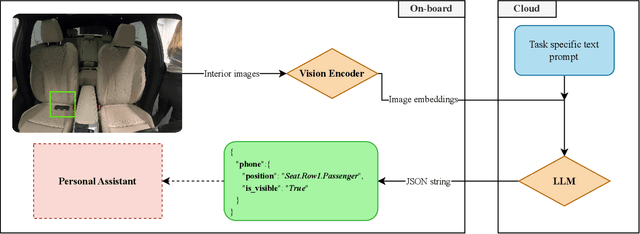
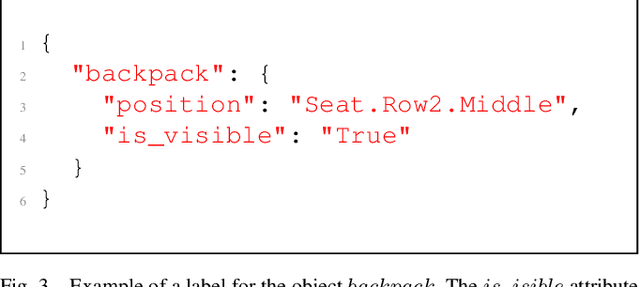
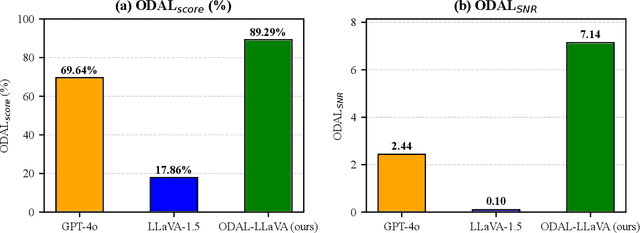
AI tasks in the car interior like identifying and localizing externally introduced objects is crucial for response quality of personal assistants. However, computational resources of on-board systems remain highly constrained, restricting the deployment of such solutions directly within the vehicle. To address this limitation, we propose the novel Object Detection and Localization (ODAL) framework for interior scene understanding. Our approach leverages vision foundation models through a distributed architecture, splitting computational tasks between on-board and cloud. This design overcomes the resource constraints of running foundation models directly in the car. To benchmark model performance, we introduce ODALbench, a new metric for comprehensive assessment of detection and localization.Our analysis demonstrates the framework's potential to establish new standards in this domain. We compare the state-of-the-art GPT-4o vision foundation model with the lightweight LLaVA 1.5 7B model and explore how fine-tuning enhances the lightweight models performance. Remarkably, our fine-tuned ODAL-LLaVA model achieves an ODAL$_{score}$ of 89%, representing a 71% improvement over its baseline performance and outperforming GPT-4o by nearly 20%. Furthermore, the fine-tuned model maintains high detection accuracy while significantly reducing hallucinations, achieving an ODAL$_{SNR}$ three times higher than GPT-4o.
Effective Data Pruning through Score Extrapolation
Jun 10, 2025Training advanced machine learning models demands massive datasets, resulting in prohibitive computational costs. To address this challenge, data pruning techniques identify and remove redundant training samples while preserving model performance. Yet, existing pruning techniques predominantly require a full initial training pass to identify removable samples, negating any efficiency benefits for single training runs. To overcome this limitation, we introduce a novel importance score extrapolation framework that requires training on only a small subset of data. We present two initial approaches in this framework - k-nearest neighbors and graph neural networks - to accurately predict sample importance for the entire dataset using patterns learned from this minimal subset. We demonstrate the effectiveness of our approach for 2 state-of-the-art pruning methods (Dynamic Uncertainty and TDDS), 4 different datasets (CIFAR-10, CIFAR-100, Places-365, and ImageNet), and 3 training paradigms (supervised, unsupervised, and adversarial). Our results indicate that score extrapolation is a promising direction to scale expensive score calculation methods, such as pruning, data attribution, or other tasks.
Prior2Former -- Evidential Modeling of Mask Transformers for Assumption-Free Open-World Panoptic Segmentation
Apr 07, 2025In panoptic segmentation, individual instances must be separated within semantic classes. As state-of-the-art methods rely on a pre-defined set of classes, they struggle with novel categories and out-of-distribution (OOD) data. This is particularly problematic in safety-critical applications, such as autonomous driving, where reliability in unseen scenarios is essential. We address the gap between outstanding benchmark performance and reliability by proposing Prior2Former (P2F), the first approach for segmentation vision transformers rooted in evidential learning. P2F extends the mask vision transformer architecture by incorporating a Beta prior for computing model uncertainty in pixel-wise binary mask assignments. This design enables high-quality uncertainty estimation that effectively detects novel and OOD objects enabling state-of-the-art anomaly instance segmentation and open-world panoptic segmentation. Unlike most segmentation models addressing unknown classes, P2F operates without access to OOD data samples or contrastive training on void (i.e., unlabeled) classes, making it highly applicable in real-world scenarios where such prior information is unavailable. Additionally, P2F can be flexibly applied to anomaly instance and panoptic segmentation. Through comprehensive experiments on the Cityscapes, COCO, SegmentMeIfYouCan, and OoDIS datasets, we demonstrate the state-of-the-art performance of P2F. It achieves the highest ranking in the OoDIS anomaly instance benchmark among methods not using OOD data in any way.
EmoGRACE: Aspect-based emotion analysis for social media data
Mar 19, 2025While sentiment analysis has advanced from sentence to aspect-level, i.e., the identification of concrete terms related to a sentiment, the equivalent field of Aspect-based Emotion Analysis (ABEA) is faced with dataset bottlenecks and the increased complexity of emotion classes in contrast to binary sentiments. This paper addresses these gaps, by generating a first ABEA training dataset, consisting of 2,621 English Tweets, and fine-tuning a BERT-based model for the ABEA sub-tasks of Aspect Term Extraction (ATE) and Aspect Emotion Classification (AEC). The dataset annotation process was based on the hierarchical emotion theory by Shaver et al. [1] and made use of group annotation and majority voting strategies to facilitate label consistency. The resulting dataset contained aspect-level emotion labels for Anger, Sadness, Happiness, Fear, and a None class. Using the new ABEA training dataset, the state-of-the-art ABSA model GRACE by Luo et al. [2] was fine-tuned for ABEA. The results reflected a performance plateau at an F1-score of 70.1% for ATE and 46.9% for joint ATE and AEC extraction. The limiting factors for model performance were broadly identified as the small training dataset size coupled with the increased task complexity, causing model overfitting and limited abilities to generalize well on new data.
Joint Out-of-Distribution Filtering and Data Discovery Active Learning
Mar 04, 2025As the data demand for deep learning models increases, active learning (AL) becomes essential to strategically select samples for labeling, which maximizes data efficiency and reduces training costs. Real-world scenarios necessitate the consideration of incomplete data knowledge within AL. Prior works address handling out-of-distribution (OOD) data, while another research direction has focused on category discovery. However, a combined analysis of real-world considerations combining AL with out-of-distribution data and category discovery remains unexplored. To address this gap, we propose Joint Out-of-distribution filtering and data Discovery Active learning (Joda) , to uniquely address both challenges simultaneously by filtering out OOD data before selecting candidates for labeling. In contrast to previous methods, we deeply entangle the training procedure with filter and selection to construct a common feature space that aligns known and novel categories while separating OOD samples. Unlike previous works, Joda is highly efficient and completely omits auxiliary models and training access to the unlabeled pool for filtering or selection. In extensive experiments on 18 configurations and 3 metrics, \ours{} consistently achieves the highest accuracy with the best class discovery to OOD filtering balance compared to state-of-the-art competitor approaches.