 Add to Chrome
 Add to Firefox
 Add to Edge
P-JEPA: Procedural Video Representation Learning via Joint Embedding Predictive Architecture
Jun 22, 2026
The increasing maturity of embodied AI platforms has driven a growing interest in procedural video representation learning to support intelligent assistance systems for complex, multi-step tasks. Leveraging large-scale latent predictive training, video foundation models capture video dynamics, enabling downstream tasks such as activity understanding, spatiotemporal localization, and predictive control. However, procedural videos include actions with long-range dependencies that these models do not support, due to the quadratic complexity of self-attention. Distinct actions, for example, may be visually similar despite appearing at different points in the procedure, such as turning the stove on versus off. Here, we propose a backbone-agnostic approach that learns long-duration video representations by reducing the problem to a dense, frame-aligned action space and predicting pooled masked latent vectors. This approach allows our Procedural Joint Embedding Predictive Architecture (P-JEPA) to ingest videos over 30 minutes long, enabling effective long-form understanding of procedural steps. We evaluate P-JEPA using features extracted with VJEPA2.1, TSM, and I3D over the EgoExo4D, EgoProceL, and Assembly101 datasets, finding that it consistently improves linear separability, streaming inference, and temporal action segmentation performance, achieving state-of-the-art results on EgoExo4D fine-grained action classification while using an order of magnitude fewer parameters than LLM-based methods and running in real time.

OR-Action: Multi-Role Video Understanding with Fine-Grained Actions
Jun 11, 2026Fine-grained understanding of operating room (OR) activity could enable workflow-aware assistance, yet remains difficult due to clutter, occlusions, and limited sensing. The prevailing approach to model this environment is scene graphs as an interpretable representation of OR interactions. Converting their frame-wise relational predictions into temporally extended, fine-grained actions however, is challenging without explicit temporal modeling. To enable a principled temporal evaluation of current OR understanding methods, we introduce the first action-centric benchmark built on a publicly available ego-exocentric OR dataset by defining a fine-grained, multi-role action taxonomy and generating dense action segments via distillation from ground-truth scene graph state changes. Experiments on this benchmark show that current scene graph prediction methods struggle to model temporal structure, even when adding explicit modeling through Graph Neural Networks. We therefore introduce a vision-only temporal model that outperforms graph-based methods significantly when using all available egocentric video as input. Building on this model we also introduce a novel multi- to single-view feature alignment strategy that improves single-view performance on multi-role action recognition, mitigating the need for extensive egocentric video capture. Benchmark and code will be released upon acceptance.
Multi-View 3D Instance Segmentation of Structural Anomalies for Enhanced Structural Inspection of Concrete Bridges
Jan 06, 2024For effective structural damage assessment, the instances of damages need to be localized in the world of a 3D model. Due to a lack of data, the detection of structural anomalies can currently not be directly learned and performed in 3D space. In this work, a three-stage approach is presented, which uses the good performance of detection models on image level to segment instances of anomalies in the 3D space. In the detection stage, semantic segmentation predictions are produced on image level. The mapping stage transfers the image-level prediction onto the respective point cloud. In the extraction stage, 3D anomaly instances are extracted from the segmented point cloud. Cloud contraction is used to transform cracks into their medial axis representation. For areal anomalies the bounding polygon is extracted by means of alpha shapes. The approach covers the classes crack, spalling, and corrosion and the three image-level segmentation models TopoCrack, nnU-Net, and DetectionHMA are compared. Granted a localization tolerance of 4cm, IoUs of over 90% can be achieved for crack and corrosion and 41% for spalling, which appears to be a specifically challenging class. Detection on instance-level measured in AP is about 45% for crack and spalling and 73% for corrosion.
Drawing the Same Bounding Box Twice? Coping Noisy Annotations in Object Detection with Repeated Labels
Sep 18, 2023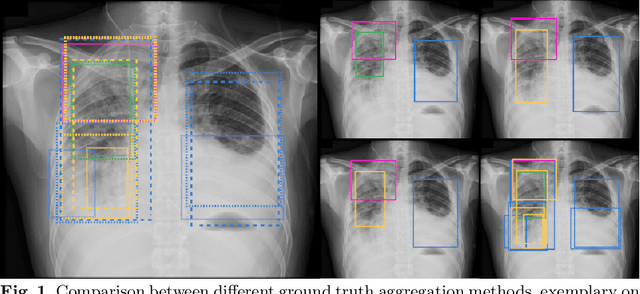
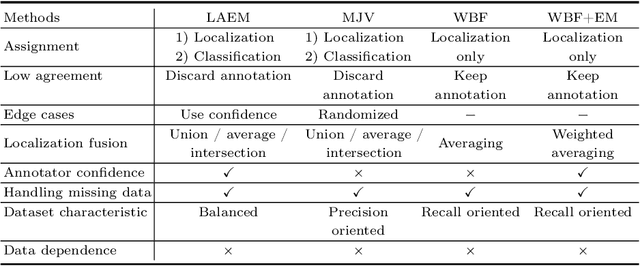
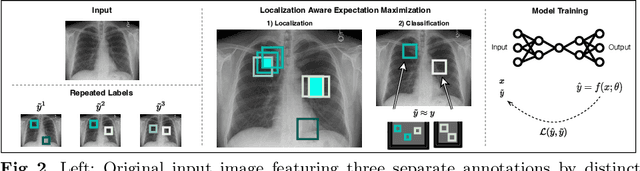
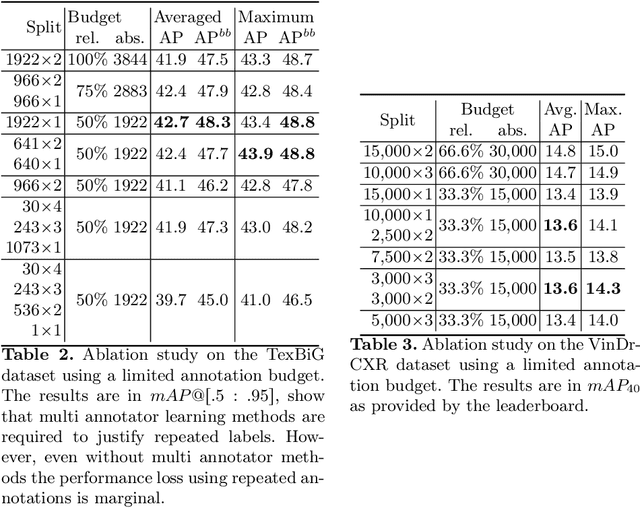
The reliability of supervised machine learning systems depends on the accuracy and availability of ground truth labels. However, the process of human annotation, being prone to error, introduces the potential for noisy labels, which can impede the practicality of these systems. While training with noisy labels is a significant consideration, the reliability of test data is also crucial to ascertain the dependability of the results. A common approach to addressing this issue is repeated labeling, where multiple annotators label the same example, and their labels are combined to provide a better estimate of the true label. In this paper, we propose a novel localization algorithm that adapts well-established ground truth estimation methods for object detection and instance segmentation tasks. The key innovation of our method lies in its ability to transform combined localization and classification tasks into classification-only problems, thus enabling the application of techniques such as Expectation-Maximization (EM) or Majority Voting (MJV). Although our main focus is the aggregation of unique ground truth for test data, our algorithm also shows superior performance during training on the TexBiG dataset, surpassing both noisy label training and label aggregation using Weighted Boxes Fusion (WBF). Our experiments indicate that the benefits of repeated labels emerge under specific dataset and annotation configurations. The key factors appear to be (1) dataset complexity, the (2) annotator consistency, and (3) the given annotation budget constraints.