 Add to Chrome
 Add to Firefox
 Add to Edge
Dink-Net: Neural Clustering on Large Graphs
May 31, 2023
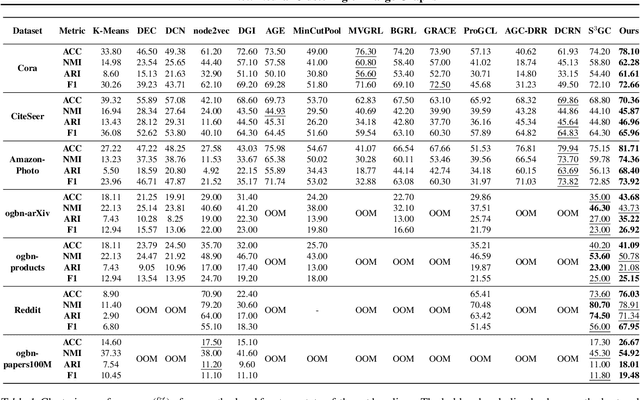

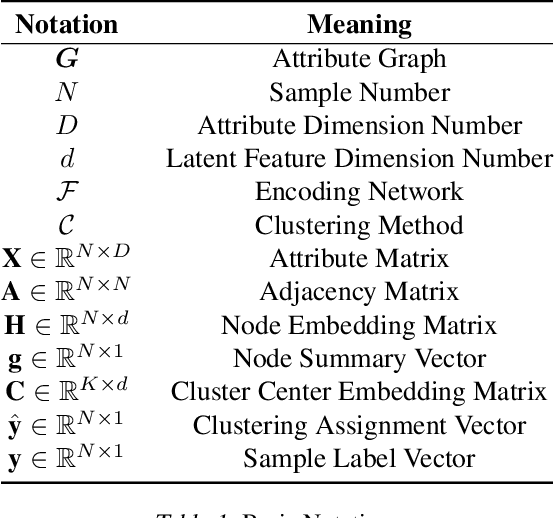

Deep graph clustering, which aims to group the nodes of a graph into disjoint clusters with deep neural networks, has achieved promising progress in recent years. However, the existing methods fail to scale to the large graph with million nodes. To solve this problem, a scalable deep graph clustering method (Dink-Net) is proposed with the idea of dilation and shrink. Firstly, by discriminating nodes, whether being corrupted by augmentations, representations are learned in a self-supervised manner. Meanwhile, the cluster centres are initialized as learnable neural parameters. Subsequently, the clustering distribution is optimized by minimizing the proposed cluster dilation loss and cluster shrink loss in an adversarial manner. By these settings, we unify the two-step clustering, i.e., representation learning and clustering optimization, into an end-to-end framework, guiding the network to learn clustering-friendly features. Besides, Dink-Net scales well to large graphs since the designed loss functions adopt the mini-batch data to optimize the clustering distribution even without performance drops. Both experimental results and theoretical analyses demonstrate the superiority of our method. Compared to the runner-up, Dink-Net achieves 9.62% NMI improvement on the ogbn-papers100M dataset with 111 million nodes and 1.6 billion edges. The source code is released at https://github.com/yueliu1999/Dink-Net. Besides, a collection (papers, codes, and datasets) of deep graph clustering is shared at https://github.com/yueliu1999/Awesome-Deep-Graph-Clustering.

Knowledge-Design: Pushing the Limit of Protein Deign via Knowledge Refinement
May 25, 2023Recent studies have shown competitive performance in protein design that aims to find the amino acid sequence folding into the desired structure. However, most of them disregard the importance of predictive confidence, fail to cover the vast protein space, and do not incorporate common protein knowledge. After witnessing the great success of pretrained models on diverse protein-related tasks and the fact that recovery is highly correlated with confidence, we wonder whether this knowledge can push the limits of protein design further. As a solution, we propose a knowledge-aware module that refines low-quality residues. We also introduce a memory-retrieval mechanism to save more than 50\% of the training time. We extensively evaluate our proposed method on the CATH, TS50, and TS500 datasets and our results show that our Knowledge-Design method outperforms the previous PiFold method by approximately 9\% on the CATH dataset. Specifically, Knowledge-Design is the first method that achieves 60+\% recovery on CATH, TS50 and TS500 benchmarks. We also provide additional analysis to demonstrate the effectiveness of our proposed method. The code will be publicly available.
MotifRetro: Exploring the Combinability-Consistency Trade-offs in retrosynthesis via Dynamic Motif Editing
May 20, 2023
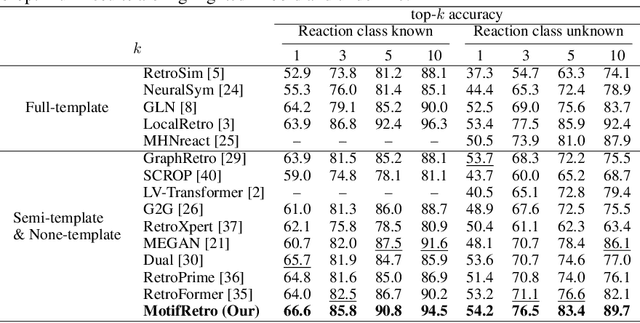
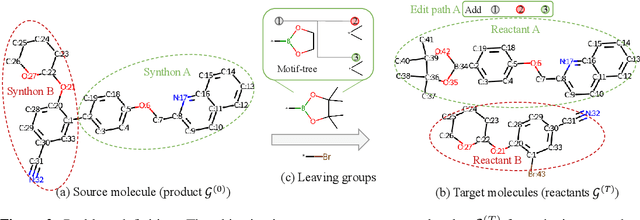
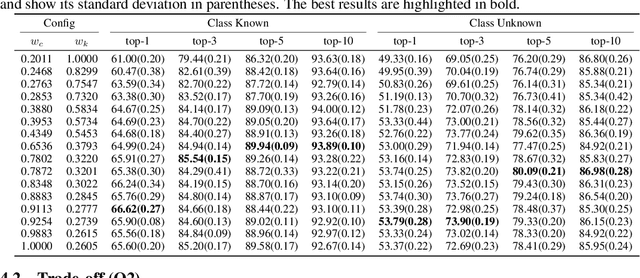
Is there a unified framework for graph-based retrosynthesis prediction? Through analysis of full-, semi-, and non-template retrosynthesis methods, we discovered that they strive to strike an optimal balance between combinability and consistency: \textit{Should atoms be combined as motifs to simplify the molecular editing process, or should motifs be broken down into atoms to reduce the vocabulary and improve predictive consistency?} Recent works have studied several specific cases, while none of them explores different combinability-consistency trade-offs. Therefore, we propose MotifRetro, a dynamic motif editing framework for retrosynthesis prediction that can explore the entire trade-off space and unify graph-based models. MotifRetro comprises two components: RetroBPE, which controls the combinability-consistency trade-off, and a motif editing model, where we introduce a novel LG-EGAT module to dynamiclly add motifs to the molecule. We conduct extensive experiments on USPTO-50K to explore how the trade-off affects the model performance and finally achieve state-of-the-art performance.
Extracting Low-/High- Frequency Knowledge from Graph Neural Networks and Injecting it into MLPs: An Effective GNN-to-MLP Distillation Framework
May 18, 2023Recent years have witnessed the great success of Graph Neural Networks (GNNs) in handling graph-related tasks. However, MLPs remain the primary workhorse for practical industrial applications due to their desirable inference efficiency and scalability. To reduce their gaps, one can directly distill knowledge from a well-designed teacher GNN to a student MLP, which is termed as GNN-to-MLP distillation. However, the process of distillation usually entails a loss of information, and ``which knowledge patterns of GNNs are more likely to be left and distilled into MLPs?" becomes an important question. In this paper, we first factorize the knowledge learned by GNNs into low- and high-frequency components in the spectral domain and then derive their correspondence in the spatial domain. Furthermore, we identified a potential information drowning problem for existing GNN-to-MLP distillation, i.e., the high-frequency knowledge of the pre-trained GNNs may be overwhelmed by the low-frequency knowledge during distillation; we have described in detail what it represents, how it arises, what impact it has, and how to deal with it. In this paper, we propose an efficient Full-Frequency GNN-to-MLP (FF-G2M) distillation framework, which extracts both low-frequency and high-frequency knowledge from GNNs and injects it into MLPs. Extensive experiments show that FF-G2M improves over the vanilla MLPs by 12.6% and outperforms its corresponding teacher GNNs by 2.6% averaged over six graph datasets and three common GNN architectures.
FM-ViT: Flexible Modal Vision Transformers for Face Anti-Spoofing
May 05, 2023The availability of handy multi-modal (i.e., RGB-D) sensors has brought about a surge of face anti-spoofing research. However, the current multi-modal face presentation attack detection (PAD) has two defects: (1) The framework based on multi-modal fusion requires providing modalities consistent with the training input, which seriously limits the deployment scenario. (2) The performance of ConvNet-based model on high fidelity datasets is increasingly limited. In this work, we present a pure transformer-based framework, dubbed the Flexible Modal Vision Transformer (FM-ViT), for face anti-spoofing to flexibly target any single-modal (i.e., RGB) attack scenarios with the help of available multi-modal data. Specifically, FM-ViT retains a specific branch for each modality to capture different modal information and introduces the Cross-Modal Transformer Block (CMTB), which consists of two cascaded attentions named Multi-headed Mutual-Attention (MMA) and Fusion-Attention (MFA) to guide each modal branch to mine potential features from informative patch tokens, and to learn modality-agnostic liveness features by enriching the modal information of own CLS token, respectively. Experiments demonstrate that the single model trained based on FM-ViT can not only flexibly evaluate different modal samples, but also outperforms existing single-modal frameworks by a large margin, and approaches the multi-modal frameworks introduced with smaller FLOPs and model parameters.
High-dimensional Clustering onto Hamiltonian Cycle
Apr 27, 2023

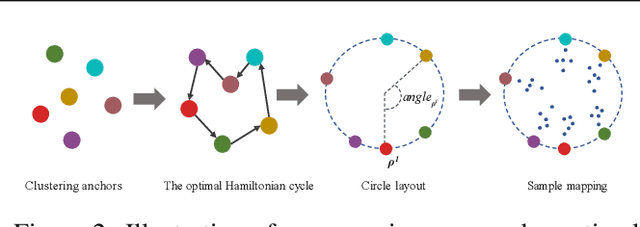

Clustering aims to group unlabelled samples based on their similarities. It has become a significant tool for the analysis of high-dimensional data. However, most of the clustering methods merely generate pseudo labels and thus are unable to simultaneously present the similarities between different clusters and outliers. This paper proposes a new framework called High-dimensional Clustering onto Hamiltonian Cycle (HCHC) to solve the above problems. First, HCHC combines global structure with local structure in one objective function for deep clustering, improving the labels as relative probabilities, to mine the similarities between different clusters while keeping the local structure in each cluster. Then, the anchors of different clusters are sorted on the optimal Hamiltonian cycle generated by the cluster similarities and mapped on the circumference of a circle. Finally, a sample with a higher probability of a cluster will be mapped closer to the corresponding anchor. In this way, our framework allows us to appreciate three aspects visually and simultaneously - clusters (formed by samples with high probabilities), cluster similarities (represented as circular distances), and outliers (recognized as dots far away from all clusters). The experiments illustrate the superiority of HCHC.
InstructBio: A Large-scale Semi-supervised Learning Paradigm for Biochemical Problems
Apr 14, 2023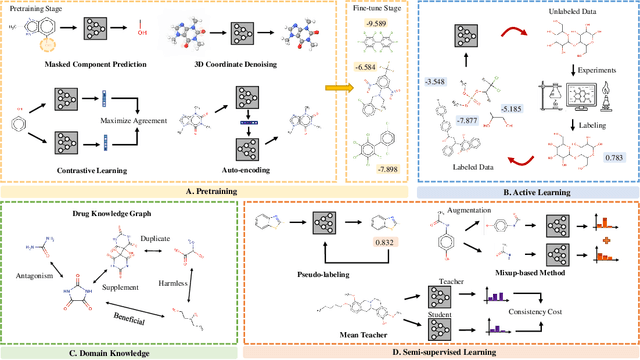
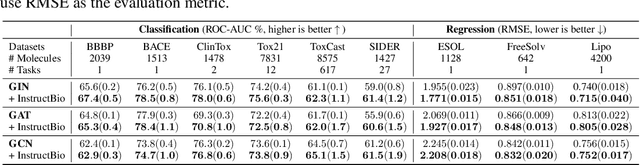
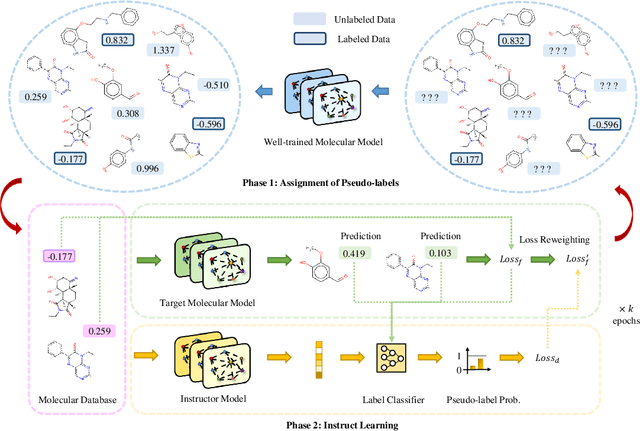
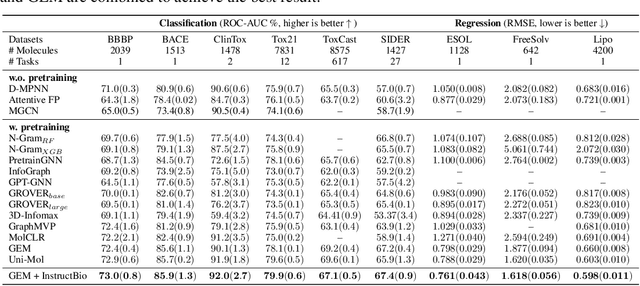
In the field of artificial intelligence for science, it is consistently an essential challenge to face a limited amount of labeled data for real-world problems. The prevailing approach is to pretrain a powerful task-agnostic model on a large unlabeled corpus but may struggle to transfer knowledge to downstream tasks. In this study, we propose InstructMol, a semi-supervised learning algorithm, to take better advantage of unlabeled examples. It introduces an instructor model to provide the confidence ratios as the measurement of pseudo-labels' reliability. These confidence scores then guide the target model to pay distinct attention to different data points, avoiding the over-reliance on labeled data and the negative influence of incorrect pseudo-annotations. Comprehensive experiments show that InstructBio substantially improves the generalization ability of molecular models, in not only molecular property predictions but also activity cliff estimations, demonstrating the superiority of the proposed method. Furthermore, our evidence indicates that InstructBio can be equipped with cutting-edge pretraining methods and used to establish large-scale and task-specific pseudo-labeled molecular datasets, which reduces the predictive errors and shortens the training process. Our work provides strong evidence that semi-supervised learning can be a promising tool to overcome the data scarcity limitation and advance molecular representation learning.
Towards Reasonable Budget Allocation in Untargeted Graph Structure Attacks via Gradient Debias
Mar 29, 2023It has become cognitive inertia to employ cross-entropy loss function in classification related tasks. In the untargeted attacks on graph structure, the gradients derived from the attack objective are the attacker's basis for evaluating a perturbation scheme. Previous methods use negative cross-entropy loss as the attack objective in attacking node-level classification models. However, the suitability of the cross-entropy function for constructing the untargeted attack objective has yet been discussed in previous works. This paper argues about the previous unreasonable attack objective from the perspective of budget allocation. We demonstrate theoretically and empirically that negative cross-entropy tends to produce more significant gradients from nodes with lower confidence in the labeled classes, even if the predicted classes of these nodes have been misled. To free up these inefficient attack budgets, we propose a simple attack model for untargeted attacks on graph structure based on a novel attack objective which generates unweighted gradients on graph structures that are not affected by the node confidence. By conducting experiments in gray-box poisoning attack scenarios, we demonstrate that a reasonable budget allocation can significantly improve the effectiveness of gradient-based edge perturbations without any extra hyper-parameter.
CVT-SLR: Contrastive Visual-Textual Transformation for Sign Language Recognition with Variational Alignment
Mar 23, 2023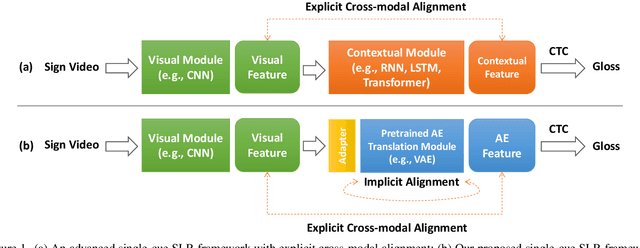
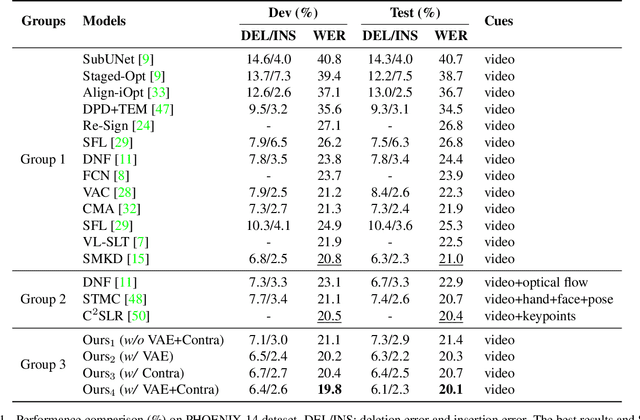
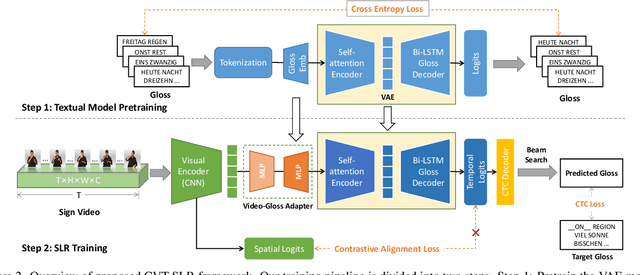
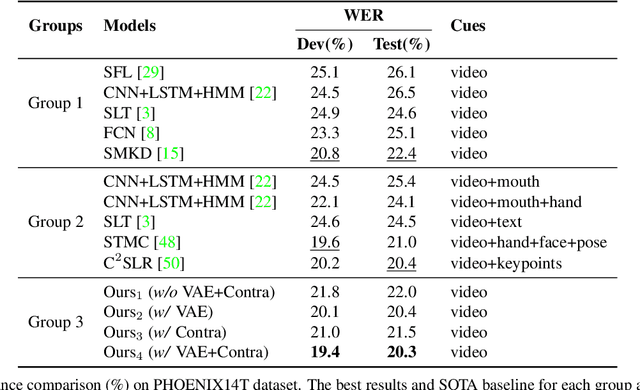
Sign language recognition (SLR) is a weakly supervised task that annotates sign videos as textual glosses. Recent studies show that insufficient training caused by the lack of large-scale available sign datasets becomes the main bottleneck for SLR. Most SLR works thereby adopt pretrained visual modules and develop two mainstream solutions. The multi-stream architectures extend multi-cue visual features, yielding the current SOTA performances but requiring complex designs and might introduce potential noise. Alternatively, the advanced single-cue SLR frameworks using explicit cross-modal alignment between visual and textual modalities are simple and effective, potentially competitive with the multi-cue framework. In this work, we propose a novel contrastive visual-textual transformation for SLR, CVT-SLR, to fully explore the pretrained knowledge of both the visual and language modalities. Based on the single-cue cross-modal alignment framework, we propose a variational autoencoder (VAE) for pretrained contextual knowledge while introducing the complete pretrained language module. The VAE implicitly aligns visual and textual modalities while benefiting from pretrained contextual knowledge as the traditional contextual module. Meanwhile, a contrastive cross-modal alignment algorithm is designed to explicitly enhance the consistency constraints. Extensive experiments on public datasets (PHOENIX-2014 and PHOENIX-2014T) demonstrate that our proposed CVT-SLR consistently outperforms existing single-cue methods and even outperforms SOTA multi-cue methods.
Lightweight Contrastive Protein Structure-Sequence Transformation
Mar 19, 2023
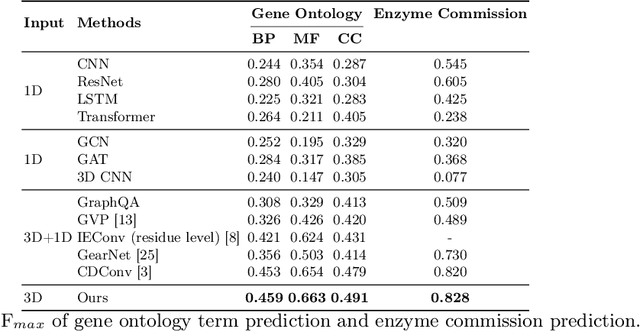

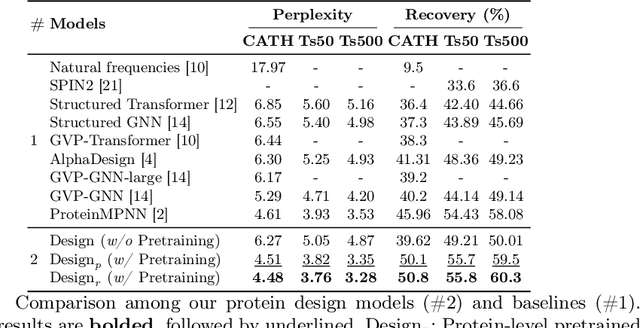
Pretrained protein structure models without labels are crucial foundations for the majority of protein downstream applications. The conventional structure pretraining methods follow the mature natural language pretraining methods such as denoised reconstruction and masked language modeling but usually destroy the real representation of spatial structures. The other common pretraining methods might predict a fixed set of predetermined object categories, where a restricted supervised manner limits their generality and usability as additional labeled data is required to specify any other protein concepts. In this work, we introduce a novel unsupervised protein structure representation pretraining with a robust protein language model. In particular, we first propose to leverage an existing pretrained language model to guide structure model learning through an unsupervised contrastive alignment. In addition, a self-supervised structure constraint is proposed to further learn the intrinsic information about the structures. With only light training data, the pretrained structure model can obtain better generalization ability. To quantitatively evaluate the proposed structure models, we design a series of rational evaluation methods, including internal tasks (e.g., contact map prediction, distribution alignment quality) and external/downstream tasks (e.g., protein design). The extensive experimental results conducted on multiple tasks and specific datasets demonstrate the superiority of the proposed sequence-structure transformation framework.