 Add to Chrome
 Add to Firefox
 Add to Edge
HELIX: Model-Harness Co-evolution for Recursive Self-Improvement
Aug 14, 2026
Scaling agent capability has largely focused on improving the model, yet an interactive agent acts through a runtime harness that mediates context, tools, control flow, and stopping. The harness shapes both what a model can accomplish and the trajectories from which it learns. This coupling motivates model-harness co-evolution for recursive self-improvement: build harnesses for a fixed model, update the model from verified sibling trajectories, and rebuild the harnesses as model capabilities change. Realizing this loop requires a controlled way to evolve harnesses while preserving intervention identity and effect. We present HELIX, a source-traceable substrate for harness evolution. HELIX decomposes agent systems into typed ports, reusable atoms, recipes, product shells, and runtime policies. It makes interventions explicit and auditable while retaining trajectories, test outcomes, and provenance. Harness evolution thus serves two linked roles: improving fixed-model execution and producing matched successes, regressions, near misses, and alternative solutions as data for subsequent model improvement. We evaluate HELIX in one evolution round on code repair. A 65-candidate portfolio discovers a fixed harness that improves task coverage by 4.0% over Pi, while the full portfolio exposes up to 58.0% more verified coverage through complementary sibling behavior. Selected candidates are assessed with repeated runs and the SWE-bench evaluator. A 200-slot sibling slice yields 438 verified SFT, critic, filter, and preference records. These results show how harness, model, and data form a feedback system: harness evolution expands current capability and creates learning signal for the next model; model updates motivate the next round of harness evolution. HELIX provides an auditable interface for studying this recursive process. Code is available at https://github.com/HKUDS/HELIX.

To Answer or to Abstain: Mitigating Search-Agent Hallucinations via Abstention-Aware Reinforcement Learning
Jul 12, 2026Recent advances in equipping Large Language Models (LLMs) with search tools and outcome-reward reinforcement learning (RL) have achieved new state-of-the-art results on open-domain QA tasks. However, we argue that current training paradigms harbor a critical vulnerability: they predominantly reward correct answers but fail to penalize fabricated ones when retrieval fails, thereby implicitly exacerbating hallucinations. To address this, we propose Abstention-Aware Reinforcement Learning (AWA-RL), which dynamically shapes the abstention reward utilizing the model's query-specific prior capabilities and continuous on-policy training observations. We also introduce a novel metric, RA-F1, to measure the capability-reliability trade-off. Compared to non-abstaining baselines, AWA-RL boosts absolute precision by up to 10.3% and overall RA-F1 by 2.9%, with only marginal sacrifice in raw accuracy. These results confirm that AWA-RL successfully yields highly capable and reliable search agents. The code, data, and model weights are publicly available at https://github.com/zfj1998/AWA-RL.
DeepInnovator: Triggering the Innovative Capabilities of LLMs
Feb 21, 2026The application of Large Language Models (LLMs) in accelerating scientific discovery has garnered increasing attention, with a key focus on constructing research agents endowed with innovative capability, i.e., the ability to autonomously generate novel and significant research ideas. Existing approaches predominantly rely on sophisticated prompt engineering and lack a systematic training paradigm. To address this, we propose DeepInnovator, a training framework designed to trigger the innovative capability of LLMs. Our approach comprises two core components. (1) ``Standing on the shoulders of giants''. We construct an automated data extraction pipeline to extract and organize structured research knowledge from a vast corpus of unlabeled scientific literature. (2) ``Conjectures and refutations''. We introduce a ``Next Idea Prediction'' training paradigm, which models the generation of research ideas as an iterative process of continuously predicting, evaluating, and refining plausible and novel next idea. Both automatic and expert evaluations demonstrate that our DeepInnovator-14B significantly outperforms untrained baselines, achieving win rates of 80.53\%-93.81\%, and attains performance comparable to that of current leading LLMs. This work provides a scalable training pathway toward building research agents with genuine, originative innovative capability, and will open-source the dataset to foster community advancement. Source code and data are available at: https://github.com/HKUDS/DeepInnovator.
Why Your Deep Research Agent Fails? On Hallucination Evaluation in Full Research Trajectory
Jan 30, 2026Diagnosing the failure mechanisms of Deep Research Agents (DRAs) remains a critical challenge. Existing benchmarks predominantly rely on end-to-end evaluation, obscuring critical intermediate hallucinations, such as flawed planning, that accumulate throughout the research trajectory. To bridge this gap, we propose a shift from outcome-based to process-aware evaluation by auditing the full research trajectory. We introduce the PIES Taxonomy to categorize hallucinations along functional components (Planning vs. Summarization) and error properties (Explicit vs. Implicit). We instantiate this taxonomy into a fine-grained evaluation framework that decomposes the trajectory to rigorously quantify these hallucinations. Leveraging this framework to isolate 100 distinctively hallucination-prone tasks including adversarial scenarios, we curate DeepHalluBench. Experiments on six state-of-theart DRAs reveal that no system achieves robust reliability. Furthermore, our diagnostic analysis traces the etiology of these failures to systemic deficits, specifically hallucination propagation and cognitive biases, providing foundational insights to guide future architectural optimization. Data and code are available at https://github.com/yuhao-zhan/DeepHalluBench.
Needle in the Web: A Benchmark for Retrieving Targeted Web Pages in the Wild
Dec 18, 2025Large Language Models (LLMs) have evolved from simple chatbots into sophisticated agents capable of automating complex real-world tasks, where browsing and reasoning over live web content is key to assessing retrieval and cognitive skills. Existing benchmarks like BrowseComp and xBench-DeepSearch emphasize complex reasoning searches requiring multi-hop synthesis but neglect Fuzzy Exploratory Search, namely queries that are vague and multifaceted, where users seek the most relevant webpage rather than a single factual answer. To address this gap, we introduce Needle in the Web, a novel benchmark specifically designed to evaluate modern search agents and LLM-based systems on their ability to retrieve and reason over real-world web content in response to ambiguous, exploratory queries under varying levels of difficulty. Needle in the Web comprises 663 questions spanning seven distinct domains. To ensure high query quality and answer uniqueness, we employ a flexible methodology that reliably generates queries of controllable difficulty based on factual claims of web contents. We benchmark three leading LLMs and three agent-based search systems on Needle in the Web, finding that most models struggle: many achieve below 35% accuracy, and none consistently excel across domains or difficulty levels. These findings reveal that Needle in the Web presents a significant challenge for current search systems and highlights the open problem of effective fuzzy retrieval under semantic ambiguity.
Understanding DeepResearch via Reports
Oct 09, 2025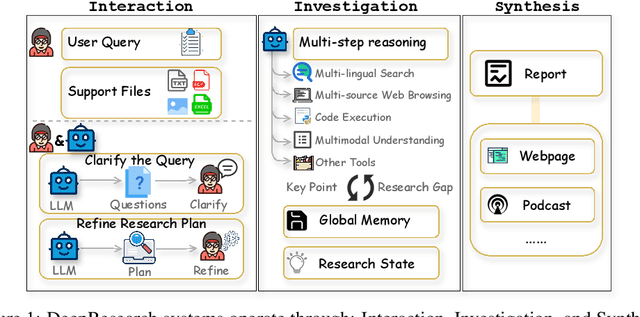

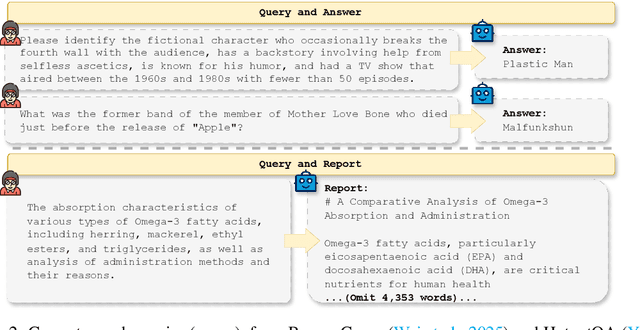

DeepResearch agents represent a transformative AI paradigm, conducting expert-level research through sophisticated reasoning and multi-tool integration. However, evaluating these systems remains critically challenging due to open-ended research scenarios and existing benchmarks that focus on isolated capabilities rather than holistic performance. Unlike traditional LLM tasks, DeepResearch systems must synthesize diverse sources, generate insights, and present coherent findings, which are capabilities that resist simple verification. To address this gap, we introduce DeepResearch-ReportEval, a comprehensive framework designed to assess DeepResearch systems through their most representative outputs: research reports. Our approach systematically measures three dimensions: quality, redundancy, and factuality, using an innovative LLM-as-a-Judge methodology achieving strong expert concordance. We contribute a standardized benchmark of 100 curated queries spanning 12 real-world categories, enabling systematic capability comparison. Our evaluation of four leading commercial systems reveals distinct design philosophies and performance trade-offs, establishing foundational insights as DeepResearch evolves from information assistants toward intelligent research partners. Source code and data are available at: https://github.com/HKUDS/DeepResearch-Eval.
Speech Enhancement Using Continuous Embeddings of Neural Audio Codec
Feb 22, 2025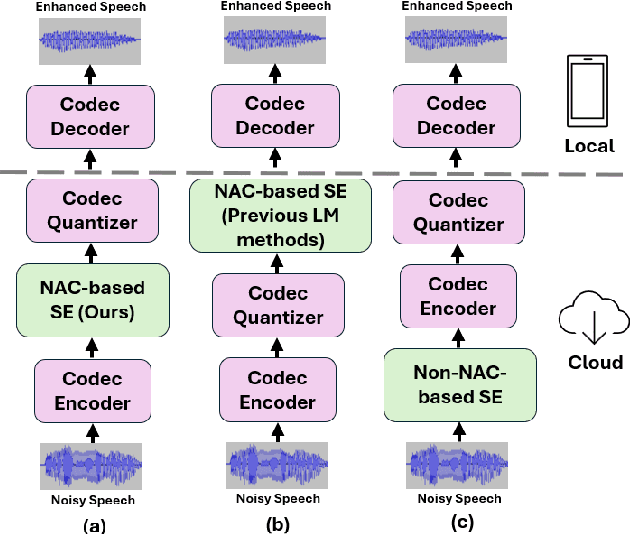
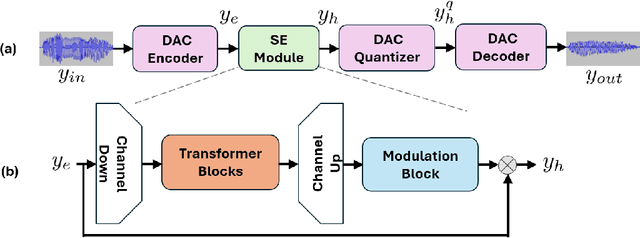

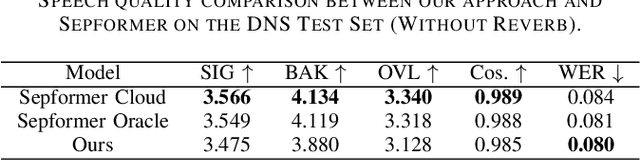
Recent advancements in Neural Audio Codec (NAC) models have inspired their use in various speech processing tasks, including speech enhancement (SE). In this work, we propose a novel, efficient SE approach by leveraging the pre-quantization output of a pretrained NAC encoder. Unlike prior NAC-based SE methods, which process discrete speech tokens using Language Models (LMs), we perform SE within the continuous embedding space of the pretrained NAC, which is highly compressed along the time dimension for efficient representation. Our lightweight SE model, optimized through an embedding-level loss, delivers results comparable to SE baselines trained on larger datasets, with a significantly lower real-time factor of 0.005. Additionally, our method achieves a low GMAC of 3.94, reducing complexity 18-fold compared to Sepformer in a simulated cloud-based audio transmission environment. This work highlights a new, efficient NAC-based SE solution, particularly suitable for cloud applications where NAC is used to compress audio before transmission. Copyright 20XX IEEE. Personal use of this material is permitted. Permission from IEEE must be obtained for all other uses, in any current or future media, including reprinting/republishing this material for advertising or promotional purposes, creating new collective works, for resale or redistribution to servers or lists, or reuse of any copyrighted component of this work in other works.
MetaChain: A Fully-Automated and Zero-Code Framework for LLM Agents
Feb 09, 2025Large Language Model (LLM) Agents have demonstrated remarkable capabilities in task automation and intelligent decision-making, driving the widespread adoption of agent development frameworks such as LangChain and AutoGen. However, these frameworks predominantly serve developers with extensive technical expertise - a significant limitation considering that only 0.03 % of the global population possesses the necessary programming skills. This stark accessibility gap raises a fundamental question: Can we enable everyone, regardless of technical background, to build their own LLM agents using natural language alone? To address this challenge, we introduce MetaChain-a Fully-Automated and highly Self-Developing framework that enables users to create and deploy LLM agents through Natural Language Alone. Operating as an autonomous Agent Operating System, MetaChain comprises four key components: i) Agentic System Utilities, ii) LLM-powered Actionable Engine, iii) Self-Managing File System, and iv) Self-Play Agent Customization module. This lightweight yet powerful system enables efficient and dynamic creation and modification of tools, agents, and workflows without coding requirements or manual intervention. Beyond its code-free agent development capabilities, MetaChain also serves as a versatile multi-agent system for General AI Assistants. Comprehensive evaluations on the GAIA benchmark demonstrate MetaChain's effectiveness in generalist multi-agent tasks, surpassing existing state-of-the-art methods. Furthermore, MetaChain's Retrieval-Augmented Generation (RAG)-related capabilities have shown consistently superior performance compared to many alternative LLM-based solutions.
Tumor Detection, Segmentation and Classification Challenge on Automated 3D Breast Ultrasound: The TDSC-ABUS Challenge
Jan 26, 2025
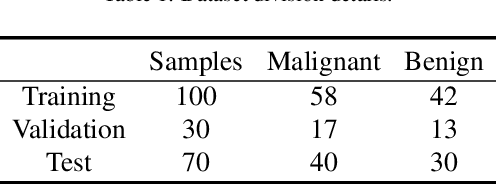
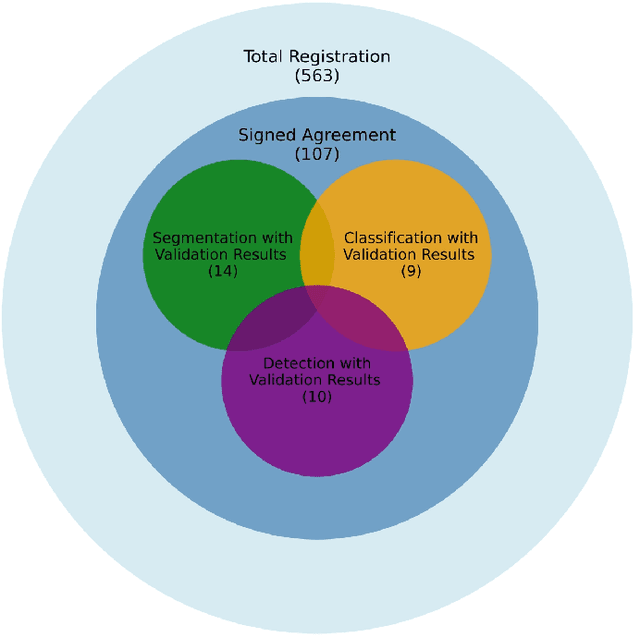

Breast cancer is one of the most common causes of death among women worldwide. Early detection helps in reducing the number of deaths. Automated 3D Breast Ultrasound (ABUS) is a newer approach for breast screening, which has many advantages over handheld mammography such as safety, speed, and higher detection rate of breast cancer. Tumor detection, segmentation, and classification are key components in the analysis of medical images, especially challenging in the context of 3D ABUS due to the significant variability in tumor size and shape, unclear tumor boundaries, and a low signal-to-noise ratio. The lack of publicly accessible, well-labeled ABUS datasets further hinders the advancement of systems for breast tumor analysis. Addressing this gap, we have organized the inaugural Tumor Detection, Segmentation, and Classification Challenge on Automated 3D Breast Ultrasound 2023 (TDSC-ABUS2023). This initiative aims to spearhead research in this field and create a definitive benchmark for tasks associated with 3D ABUS image analysis. In this paper, we summarize the top-performing algorithms from the challenge and provide critical analysis for ABUS image examination. We offer the TDSC-ABUS challenge as an open-access platform at https://tdsc-abus2023.grand-challenge.org/ to benchmark and inspire future developments in algorithmic research.
MiniRAG: Towards Extremely Simple Retrieval-Augmented Generation
Jan 14, 2025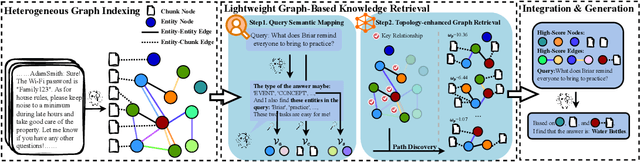
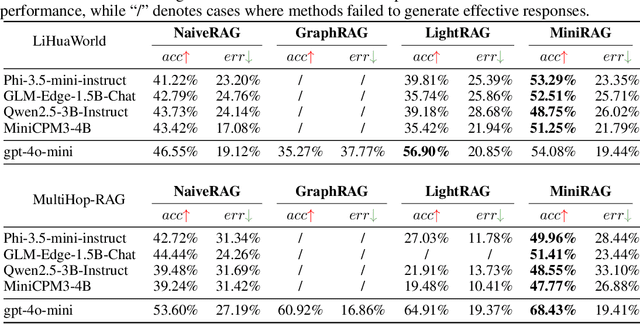
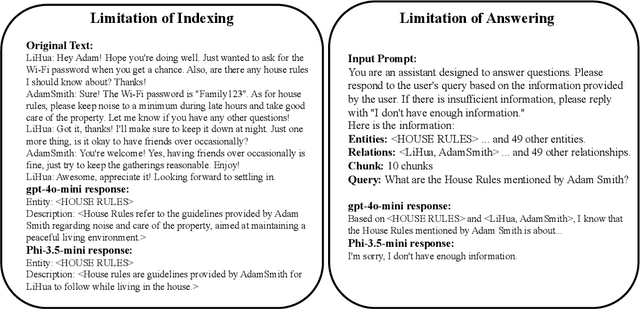
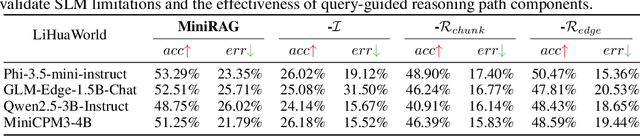
The growing demand for efficient and lightweight Retrieval-Augmented Generation (RAG) systems has highlighted significant challenges when deploying Small Language Models (SLMs) in existing RAG frameworks. Current approaches face severe performance degradation due to SLMs' limited semantic understanding and text processing capabilities, creating barriers for widespread adoption in resource-constrained scenarios. To address these fundamental limitations, we present MiniRAG, a novel RAG system designed for extreme simplicity and efficiency. MiniRAG introduces two key technical innovations: (1) a semantic-aware heterogeneous graph indexing mechanism that combines text chunks and named entities in a unified structure, reducing reliance on complex semantic understanding, and (2) a lightweight topology-enhanced retrieval approach that leverages graph structures for efficient knowledge discovery without requiring advanced language capabilities. Our extensive experiments demonstrate that MiniRAG achieves comparable performance to LLM-based methods even when using SLMs while requiring only 25\% of the storage space. Additionally, we contribute a comprehensive benchmark dataset for evaluating lightweight RAG systems under realistic on-device scenarios with complex queries. We fully open-source our implementation and datasets at: https://github.com/HKUDS/MiniRAG.