 Add to Chrome
 Add to Firefox
 Add to Edge
Machine learning's own Industrial Revolution
Nov 04, 2023
Machine learning is expected to enable the next Industrial Revolution. However, lacking standardized and automated assembly networks, ML faces significant challenges to meet ever-growing enterprise demands and empower broad industries. In the Perspective, we argue that ML needs to first complete its own Industrial Revolution, elaborate on how to best achieve its goals, and discuss new opportunities to enable rapid translation from ML's innovation frontier to mass production and utilization.

PockEngine: Sparse and Efficient Fine-tuning in a Pocket
Oct 26, 2023


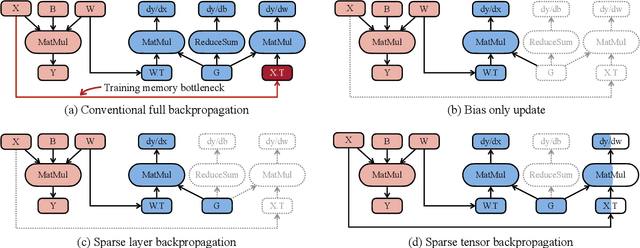
On-device learning and efficient fine-tuning enable continuous and privacy-preserving customization (e.g., locally fine-tuning large language models on personalized data). However, existing training frameworks are designed for cloud servers with powerful accelerators (e.g., GPUs, TPUs) and lack the optimizations for learning on the edge, which faces challenges of resource limitations and edge hardware diversity. We introduce PockEngine: a tiny, sparse and efficient engine to enable fine-tuning on various edge devices. PockEngine supports sparse backpropagation: it prunes the backward graph and sparsely updates the model with measured memory saving and latency reduction while maintaining the model quality. Secondly, PockEngine is compilation first: the entire training graph (including forward, backward and optimization steps) is derived at compile-time, which reduces the runtime overhead and brings opportunities for graph transformations. PockEngine also integrates a rich set of training graph optimizations, thus can further accelerate the training cost, including operator reordering and backend switching. PockEngine supports diverse applications, frontends and hardware backends: it flexibly compiles and tunes models defined in PyTorch/TensorFlow/Jax and deploys binaries to mobile CPU/GPU/DSPs. We evaluated PockEngine on both vision models and large language models. PockEngine achieves up to 15 $\times$ speedup over off-the-shelf TensorFlow (Raspberry Pi), 5.6 $\times$ memory saving back-propagation (Jetson AGX Orin). Remarkably, PockEngine enables fine-tuning LLaMav2-7B on NVIDIA Jetson AGX Orin at 550 tokens/s, 7.9$\times$ faster than the PyTorch.
Efficient Streaming Language Models with Attention Sinks
Sep 29, 2023
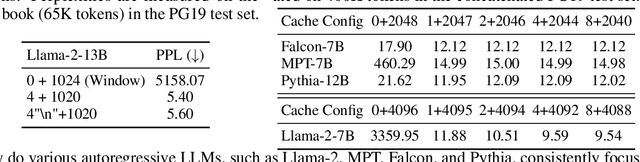
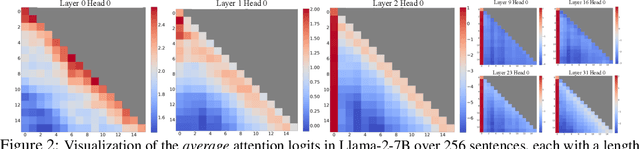

Deploying Large Language Models (LLMs) in streaming applications such as multi-round dialogue, where long interactions are expected, is urgently needed but poses two major challenges. Firstly, during the decoding stage, caching previous tokens' Key and Value states (KV) consumes extensive memory. Secondly, popular LLMs cannot generalize to longer texts than the training sequence length. Window attention, where only the most recent KVs are cached, is a natural approach -- but we show that it fails when the text length surpasses the cache size. We observe an interesting phenomenon, namely attention sink, that keeping the KV of initial tokens will largely recover the performance of window attention. In this paper, we first demonstrate that the emergence of attention sink is due to the strong attention scores towards initial tokens as a ``sink'' even if they are not semantically important. Based on the above analysis, we introduce StreamingLLM, an efficient framework that enables LLMs trained with a finite length attention window to generalize to infinite sequence lengths without any fine-tuning. We show that StreamingLLM can enable Llama-2, MPT, Falcon, and Pythia to perform stable and efficient language modeling with up to 4 million tokens and more. In addition, we discover that adding a placeholder token as a dedicated attention sink during pre-training can further improve streaming deployment. In streaming settings, StreamingLLM outperforms the sliding window recomputation baseline by up to 22.2x speedup. Code and datasets are provided at https://github.com/mit-han-lab/streaming-llm.
LongLoRA: Efficient Fine-tuning of Long-Context Large Language Models
Sep 21, 2023

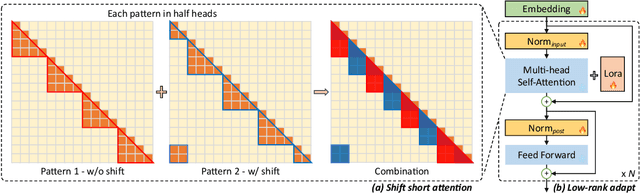

We present LongLoRA, an efficient fine-tuning approach that extends the context sizes of pre-trained large language models (LLMs), with limited computation cost. Typically, training LLMs with long context sizes is computationally expensive, requiring extensive training hours and GPU resources. For example, training on the context length of 8192 needs 16x computational costs in self-attention layers as that of 2048. In this paper, we speed up the context extension of LLMs in two aspects. On the one hand, although dense global attention is needed during inference, fine-tuning the model can be effectively and efficiently done by sparse local attention. The proposed shift short attention effectively enables context extension, leading to non-trivial computation saving with similar performance to fine-tuning with vanilla attention. Particularly, it can be implemented with only two lines of code in training, while being optional in inference. On the other hand, we revisit the parameter-efficient fine-tuning regime for context expansion. Notably, we find that LoRA for context extension works well under the premise of trainable embedding and normalization. LongLoRA demonstrates strong empirical results on various tasks on LLaMA2 models from 7B/13B to 70B. LongLoRA adopts LLaMA2 7B from 4k context to 100k, or LLaMA2 70B to 32k on a single 8x A100 machine. LongLoRA extends models' context while retaining their original architectures, and is compatible with most existing techniques, like FlashAttention-2. In addition, to make LongLoRA practical, we collect a dataset, LongQA, for supervised fine-tuning. It contains more than 3k long context question-answer pairs.
AWQ: Activation-aware Weight Quantization for LLM Compression and Acceleration
Jun 01, 2023



Large language models (LLMs) have shown excellent performance on various tasks, but the astronomical model size raises the hardware barrier for serving (memory size) and slows down token generation (memory bandwidth). In this paper, we propose Activation-aware Weight Quantization (AWQ), a hardware-friendly approach for LLM low-bit weight-only quantization. Our method is based on the observation that weights are not equally important: protecting only 1% of salient weights can greatly reduce quantization error. We then propose to search for the optimal per-channel scaling that protects the salient weights by observing the activation, not weights. AWQ does not rely on any backpropagation or reconstruction, so it can well preserve LLMs' generalization ability on different domains and modalities, without overfitting to the calibration set; it also does not rely on any data layout reordering, maintaining the hardware efficiency. AWQ outperforms existing work on various language modeling, common sense QA, and domain-specific benchmarks. Thanks to better generalization, it achieves excellent quantization performance for instruction-tuned LMs and, for the first time, multi-modal LMs. We also implement efficient tensor core kernels with reorder-free online dequantization to accelerate AWQ, achieving a 1.45x speedup over GPTQ and is 1.85x faster than the cuBLAS FP16 implementation. Our method provides a turn-key solution to compress LLMs to 3/4 bits for efficient deployment.
FastComposer: Tuning-Free Multi-Subject Image Generation with Localized Attention
May 21, 2023



Diffusion models excel at text-to-image generation, especially in subject-driven generation for personalized images. However, existing methods are inefficient due to the subject-specific fine-tuning, which is computationally intensive and hampers efficient deployment. Moreover, existing methods struggle with multi-subject generation as they often blend features among subjects. We present FastComposer which enables efficient, personalized, multi-subject text-to-image generation without fine-tuning. FastComposer uses subject embeddings extracted by an image encoder to augment the generic text conditioning in diffusion models, enabling personalized image generation based on subject images and textual instructions with only forward passes. To address the identity blending problem in the multi-subject generation, FastComposer proposes cross-attention localization supervision during training, enforcing the attention of reference subjects localized to the correct regions in the target images. Naively conditioning on subject embeddings results in subject overfitting. FastComposer proposes delayed subject conditioning in the denoising step to maintain both identity and editability in subject-driven image generation. FastComposer generates images of multiple unseen individuals with different styles, actions, and contexts. It achieves 300$\times$-2500$\times$ speedup compared to fine-tuning-based methods and requires zero extra storage for new subjects. FastComposer paves the way for efficient, personalized, and high-quality multi-subject image creation. Code, model, and dataset are available at https://github.com/mit-han-lab/fastcomposer.
SparseViT: Revisiting Activation Sparsity for Efficient High-Resolution Vision Transformer
Mar 30, 2023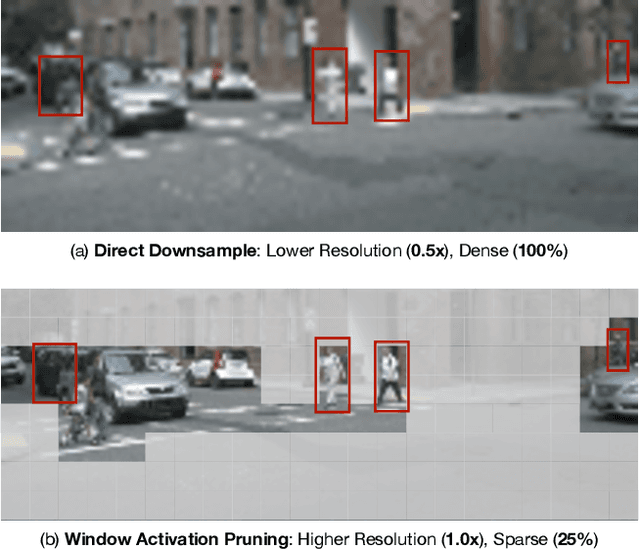
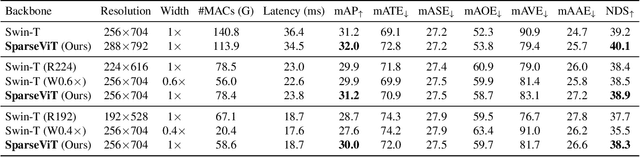
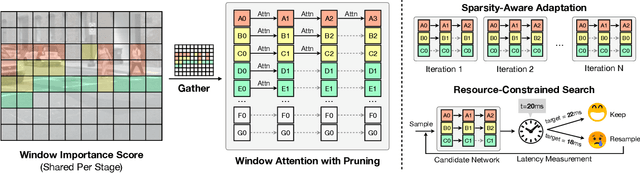
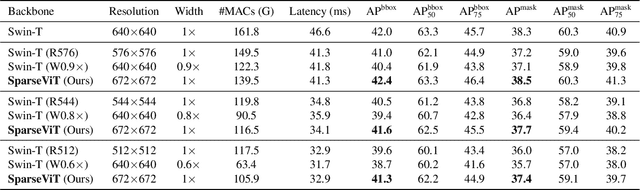
High-resolution images enable neural networks to learn richer visual representations. However, this improved performance comes at the cost of growing computational complexity, hindering their usage in latency-sensitive applications. As not all pixels are equal, skipping computations for less-important regions offers a simple and effective measure to reduce the computation. This, however, is hard to be translated into actual speedup for CNNs since it breaks the regularity of the dense convolution workload. In this paper, we introduce SparseViT that revisits activation sparsity for recent window-based vision transformers (ViTs). As window attentions are naturally batched over blocks, actual speedup with window activation pruning becomes possible: i.e., ~50% latency reduction with 60% sparsity. Different layers should be assigned with different pruning ratios due to their diverse sensitivities and computational costs. We introduce sparsity-aware adaptation and apply the evolutionary search to efficiently find the optimal layerwise sparsity configuration within the vast search space. SparseViT achieves speedups of 1.5x, 1.4x, and 1.3x compared to its dense counterpart in monocular 3D object detection, 2D instance segmentation, and 2D semantic segmentation, respectively, with negligible to no loss of accuracy.
Offsite-Tuning: Transfer Learning without Full Model
Feb 09, 2023
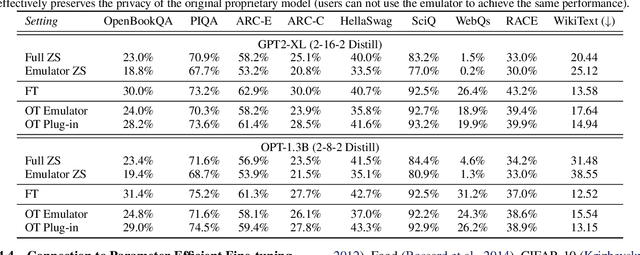

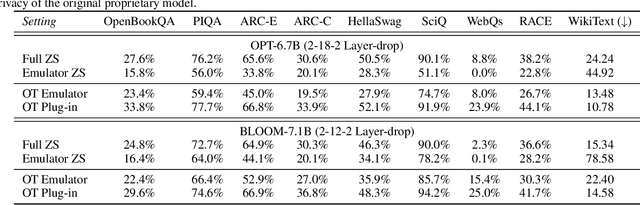
Transfer learning is important for foundation models to adapt to downstream tasks. However, many foundation models are proprietary, so users must share their data with model owners to fine-tune the models, which is costly and raise privacy concerns. Moreover, fine-tuning large foundation models is computation-intensive and impractical for most downstream users. In this paper, we propose Offsite-Tuning, a privacy-preserving and efficient transfer learning framework that can adapt billion-parameter foundation models to downstream data without access to the full model. In offsite-tuning, the model owner sends a light-weight adapter and a lossy compressed emulator to the data owner, who then fine-tunes the adapter on the downstream data with the emulator's assistance. The fine-tuned adapter is then returned to the model owner, who plugs it into the full model to create an adapted foundation model. Offsite-tuning preserves both parties' privacy and is computationally more efficient than the existing fine-tuning methods that require access to the full model weights. We demonstrate the effectiveness of offsite-tuning on various large language and vision foundation models. Offsite-tuning can achieve comparable accuracy as full model fine-tuning while being privacy-preserving and efficient, achieving 6.5x speedup and 5.6x memory reduction. Code is available at https://github.com/mit-han-lab/offsite-tuning.
FlatFormer: Flattened Window Attention for Efficient Point Cloud Transformer
Jan 20, 2023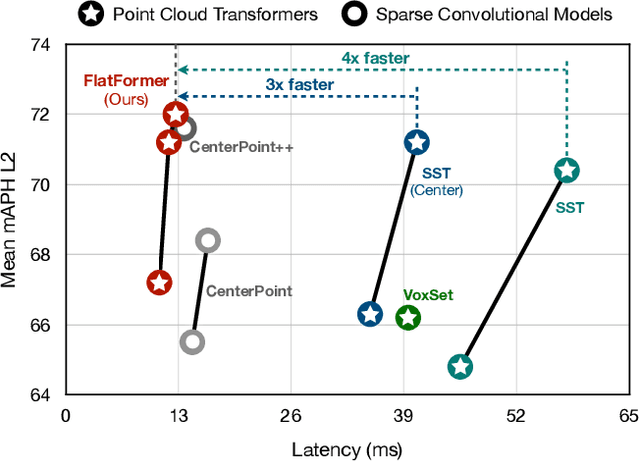


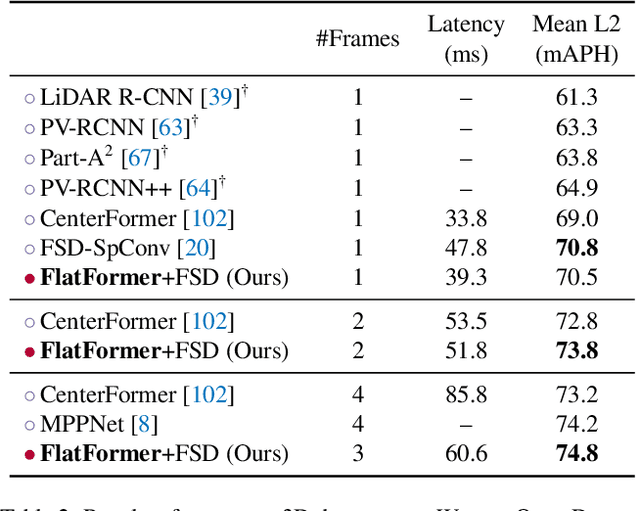
Transformer, as an alternative to CNN, has been proven effective in many modalities (e.g., texts and images). For 3D point cloud transformers, existing efforts focus primarily on pushing their accuracy to the state-of-the-art level. However, their latency lags behind sparse convolution-based models (3x slower), hindering their usage in resource-constrained, latency-sensitive applications (such as autonomous driving). This inefficiency comes from point clouds' sparse and irregular nature, whereas transformers are designed for dense, regular workloads. This paper presents FlatFormer to close this latency gap by trading spatial proximity for better computational regularity. We first flatten the point cloud with window-based sorting and partition points into groups of equal sizes rather than windows of equal shapes. This effectively avoids expensive structuring and padding overheads. We then apply self-attention within groups to extract local features, alternate sorting axis to gather features from different directions, and shift windows to exchange features across groups. FlatFormer delivers state-of-the-art accuracy on Waymo Open Dataset with 4.6x speedup over (transformer-based) SST and 1.4x speedup over (sparse convolutional) CenterPoint. This is the first point cloud transformer that achieves real-time performance on edge GPUs and is faster than sparse convolutional methods while achieving on-par or even superior accuracy on large-scale benchmarks. Code to reproduce our results will be made publicly available.
SmoothQuant: Accurate and Efficient Post-Training Quantization for Large Language Models
Nov 28, 2022Large language models (LLMs) show excellent performance but are compute- and memory-intensive. Quantization can reduce memory and accelerate inference. However, for LLMs beyond 100 billion parameters, existing methods cannot maintain accuracy or do not run efficiently on hardware. We propose SmoothQuant, a training-free, accuracy-preserving, and general-purpose post-training quantization (PTQ) solution to enable 8-bit weight, 8-bit activation (W8A8) quantization for LLMs that can be implemented efficiently. We observe that systematic outliers appear at fixed activation channels. Based on the fact that weights are easy to quantize while activations are not, SmoothQuant smooths the activation outliers by offline migrating the quantization difficulty from activations to weights with a mathematically equivalent transformation. SmoothQuant enables an INT8 quantization of both weights and activations for all the GEMMs in LLMs, including OPT-175B, BLOOM-176B, and GLM-130B. SmoothQuant has better hardware efficiency than existing techniques using mixed-precision activation quantization or weight-only quantization. We demonstrate up to 1.56x speedup and 2x memory reduction for LLMs with negligible loss in accuracy. Thanks to the hardware-friendly design, we integrate SmoothQuant into FasterTransformer, a state-of-the-art LLM serving framework, and achieve faster inference speed with half the number of GPUs compared to FP16. Our work offers a turn-key solution that reduces hardware costs and democratizes LLMs. Code is available at: https://github.com/mit-han-lab/smoothquant.