 Add to Chrome
 Add to Firefox
 Add to Edge
Efficient and Reliable Teleoperation through Real-to-Sim-to-Real Shared Autonomy
Mar 17, 2026
Fine-grained, contact-rich teleoperation remains slow, error-prone, and unreliable in real-world manipulation tasks, even for experienced operators. Shared autonomy offers a promising way to improve performance by combining human intent with automated assistance, but learning effective assistance in simulation requires a faithful model of human behavior, which is difficult to obtain in practice. We propose a real-to-sim-to-real shared autonomy framework that augments human teleoperation with learned corrective behaviors, using a simple yet effective k-nearest-neighbor (kNN) human surrogate to model operator actions in simulation. The surrogate is fit from less than five minutes of real-world teleoperation data and enables stable training of a residual copilot policy with model-free reinforcement learning. The resulting copilot is deployed to assist human operators in real-world fine-grained manipulation tasks. Through simulation experiments and a user study with sixteen participants on industry-relevant tasks, including nut threading, gear meshing, and peg insertion, we show that our system improves task success for novice operators and execution efficiency for experienced operators compared to direct teleoperation and shared-autonomy baselines that rely on expert priors or behavioral-cloning pilots. In addition, copilot-assisted teleoperation produces higher-quality demonstrations for downstream imitation learning.

ManipulationNet: An Infrastructure for Benchmarking Real-World Robot Manipulation with Physical Skill Challenges and Embodied Multimodal Reasoning
Mar 04, 2026Dexterous manipulation enables robots to purposefully alter the physical world, transforming them from passive observers into active agents in unstructured environments. This capability is the cornerstone of physical artificial intelligence. Despite decades of advances in hardware, perception, control, and learning, progress toward general manipulation systems remains fragmented due to the absence of widely adopted standard benchmarks. The central challenge lies in reconciling the variability of the real world with the reproducibility and authenticity required for rigorous scientific evaluation. To address this, we introduce ManipulationNet, a global infrastructure that hosts real-world benchmark tasks for robotic manipulation. ManipulationNet delivers reproducible task setups through standardized hardware kits, and enables distributed performance evaluation via a unified software client that delivers real-time task instructions and collects benchmarking results. As a persistent and scalable infrastructure, ManipulationNet organizes benchmark tasks into two complementary tracks: 1) the Physical Skills Track, which evaluates low-level physical interaction skills, and 2) the Embodied Reasoning Track, which tests high-level reasoning and multimodal grounding abilities. This design fosters the systematic growth of an interconnected network of real-world abilities and skills, paving the path toward general robotic manipulation. By enabling comparable manipulation research in the real world at scale, this infrastructure establishes a sustainable foundation for measuring long-term scientific progress and identifying capabilities ready for real-world deployment.
Real-to-Sim Robot Policy Evaluation with Gaussian Splatting Simulation of Soft-Body Interactions
Nov 06, 2025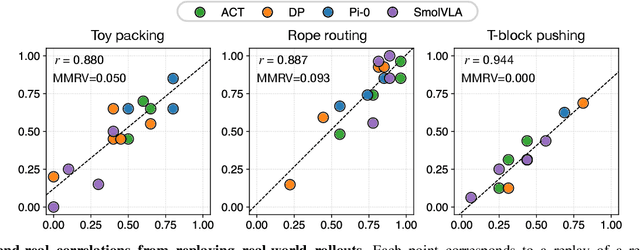
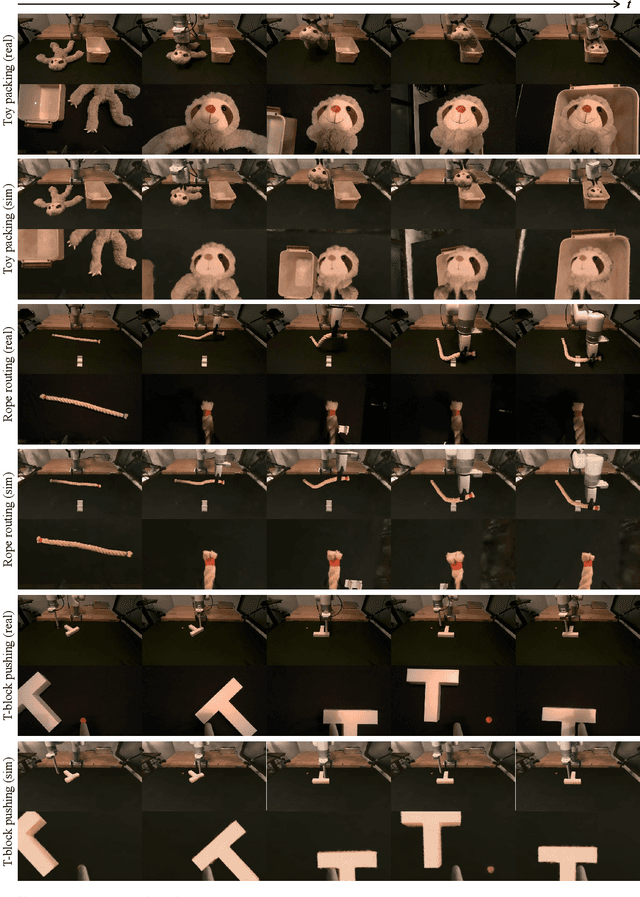
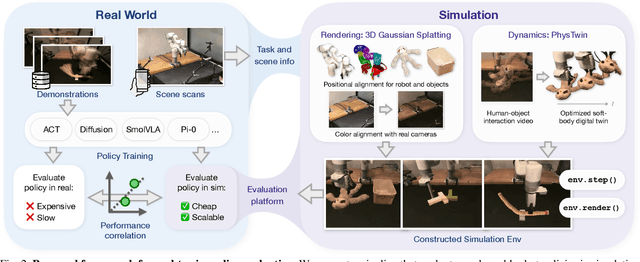
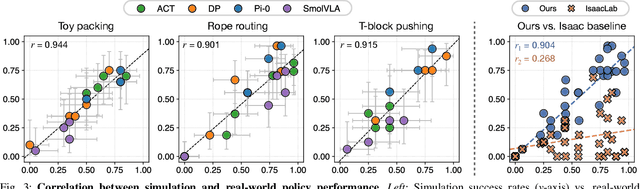
Robotic manipulation policies are advancing rapidly, but their direct evaluation in the real world remains costly, time-consuming, and difficult to reproduce, particularly for tasks involving deformable objects. Simulation provides a scalable and systematic alternative, yet existing simulators often fail to capture the coupled visual and physical complexity of soft-body interactions. We present a real-to-sim policy evaluation framework that constructs soft-body digital twins from real-world videos and renders robots, objects, and environments with photorealistic fidelity using 3D Gaussian Splatting. We validate our approach on representative deformable manipulation tasks, including plush toy packing, rope routing, and T-block pushing, demonstrating that simulated rollouts correlate strongly with real-world execution performance and reveal key behavioral patterns of learned policies. Our results suggest that combining physics-informed reconstruction with high-quality rendering enables reproducible, scalable, and accurate evaluation of robotic manipulation policies. Website: https://real2sim-eval.github.io/
TAG-K: Tail-Averaged Greedy Kaczmarz for Computationally Efficient and Performant Online Inertial Parameter Estimation
Oct 06, 2025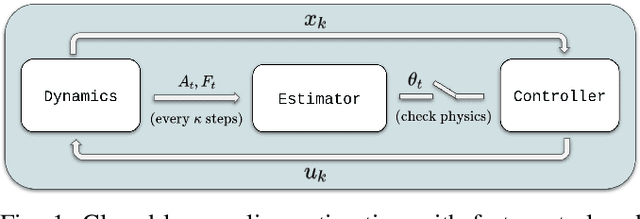
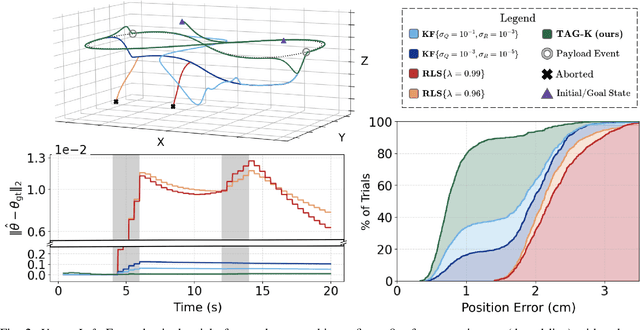
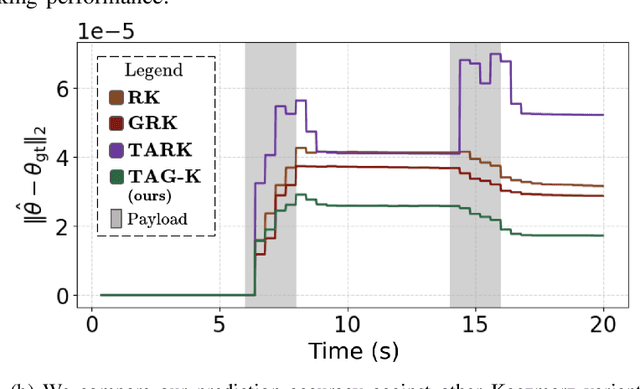
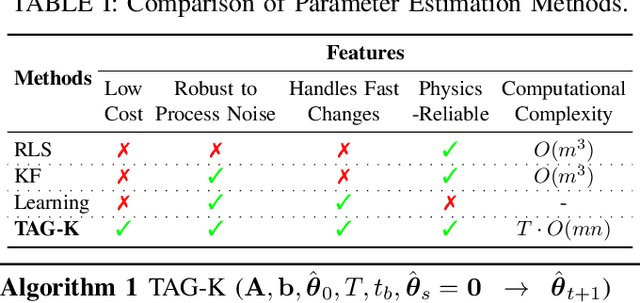
Accurate online inertial parameter estimation is essential for adaptive robotic control, enabling real-time adjustment to payload changes, environmental interactions, and system wear. Traditional methods such as Recursive Least Squares (RLS) and the Kalman Filter (KF) often struggle to track abrupt parameter shifts or incur high computational costs, limiting their effectiveness in dynamic environments and for computationally constrained robotic systems. As such, we introduce TAG-K, a lightweight extension of the Kaczmarz method that combines greedy randomized row selection for rapid convergence with tail averaging for robustness under noise and inconsistency. This design enables fast, stable parameter adaptation while retaining the low per-iteration complexity inherent to the Kaczmarz framework. We evaluate TAG-K in synthetic benchmarks and quadrotor tracking tasks against RLS, KF, and other Kaczmarz variants. TAG-K achieves 1.5x-1.9x faster solve times on laptop-class CPUs and 4.8x-20.7x faster solve times on embedded microcontrollers. More importantly, these speedups are paired with improved resilience to measurement noise and a 25% reduction in estimation error, leading to nearly 2x better end-to-end tracking performance.