 Add to Chrome
 Add to Firefox
 Add to Edge
ManipulationNet: An Infrastructure for Benchmarking Real-World Robot Manipulation with Physical Skill Challenges and Embodied Multimodal Reasoning
Mar 04, 2026
Dexterous manipulation enables robots to purposefully alter the physical world, transforming them from passive observers into active agents in unstructured environments. This capability is the cornerstone of physical artificial intelligence. Despite decades of advances in hardware, perception, control, and learning, progress toward general manipulation systems remains fragmented due to the absence of widely adopted standard benchmarks. The central challenge lies in reconciling the variability of the real world with the reproducibility and authenticity required for rigorous scientific evaluation. To address this, we introduce ManipulationNet, a global infrastructure that hosts real-world benchmark tasks for robotic manipulation. ManipulationNet delivers reproducible task setups through standardized hardware kits, and enables distributed performance evaluation via a unified software client that delivers real-time task instructions and collects benchmarking results. As a persistent and scalable infrastructure, ManipulationNet organizes benchmark tasks into two complementary tracks: 1) the Physical Skills Track, which evaluates low-level physical interaction skills, and 2) the Embodied Reasoning Track, which tests high-level reasoning and multimodal grounding abilities. This design fosters the systematic growth of an interconnected network of real-world abilities and skills, paving the path toward general robotic manipulation. By enabling comparable manipulation research in the real world at scale, this infrastructure establishes a sustainable foundation for measuring long-term scientific progress and identifying capabilities ready for real-world deployment.

Towards an Efficient Synthetic Image Data Pipeline for Training Vision-Based Robot Systems
Nov 09, 2024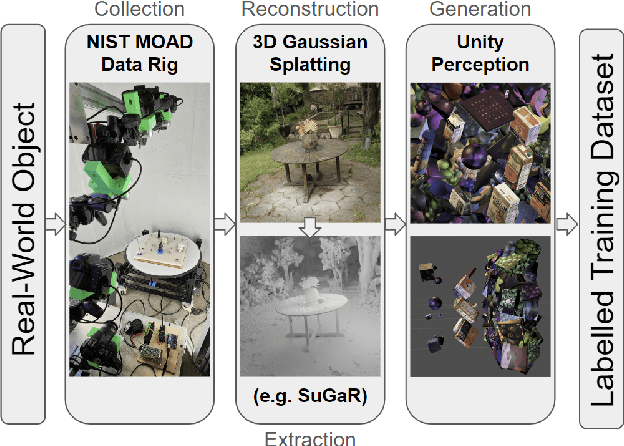
Training data is an essential resource for creating capable and robust vision systems which are integral to the proper function of many robotic systems. Synthesized training data has been shown in recent years to be a viable alternative to manually collecting and labelling data. In order to meet the rising popularity of synthetic image training data we propose a framework for defining synthetic image data pipelines. Additionally we survey the literature to identify the most promising candidates for components of the proposed pipeline. We propose that defining such a pipeline will be beneficial in reducing development cycles and coordinating future research.