 Add to Chrome
 Add to Firefox
 Add to Edge
Balancing of Humanoid with Object Mass: Trade-off Analyses and Lifting Control
Jul 31, 2026
The demand for humanoid loco-manipulation tasks with an object has recently increased, and most existing control approaches for stability in such tasks rely on heuristics or machine-learning techniques. This study rigorously analyzes and exploits the dynamic effects of the object mass on balance stability. By formulating the object mass parameters in the whole-body dynamics with distributed contact wrenches and centers of pressure at the stance contacts, their nonlinear effects on the system momenta and constraints are quantified. The dynamic models and constraints are incorporated into the construction of the balanced state basin/boundary (BSB), a partition of the center-of-mass state space for a biped system to maintain balance in its desired contacts. The implications of the BSB for prediction and control are highlighted using a humanoid robot and an analytically tractable reduced-order mechanism. The BSBs under different conditions of base of support, actuation capacity, and pose provide systematic analyses of the effects of object mass on the balancing capability of a system. In particular, the trade-off relationships between momentum regulation and limiting factors in balancing are characterized, introducing two key quantities of the object: the critical mass, at which the system's balancing capability is maximum, and the transition mass, which activates different limiting factors. In addition, sufficient conditions for imposing balanced states on a trajectory are established and implemented with BSBs as explicit threshold constraints in the whole-body trajectory optimization for stable object-lifting control of the humanoid, demonstrating the lift-and-hold and lift-and-release tasks with distinct mass properties in simulations and experiments.

Real-to-Sim Robot Policy Evaluation with Gaussian Splatting Simulation of Soft-Body Interactions
Nov 06, 2025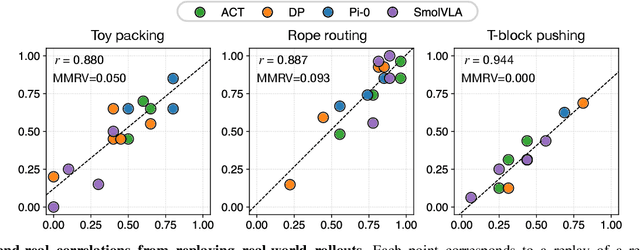
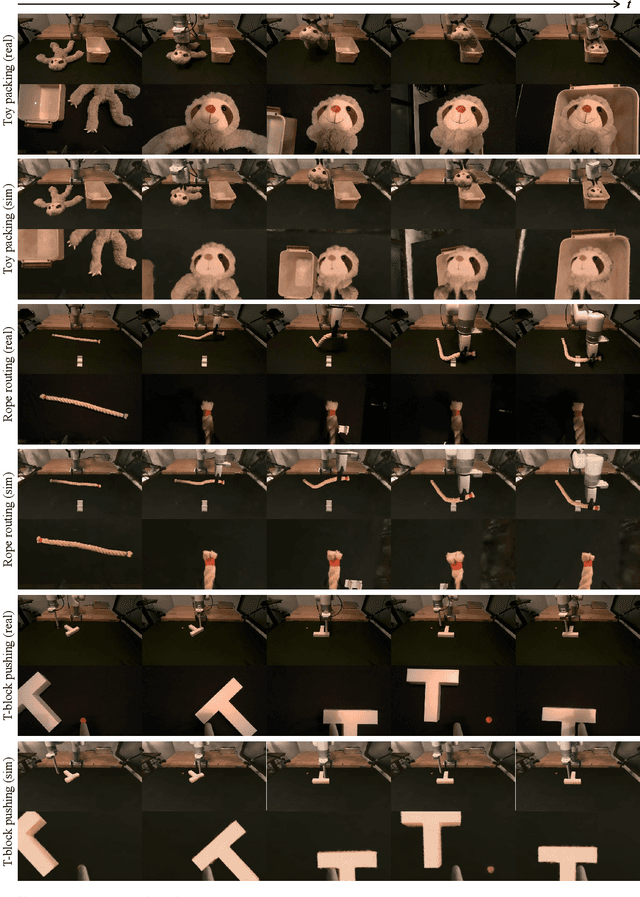
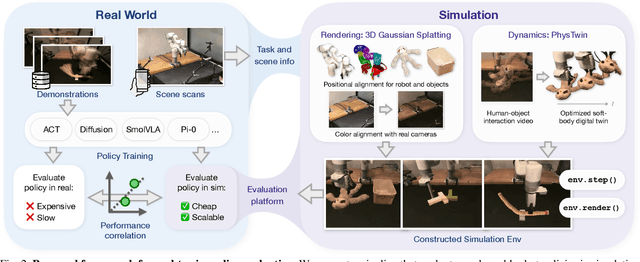
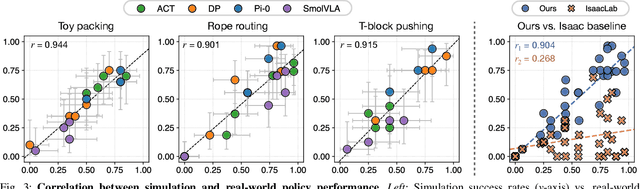
Robotic manipulation policies are advancing rapidly, but their direct evaluation in the real world remains costly, time-consuming, and difficult to reproduce, particularly for tasks involving deformable objects. Simulation provides a scalable and systematic alternative, yet existing simulators often fail to capture the coupled visual and physical complexity of soft-body interactions. We present a real-to-sim policy evaluation framework that constructs soft-body digital twins from real-world videos and renders robots, objects, and environments with photorealistic fidelity using 3D Gaussian Splatting. We validate our approach on representative deformable manipulation tasks, including plush toy packing, rope routing, and T-block pushing, demonstrating that simulated rollouts correlate strongly with real-world execution performance and reveal key behavioral patterns of learned policies. Our results suggest that combining physics-informed reconstruction with high-quality rendering enables reproducible, scalable, and accurate evaluation of robotic manipulation policies. Website: https://real2sim-eval.github.io/