 Add to Chrome
 Add to Firefox
 Add to Edge
If you're waiting for a sign... that might not be it! Mitigating Trust Boundary Confusion from Visual Injections on Vision-Language Agentic Systems
Apr 21, 2026
Recent advances in embodied Vision-Language Agentic Systems (VLAS), powered by large vision-language models (LVLMs), enable AI systems to perceive and reason over real-world scenes. Within this context, environmental signals such as traffic lights are essential in-band signals that can and should influence agent behavior. However, similar signals could also be crafted to operate as misleading visual injections, overriding user intent and posing security risks. This duality creates a fundamental challenge: agents must respond to legitimate environmental cues while remaining robust to misleading ones. We refer to this tension as trust boundary confusion. To study this behavior, we design a dual-intent dataset and evaluation framework, through which we show that current LVLM-based agents fail to reliably balance this trade-off, either ignoring useful signals or following harmful ones. We systematically evaluate 7 LVLM agents across multiple embodied settings under both structure-based and noise-based visual injections. To address these vulnerabilities, we propose a multi-agent defense framework that separates perception from decision-making to dynamically assess the reliability of visual inputs. Our approach significantly reduces misleading behaviors while preserving correct responses and provides robustness guarantees under adversarial perturbations. The code of the evaluation framework and artifacts are made available at https://anonymous.4open.science/r/Visual-Prompt-Inject.

What's Pulling the Strings? Evaluating Integrity and Attribution in AI Training and Inference through Concept Shift
Apr 28, 2025The growing adoption of artificial intelligence (AI) has amplified concerns about trustworthiness, including integrity, privacy, robustness, and bias. To assess and attribute these threats, we propose ConceptLens, a generic framework that leverages pre-trained multimodal models to identify the root causes of integrity threats by analyzing Concept Shift in probing samples. ConceptLens demonstrates strong detection performance for vanilla data poisoning attacks and uncovers vulnerabilities to bias injection, such as the generation of covert advertisements through malicious concept shifts. It identifies privacy risks in unaltered but high-risk samples, filters them before training, and provides insights into model weaknesses arising from incomplete or imbalanced training data. Additionally, at the model level, it attributes concepts that the target model is overly dependent on, identifies misleading concepts, and explains how disrupting key concepts negatively impacts the model. Furthermore, it uncovers sociological biases in generative content, revealing disparities across sociological contexts. Strikingly, ConceptLens reveals how safe training and inference data can be unintentionally and easily exploited, potentially undermining safety alignment. Our study informs actionable insights to breed trust in AI systems, thereby speeding adoption and driving greater innovation.
Copyright Protection and Accountability of Generative AI:Attack, Watermarking and Attribution
Mar 15, 2023
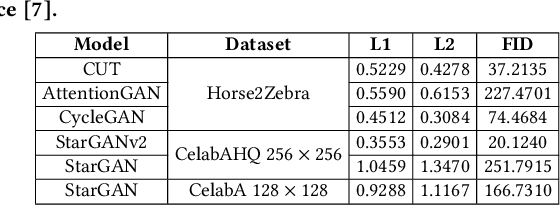
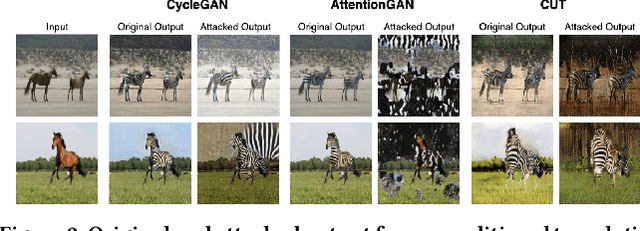
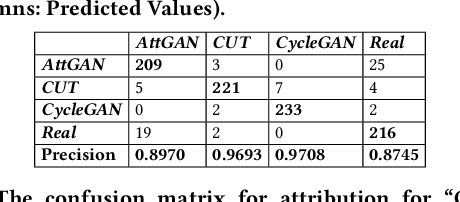
Generative AI (e.g., Generative Adversarial Networks - GANs) has become increasingly popular in recent years. However, Generative AI introduces significant concerns regarding the protection of Intellectual Property Rights (IPR) (resp. model accountability) pertaining to images (resp. toxic images) and models (resp. poisoned models) generated. In this paper, we propose an evaluation framework to provide a comprehensive overview of the current state of the copyright protection measures for GANs, evaluate their performance across a diverse range of GAN architectures, and identify the factors that affect their performance and future research directions. Our findings indicate that the current IPR protection methods for input images, model watermarking, and attribution networks are largely satisfactory for a wide range of GANs. We highlight that further attention must be directed towards protecting training sets, as the current approaches fail to provide robust IPR protection and provenance tracing on training sets.