 Add to Chrome
 Add to Firefox
 Add to Edge
MaLa-ASR: Multimedia-Assisted LLM-Based ASR
Jun 09, 2024
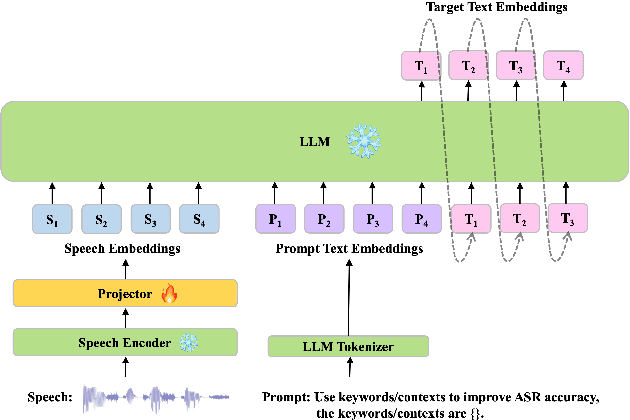
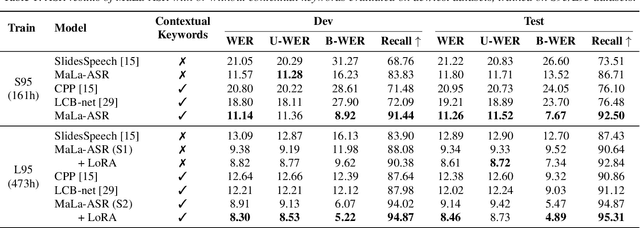

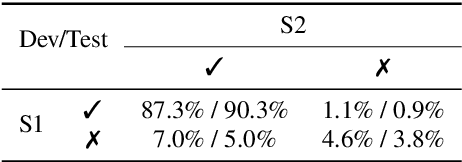
As more and more information-rich data like video become available, utilizing multi-modal auxiliary information to enhance audio tasks has sparked widespread research interest. The recent surge in research on LLM-based audio models provides fresh perspectives for tackling audio tasks. Given that LLM can flexibly ingest multiple inputs, we propose MaLa-ASR, an LLM-based ASR model that can integrate textual keywords extracted from presentation slides to improve recognition of conference content. MaLa-ASR yields average WERs of 9.4% and 11.7% on the L95 and S95 subsets of the SlideSpeech corpus, representing a significant relative WER drop of 27.9% and 44.7% over the baseline model reported in SlideSpeech. MaLa-ASR underscores LLM's strong performance in speech tasks and the capability to integrate auxiliary information conveniently. By adding keywords to the input prompt, the biased word error rate (B-WER) reduces relatively by 46.0% and 44.2%, establishing a new SOTA on this dataset.

LocLLM: Exploiting Generalizable Human Keypoint Localization via Large Language Model
Jun 07, 2024The capacity of existing human keypoint localization models is limited by keypoint priors provided by the training data. To alleviate this restriction and pursue more general model, this work studies keypoint localization from a different perspective by reasoning locations based on keypiont clues in text descriptions. We propose LocLLM, the first Large-Language Model (LLM) based keypoint localization model that takes images and text instructions as inputs and outputs the desired keypoint coordinates. LocLLM leverages the strong reasoning capability of LLM and clues of keypoint type, location, and relationship in textual descriptions for keypoint localization. To effectively tune LocLLM, we construct localization-based instruction conversations to connect keypoint description with corresponding coordinates in input image, and fine-tune the whole model in a parameter-efficient training pipeline. LocLLM shows remarkable performance on standard 2D/3D keypoint localization benchmarks. Moreover, incorporating language clues into the localization makes LocLLM show superior flexibility and generalizable capability in cross dataset keypoint localization, and even detecting novel type of keypoints unseen during training.
OVMR: Open-Vocabulary Recognition with Multi-Modal References
Jun 07, 2024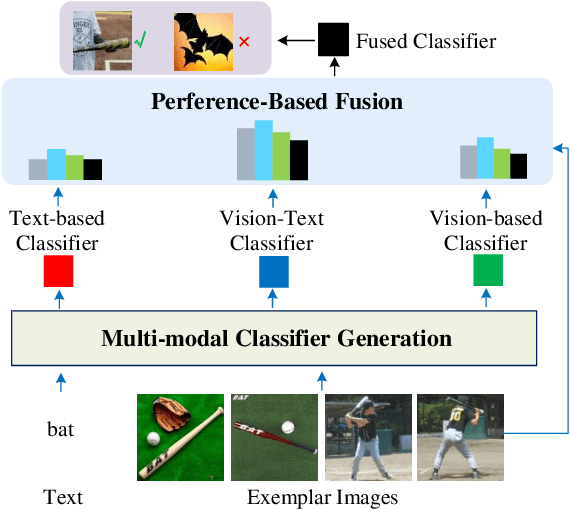

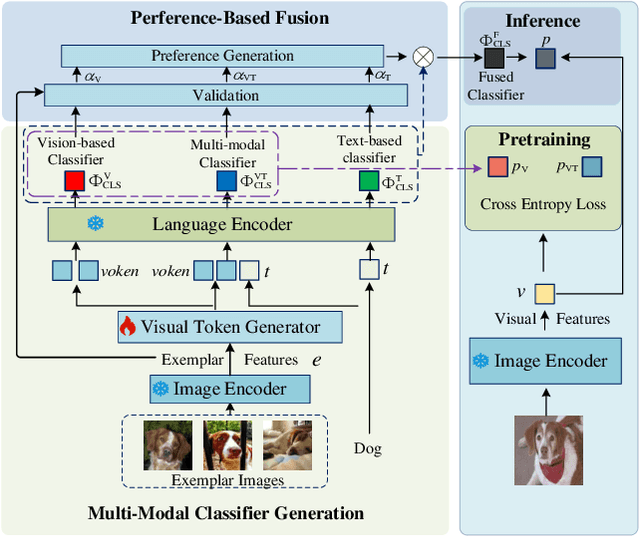

The challenge of open-vocabulary recognition lies in the model has no clue of new categories it is applied to. Existing works have proposed different methods to embed category cues into the model, \eg, through few-shot fine-tuning, providing category names or textual descriptions to Vision-Language Models. Fine-tuning is time-consuming and degrades the generalization capability. Textual descriptions could be ambiguous and fail to depict visual details. This paper tackles open-vocabulary recognition from a different perspective by referring to multi-modal clues composed of textual descriptions and exemplar images. Our method, named OVMR, adopts two innovative components to pursue a more robust category cues embedding. A multi-modal classifier is first generated by dynamically complementing textual descriptions with image exemplars. A preference-based refinement module is hence applied to fuse uni-modal and multi-modal classifiers, with the aim to alleviate issues of low-quality exemplar images or textual descriptions. The proposed OVMR is a plug-and-play module, and works well with exemplar images randomly crawled from the Internet. Extensive experiments have demonstrated the promising performance of OVMR, \eg, it outperforms existing methods across various scenarios and setups. Codes are publicly available at \href{https://github.com/Zehong-Ma/OVMR}{https://github.com/Zehong-Ma/OVMR}.
ERes2NetV2: Boosting Short-Duration Speaker Verification Performance with Computational Efficiency
Jun 04, 2024Speaker verification systems experience significant performance degradation when tasked with short-duration trial recordings. To address this challenge, a multi-scale feature fusion approach has been proposed to effectively capture speaker characteristics from short utterances. Constrained by the model's size, a robust backbone Enhanced Res2Net (ERes2Net) combining global and local feature fusion demonstrates sub-optimal performance in short-duration speaker verification. To further improve the short-duration feature extraction capability of ERes2Net, we expand the channel dimension within each stage. However, this modification also increases the number of model parameters and computational complexity. To alleviate this problem, we propose an improved ERes2NetV2 by pruning redundant structures, ultimately reducing both the model parameters and its computational cost. A range of experiments conducted on the VoxCeleb datasets exhibits the superiority of ERes2NetV2, which achieves EER of 0.61% for the full-duration trial, 0.98% for the 3s-duration trial, and 1.48% for the 2s-duration trial on VoxCeleb1-O, respectively.
MV-VTON: Multi-View Virtual Try-On with Diffusion Models
Apr 29, 2024The goal of image-based virtual try-on is to generate an image of the target person naturally wearing the given clothing. However, most existing methods solely focus on the frontal try-on using the frontal clothing. When the views of the clothing and person are significantly inconsistent, particularly when the person's view is non-frontal, the results are unsatisfactory. To address this challenge, we introduce Multi-View Virtual Try-ON (MV-VTON), which aims to reconstruct the dressing results of a person from multiple views using the given clothes. On the one hand, given that single-view clothes provide insufficient information for MV-VTON, we instead employ two images, i.e., the frontal and back views of the clothing, to encompass the complete view as much as possible. On the other hand, the diffusion models that have demonstrated superior abilities are adopted to perform our MV-VTON. In particular, we propose a view-adaptive selection method where hard-selection and soft-selection are applied to the global and local clothing feature extraction, respectively. This ensures that the clothing features are roughly fit to the person's view. Subsequently, we suggest a joint attention block to align and fuse clothing features with person features. Additionally, we collect a MV-VTON dataset, i.e., Multi-View Garment (MVG), in which each person has multiple photos with diverse views and poses. Experiments show that the proposed method not only achieves state-of-the-art results on MV-VTON task using our MVG dataset, but also has superiority on frontal-view virtual try-on task using VITON-HD and DressCode datasets. Codes and datasets will be publicly released at https://github.com/hywang2002/MV-VTON .
3D-Speaker-Toolkit: An Open Source Toolkit for Multi-modal Speaker Verification and Diarization
Mar 29, 2024This paper introduces 3D-Speaker-Toolkit, an open source toolkit for multi-modal speaker verification and diarization. It is designed for the needs of academic researchers and industrial practitioners. The 3D-Speaker-Toolkit adeptly leverages the combined strengths of acoustic, semantic, and visual data, seamlessly fusing these modalities to offer robust speaker recognition capabilities. The acoustic module extracts speaker embeddings from acoustic features, employing both fully-supervised and self-supervised learning approaches. The semantic module leverages advanced language models to apprehend the substance and context of spoken language, thereby augmenting the system's proficiency in distinguishing speakers through linguistic patterns. Finally, the visual module applies image processing technologies to scrutinize facial features, which bolsters the precision of speaker diarization in multi-speaker environments. Collectively, these modules empower the 3D-Speaker-Toolkit to attain elevated levels of accuracy and dependability in executing speaker-related tasks, establishing a new benchmark in multi-modal speaker analysis. The 3D-Speaker project also includes a handful of open-sourced state-of-the-art models and a large dataset containing over 10,000 speakers. The toolkit is publicly available at https://github.com/alibaba-damo-academy/3D-Speaker.
Decoupled Contrastive Learning for Long-Tailed Recognition
Mar 10, 2024Supervised Contrastive Loss (SCL) is popular in visual representation learning. Given an anchor image, SCL pulls two types of positive samples, i.e., its augmentation and other images from the same class together, while pushes negative images apart to optimize the learned embedding. In the scenario of long-tailed recognition, where the number of samples in each class is imbalanced, treating two types of positive samples equally leads to the biased optimization for intra-category distance. In addition, similarity relationship among negative samples, that are ignored by SCL, also presents meaningful semantic cues. To improve the performance on long-tailed recognition, this paper addresses those two issues of SCL by decoupling the training objective. Specifically, it decouples two types of positives in SCL and optimizes their relations toward different objectives to alleviate the influence of the imbalanced dataset. We further propose a patch-based self distillation to transfer knowledge from head to tail classes to relieve the under-representation of tail classes. It uses patch-based features to mine shared visual patterns among different instances and leverages a self distillation procedure to transfer such knowledge. Experiments on different long-tailed classification benchmarks demonstrate the superiority of our method. For instance, it achieves the 57.7% top-1 accuracy on the ImageNet-LT dataset. Combined with the ensemble-based method, the performance can be further boosted to 59.7%, which substantially outperforms many recent works. The code is available at https://github.com/SY-Xuan/DSCL.
An Embarrassingly Simple Approach for LLM with Strong ASR Capacity
Feb 13, 2024In this paper, we focus on solving one of the most important tasks in the field of speech processing, i.e., automatic speech recognition (ASR), with speech foundation encoders and large language models (LLM). Recent works have complex designs such as compressing the output temporally for the speech encoder, tackling modal alignment for the projector, and utilizing parameter-efficient fine-tuning for the LLM. We found that delicate designs are not necessary, while an embarrassingly simple composition of off-the-shelf speech encoder, LLM, and the only trainable linear projector is competent for the ASR task. To be more specific, we benchmark and explore various combinations of LLMs and speech encoders, leading to the optimal LLM-based ASR system, which we call SLAM-ASR. The proposed SLAM-ASR provides a clean setup and little task-specific design, where only the linear projector is trained. To the best of our knowledge, SLAM-ASR achieves the best performance on the Librispeech benchmark among LLM-based ASR models and even outperforms the latest LLM-based audio-universal model trained on massive pair data. Finally, we explore the capability emergence of LLM-based ASR in the process of modal alignment. We hope that our study can facilitate the research on extending LLM with cross-modality capacity and shed light on the LLM-based ASR community.
LCB-net: Long-Context Biasing for Audio-Visual Speech Recognition
Jan 12, 2024The growing prevalence of online conferences and courses presents a new challenge in improving automatic speech recognition (ASR) with enriched textual information from video slides. In contrast to rare phrase lists, the slides within videos are synchronized in real-time with the speech, enabling the extraction of long contextual bias. Therefore, we propose a novel long-context biasing network (LCB-net) for audio-visual speech recognition (AVSR) to leverage the long-context information available in videos effectively. Specifically, we adopt a bi-encoder architecture to simultaneously model audio and long-context biasing. Besides, we also propose a biasing prediction module that utilizes binary cross entropy (BCE) loss to explicitly determine biased phrases in the long-context biasing. Furthermore, we introduce a dynamic contextual phrases simulation to enhance the generalization and robustness of our LCB-net. Experiments on the SlideSpeech, a large-scale audio-visual corpus enriched with slides, reveal that our proposed LCB-net outperforms general ASR model by 9.4%/9.1%/10.9% relative WER/U-WER/B-WER reduction on test set, which enjoys high unbiased and biased performance. Moreover, we also evaluate our model on LibriSpeech corpus, leading to 23.8%/19.2%/35.4% relative WER/U-WER/B-WER reduction over the ASR model.
E-chat: Emotion-sensitive Spoken Dialogue System with Large Language Models
Jan 06, 2024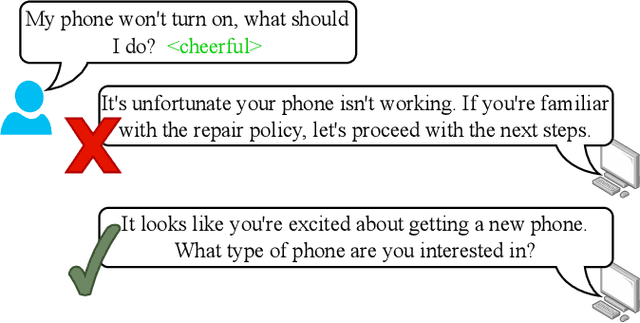
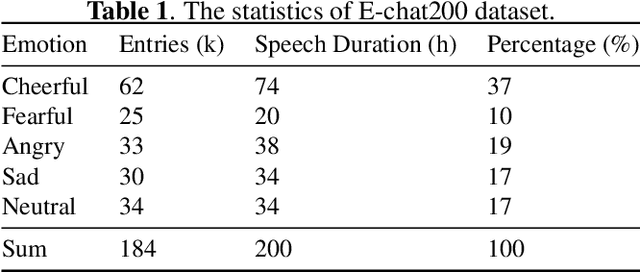
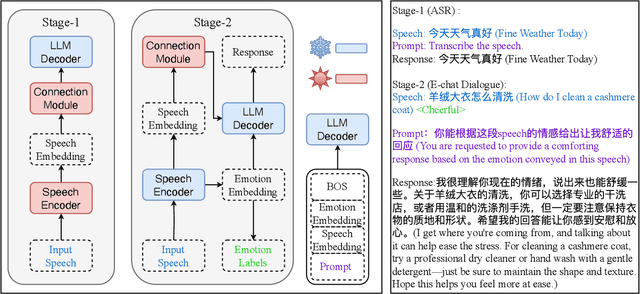
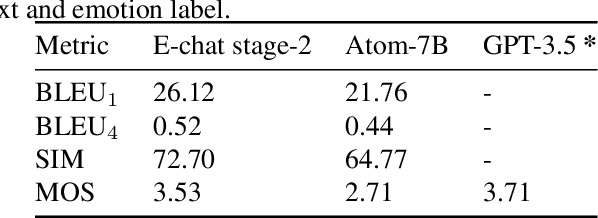
This study focuses on emotion-sensitive spoken dialogue in human-machine speech interaction. With the advancement of Large Language Models (LLMs), dialogue systems can handle multimodal data, including audio. Recent models have enhanced the understanding of complex audio signals through the integration of various audio events. However, they are unable to generate appropriate responses based on emotional speech. To address this, we introduce the Emotional chat Model (E-chat), a novel spoken dialogue system capable of comprehending and responding to emotions conveyed from speech. This model leverages an emotion embedding extracted by a speech encoder, combined with LLMs, enabling it to respond according to different emotional contexts. Additionally, we introduce the E-chat200 dataset, designed explicitly for emotion-sensitive spoken dialogue. In various evaluation metrics, E-chat consistently outperforms baseline LLMs, demonstrating its potential in emotional comprehension and human-machine interaction.