 Add to Chrome
 Add to Firefox
 Add to Edge
VaaWIT: Visual-Aware Adaptation of Large Language Models for Multilingual Web Image Translation
May 23, 2026
Translating text embedded in Web images is crucial for improving content accessibility and cross-lingual information retrieval, particularly within social media and e-commerce domains. Although Large Vision-Language Models (LVLMs) have advanced multimodal understanding, applying them to Web image translation remains challenging due to the visual representation gap: standard encoders often prioritize high-level semantics over the fine-grained visual details required for recognizing diverse character morphologies. To address this challenge, we propose VaaWIT, an end-to-end framework that adapts Large Language Models for multilingual Web image translation. The framework introduces two key technical contributions: (1) a Dual-Stream Attention Module (DSAM), which facilitates bidirectional interaction between multilingual semantic features and detailed visual representations, thereby synthesizing unified features robust to textual variations; and (2) a Visual-Aware Adapter (VAA), a parameter-efficient fine-tuning strategy that dynamically injects these fused visual cues into the frozen LLM backbone. This design enables the model to align the visual context with linguistic reasoning effectively while minimizing computational costs. Extensive experiments on eight tasks on three public benchmarks demonstrate that VaaWIT significantly outperforms state-of-the-art (SOTA) open-source baselines and achieves competitive performance against proprietary models. These results validate the efficacy of integrating fine-grained visual perception into LLMs for complex Web content analysis.

Assessing and Mitigating Miscalibration in LLM-Based Social Science Measurement
May 12, 2026Large language models (LLMs) are increasingly used in social science as scalable measurement tools for converting unstructured text into variables that can enter standard empirical designs. Measurement validity demands more than high average accuracy, which requires well calibrated confidence that faithfully reflects the empirical probability of each measurement being correct. This paper studies the model miscalibration in LLM-based social science measurement. We begin with a case study on FOMC and show that confidence based filtering can change downstream regression estimates when LLM confidence is miscalibrated. We then audit calibration across 14 social science constructs covering both proprietary models, including GPT-5-mini, DeepSeek-V3.2, and open source models. Across tasks and model families, reported confidence is poorly aligned with tolerance-based correctness. As a simple mitigation, we propose a soft label distillation pipeline for calibrating Bert with LLM. The method converts an LLM score and its verbalized confidence into a soft target distribution, then trains a smaller discriminative classifier on encoder models for these targets. Averaged across datasets, this approach reduces ECE by 43.2\% and Brier by 34.0\%. These results suggest that LLM-based social science pipelines should treat calibration as part of measurement validity, rather than as an optional post-processing concern.
Multi-Scale and Multi-Objective Optimization for Cross-Lingual Aspect-Based Sentiment Analysis
Feb 19, 2025Aspect-based sentiment analysis (ABSA) is a sequence labeling task that has garnered growing research interest in multilingual contexts. However, recent studies lack more robust feature alignment and finer aspect-level alignment. In this paper, we propose a novel framework, Multi-Scale and Multi-Objective optimization (MSMO) for cross-lingual ABSA. During multi-scale alignment, we achieve cross-lingual sentence-level and aspect-level alignment, aligning features of aspect terms in different contextual environments. Specifically, we introduce code-switched bilingual sentences into the language discriminator and consistency training modules to enhance the model's robustness. During multi-objective optimization, we design two optimization objectives: supervised training and consistency training, aiming to enhance cross-lingual semantic alignment. To further improve model performance, we incorporate distilled knowledge of the target language into the model. Results show that MSMO significantly enhances cross-lingual ABSA by achieving state-of-the-art performance across multiple languages and models.
M-ABSA: A Multilingual Dataset for Aspect-Based Sentiment Analysis
Feb 17, 2025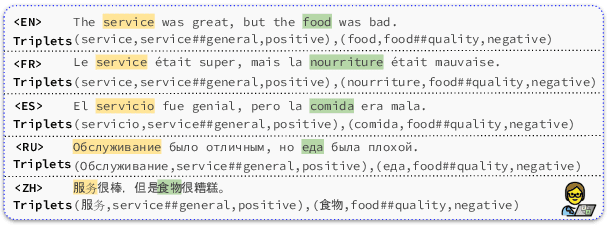
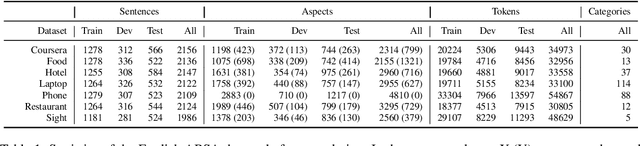
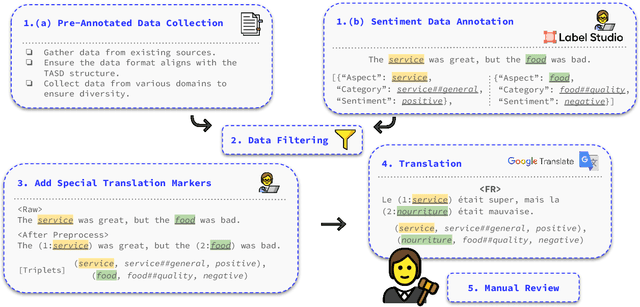
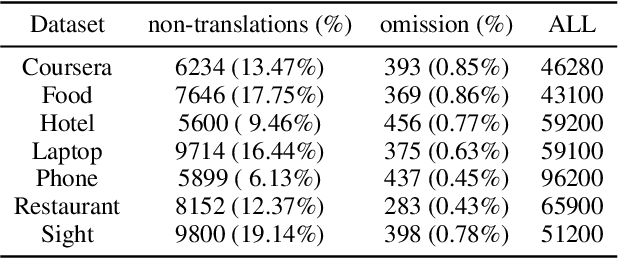
Aspect-based sentiment analysis (ABSA) is a crucial task in information extraction and sentiment analysis, aiming to identify aspects with associated sentiment elements in text. However, existing ABSA datasets are predominantly English-centric, limiting the scope for multilingual evaluation and research. To bridge this gap, we present M-ABSA, a comprehensive dataset spanning 7 domains and 21 languages, making it the most extensive multilingual parallel dataset for ABSA to date. Our primary focus is on triplet extraction, which involves identifying aspect terms, aspect categories, and sentiment polarities. The dataset is constructed through an automatic translation process with human review to ensure quality. We perform extensive experiments using various baselines to assess performance and compatibility on M-ABSA. Our empirical findings highlight that the dataset enables diverse evaluation tasks, such as multilingual and multi-domain transfer learning, and large language model evaluation, underscoring its inclusivity and its potential to drive advancements in multilingual ABSA research.
Evaluating Zero-Shot Multilingual Aspect-Based Sentiment Analysis with Large Language Models
Dec 17, 2024


Aspect-based sentiment analysis (ABSA), a sequence labeling task, has attracted increasing attention in multilingual contexts. While previous research has focused largely on fine-tuning or training models specifically for ABSA, we evaluate large language models (LLMs) under zero-shot conditions to explore their potential to tackle this challenge with minimal task-specific adaptation. We conduct a comprehensive empirical evaluation of a series of LLMs on multilingual ABSA tasks, investigating various prompting strategies, including vanilla zero-shot, chain-of-thought (CoT), self-improvement, self-debate, and self-consistency, across nine different models. Results indicate that while LLMs show promise in handling multilingual ABSA, they generally fall short of fine-tuned, task-specific models. Notably, simpler zero-shot prompts often outperform more complex strategies, especially in high-resource languages like English. These findings underscore the need for further refinement of LLM-based approaches to effectively address ABSA task across diverse languages.