 Add to Chrome
 Add to Firefox
 Add to Edge
GTP-ViT: Efficient Vision Transformers via Graph-based Token Propagation
Nov 06, 2023
Vision Transformers (ViTs) have revolutionized the field of computer vision, yet their deployments on resource-constrained devices remain challenging due to high computational demands. To expedite pre-trained ViTs, token pruning and token merging approaches have been developed, which aim at reducing the number of tokens involved in the computation. However, these methods still have some limitations, such as image information loss from pruned tokens and inefficiency in the token-matching process. In this paper, we introduce a novel Graph-based Token Propagation (GTP) method to resolve the challenge of balancing model efficiency and information preservation for efficient ViTs. Inspired by graph summarization algorithms, GTP meticulously propagates less significant tokens' information to spatially and semantically connected tokens that are of greater importance. Consequently, the remaining few tokens serve as a summarization of the entire token graph, allowing the method to reduce computational complexity while preserving essential information of eliminated tokens. Combined with an innovative token selection strategy, GTP can efficiently identify image tokens to be propagated. Extensive experiments have validated GTP's effectiveness, demonstrating both efficiency and performance improvements. Specifically, GTP decreases the computational complexity of both DeiT-S and DeiT-B by up to 26% with only a minimal 0.3% accuracy drop on ImageNet-1K without finetuning, and remarkably surpasses the state-of-the-art token merging method on various backbones at an even faster inference speed. The source code is available at https://github.com/Ackesnal/GTP-ViT.

In Search of Lost Online Test-time Adaptation: A Survey
Oct 31, 2023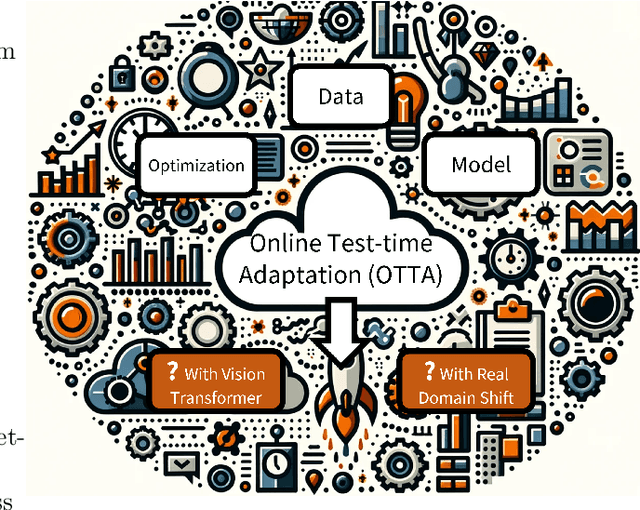

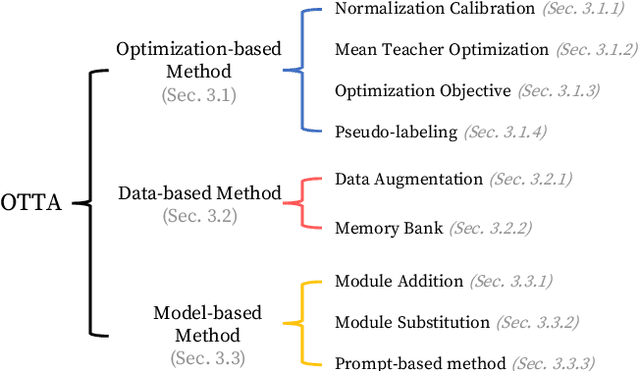

In this paper, we present a comprehensive survey on online test-time adaptation (OTTA), a paradigm focused on adapting machine learning models to novel data distributions upon batch arrival. Despite the proliferation of OTTA methods recently, the field is mired in issues like ambiguous settings, antiquated backbones, and inconsistent hyperparameter tuning, obfuscating the real challenges and making reproducibility elusive. For clarity and a rigorous comparison, we classify OTTA techniques into three primary categories and subject them to benchmarks using the potent Vision Transformer (ViT) backbone to discover genuinely effective strategies. Our benchmarks span not only conventional corrupted datasets such as CIFAR-10/100-C and ImageNet-C but also real-world shifts embodied in CIFAR-10.1 and CIFAR-10-Warehouse, encapsulating variations across search engines and synthesized data by diffusion models. To gauge efficiency in online scenarios, we introduce novel evaluation metrics, inclusive of FLOPs, shedding light on the trade-offs between adaptation accuracy and computational overhead. Our findings diverge from existing literature, indicating: (1) transformers exhibit heightened resilience to diverse domain shifts, (2) the efficacy of many OTTA methods hinges on ample batch sizes, and (3) stability in optimization and resistance to perturbations are critical during adaptation, especially when the batch size is 1. Motivated by these insights, we pointed out promising directions for future research. The source code will be made available.
Understanding the Effects of Projectors in Knowledge Distillation
Oct 26, 2023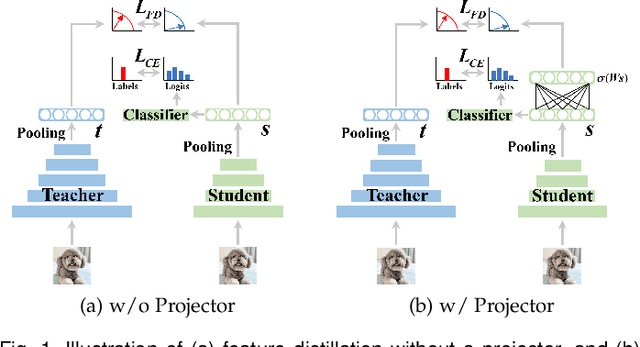

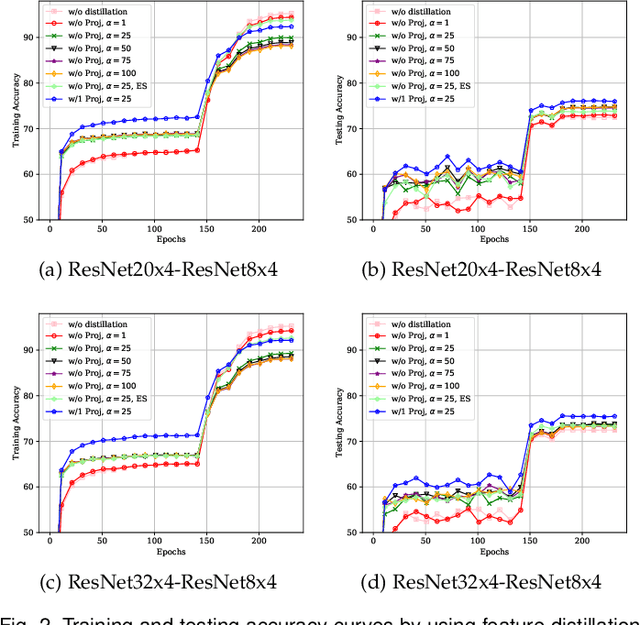
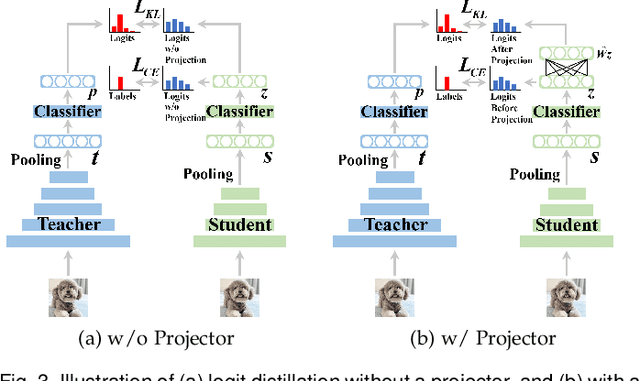
Conventionally, during the knowledge distillation process (e.g. feature distillation), an additional projector is often required to perform feature transformation due to the dimension mismatch between the teacher and the student networks. Interestingly, we discovered that even if the student and the teacher have the same feature dimensions, adding a projector still helps to improve the distillation performance. In addition, projectors even improve logit distillation if we add them to the architecture too. Inspired by these surprising findings and the general lack of understanding of the projectors in the knowledge distillation process from existing literature, this paper investigates the implicit role that projectors play but so far have been overlooked. Our empirical study shows that the student with a projector (1) obtains a better trade-off between the training accuracy and the testing accuracy compared to the student without a projector when it has the same feature dimensions as the teacher, (2) better preserves its similarity to the teacher beyond shallow and numeric resemblance, from the view of Centered Kernel Alignment (CKA), and (3) avoids being over-confident as the teacher does at the testing phase. Motivated by the positive effects of projectors, we propose a projector ensemble-based feature distillation method to further improve distillation performance. Despite the simplicity of the proposed strategy, empirical results from the evaluation of classification tasks on benchmark datasets demonstrate the superior classification performance of our method on a broad range of teacher-student pairs and verify from the aspects of CKA and model calibration that the student's features are of improved quality with the projector ensemble design.
MonoSKD: General Distillation Framework for Monocular 3D Object Detection via Spearman Correlation Coefficient
Oct 17, 2023Monocular 3D object detection is an inherently ill-posed problem, as it is challenging to predict accurate 3D localization from a single image. Existing monocular 3D detection knowledge distillation methods usually project the LiDAR onto the image plane and train the teacher network accordingly. Transferring LiDAR-based model knowledge to RGB-based models is more complex, so a general distillation strategy is needed. To alleviate cross-modal prob-lem, we propose MonoSKD, a novel Knowledge Distillation framework for Monocular 3D detection based on Spearman correlation coefficient, to learn the relative correlation between cross-modal features. Considering the large gap between these features, strict alignment of features may mislead the training, so we propose a looser Spearman loss. Furthermore, by selecting appropriate distillation locations and removing redundant modules, our scheme saves more GPU resources and trains faster than existing methods. Extensive experiments are performed to verify the effectiveness of our framework on the challenging KITTI 3D object detection benchmark. Our method achieves state-of-the-art performance until submission with no additional inference computational cost. Our codes are available at https://github.com/Senwang98/MonoSKD
Plug n' Play: Channel Shuffle Module for Enhancing Tiny Vision Transformers
Oct 09, 2023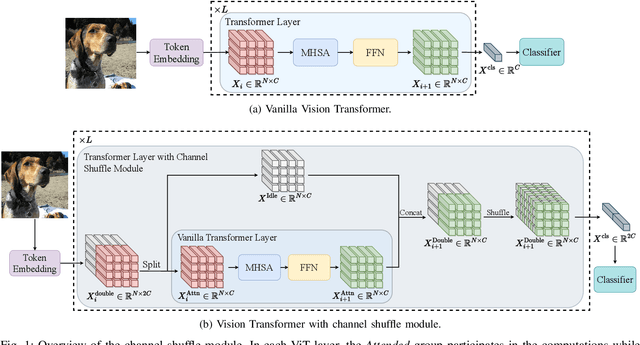

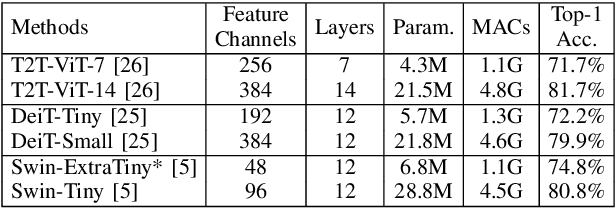
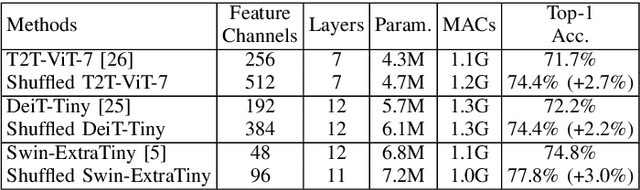
Vision Transformers (ViTs) have demonstrated remarkable performance in various computer vision tasks. However, the high computational complexity hinders ViTs' applicability on devices with limited memory and computing resources. Although certain investigations have delved into the fusion of convolutional layers with self-attention mechanisms to enhance the efficiency of ViTs, there remains a knowledge gap in constructing tiny yet effective ViTs solely based on the self-attention mechanism. Furthermore, the straightforward strategy of reducing the feature channels in a large but outperforming ViT often results in significant performance degradation despite improved efficiency. To address these challenges, we propose a novel channel shuffle module to improve tiny-size ViTs, showing the potential of pure self-attention models in environments with constrained computing resources. Inspired by the channel shuffle design in ShuffleNetV2 \cite{ma2018shufflenet}, our module expands the feature channels of a tiny ViT and partitions the channels into two groups: the \textit{Attended} and \textit{Idle} groups. Self-attention computations are exclusively employed on the designated \textit{Attended} group, followed by a channel shuffle operation that facilitates information exchange between the two groups. By incorporating our module into a tiny ViT, we can achieve superior performance while maintaining a comparable computational complexity to the vanilla model. Specifically, our proposed channel shuffle module consistently improves the top-1 accuracy on the ImageNet-1K dataset for various tiny ViT models by up to 2.8\%, with the changes in model complexity being less than 0.03 GMACs.
No Token Left Behind: Efficient Vision Transformer via Dynamic Token Idling
Oct 09, 2023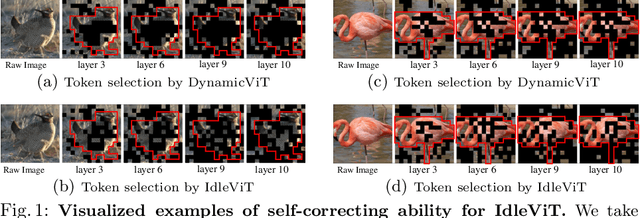
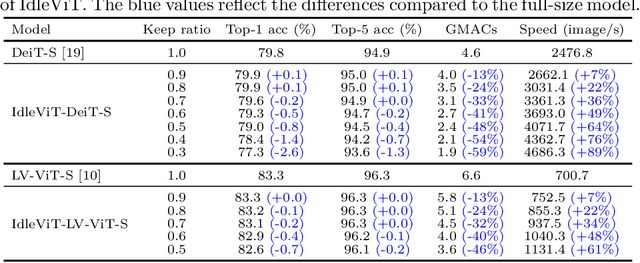
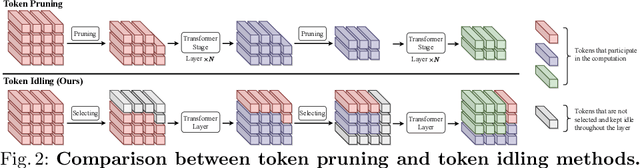

Vision Transformers (ViTs) have demonstrated outstanding performance in computer vision tasks, yet their high computational complexity prevents their deployment in computing resource-constrained environments. Various token pruning techniques have been introduced to alleviate the high computational burden of ViTs by dynamically dropping image tokens. However, some undesirable pruning at early stages may result in permanent loss of image information in subsequent layers, consequently hindering model performance. To address this problem, we propose IdleViT, a dynamic token-idle-based method that achieves an excellent trade-off between performance and efficiency. Specifically, in each layer, IdleViT selects a subset of the image tokens to participate in computations while keeping the rest of the tokens idle and directly passing them to this layer's output. By allowing the idle tokens to be re-selected in the following layers, IdleViT mitigates the negative impact of improper pruning in the early stages. Furthermore, inspired by the normalized graph cut, we devise a token cut loss on the attention map as regularization to improve IdleViT's token selection ability. Our method is simple yet effective and can be extended to pyramid ViTs since no token is completely dropped. Extensive experimental results on various ViT architectures have shown that IdleViT can diminish the complexity of pretrained ViTs by up to 33\% with no more than 0.2\% accuracy decrease on ImageNet, after finetuning for only 30 epochs. Notably, when the keep ratio is 0.5, IdleViT outperforms the state-of-the-art EViT on DeiT-S by 0.5\% higher accuracy and even faster inference speed. The source code is available in the supplementary material.
HI-SLAM: Monocular Real-time Dense Mapping with Hybrid Implicit Fields
Oct 07, 2023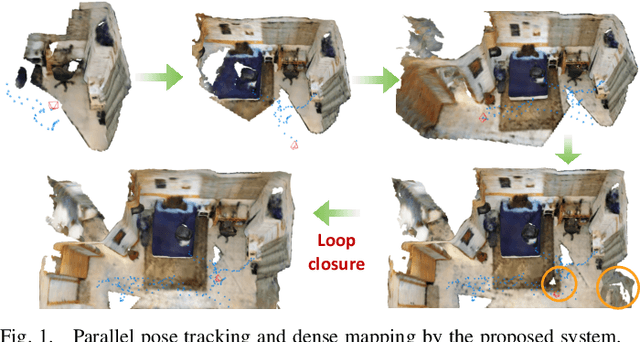
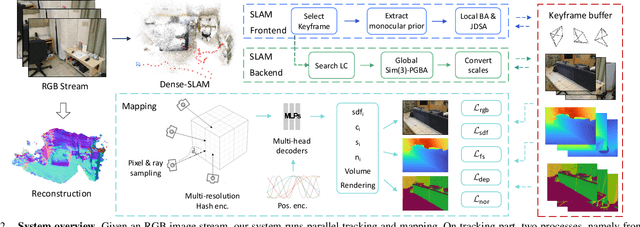


In this letter, we present a neural field-based real-time monocular mapping framework for accurate and dense Simultaneous Localization and Mapping (SLAM). Recent neural mapping frameworks show promising results, but rely on RGB-D or pose inputs, or cannot run in real-time. To address these limitations, our approach integrates dense-SLAM with neural implicit fields. Specifically, our dense SLAM approach runs parallel tracking and global optimization, while a neural field-based map is constructed incrementally based on the latest SLAM estimates. For the efficient construction of neural fields, we employ multi-resolution grid encoding and signed distance function (SDF) representation. This allows us to keep the map always up-to-date and adapt instantly to global updates via loop closing. For global consistency, we propose an efficient Sim(3)-based pose graph bundle adjustment (PGBA) approach to run online loop closing and mitigate the pose and scale drift. To enhance depth accuracy further, we incorporate learned monocular depth priors. We propose a novel joint depth and scale adjustment (JDSA) module to solve the scale ambiguity inherent in depth priors. Extensive evaluations across synthetic and real-world datasets validate that our approach outperforms existing methods in accuracy and map completeness while preserving real-time performance.
Object Detection Difficulty: Suppressing Over-aggregation for Faster and Better Video Object Detection
Aug 22, 2023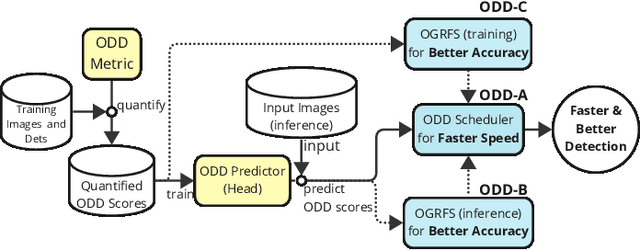
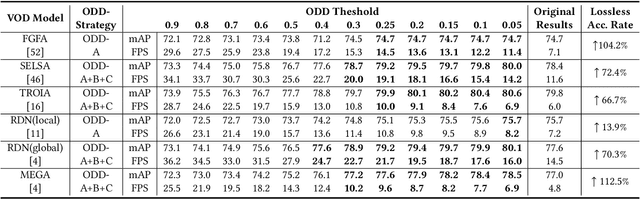
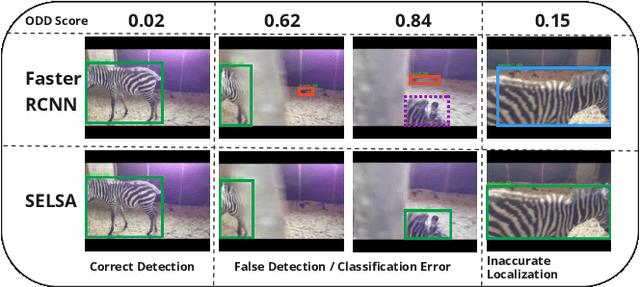

Current video object detection (VOD) models often encounter issues with over-aggregation due to redundant aggregation strategies, which perform feature aggregation on every frame. This results in suboptimal performance and increased computational complexity. In this work, we propose an image-level Object Detection Difficulty (ODD) metric to quantify the difficulty of detecting objects in a given image. The derived ODD scores can be used in the VOD process to mitigate over-aggregation. Specifically, we train an ODD predictor as an auxiliary head of a still-image object detector to compute the ODD score for each image based on the discrepancies between detection results and ground-truth bounding boxes. The ODD score enhances the VOD system in two ways: 1) it enables the VOD system to select superior global reference frames, thereby improving overall accuracy; and 2) it serves as an indicator in the newly designed ODD Scheduler to eliminate the aggregation of frames that are easy to detect, thus accelerating the VOD process. Comprehensive experiments demonstrate that, when utilized for selecting global reference frames, ODD-VOD consistently enhances the accuracy of Global-frame-based VOD models. When employed for acceleration, ODD-VOD consistently improves the frames per second (FPS) by an average of 73.3% across 8 different VOD models without sacrificing accuracy. When combined, ODD-VOD attains state-of-the-art performance when competing with many VOD methods in both accuracy and speed. Our work represents a significant advancement towards making VOD more practical for real-world applications.
Enhancing AUV Autonomy With Model Predictive Path Integral Control
Aug 10, 2023


Autonomous underwater vehicles (AUVs) play a crucial role in surveying marine environments, carrying out underwater inspection tasks, and ocean exploration. However, in order to ensure that the AUV is able to carry out its mission successfully, a control system capable of adapting to changing environmental conditions is required. Furthermore, to ensure the robotic platform's safe operation, the onboard controller should be able to operate under certain constraints. In this work, we investigate the feasibility of Model Predictive Path Integral Control (MPPI) for the control of an AUV. We utilise a non-linear model of the AUV to propagate the samples of the MPPI, which allow us to compute the control action in real time. We provide a detailed evaluation of the effect of the main hyperparameters on the performance of the MPPI controller. Furthermore, we compared the performance of the proposed method with a classical PID and Cascade PID approach, demonstrating the superiority of our proposed controller. Finally, we present results where environmental constraints are added and show how MPPI can handle them by simply incorporating those constraints in the cost function.
Cal-SFDA: Source-Free Domain-adaptive Semantic Segmentation with Differentiable Expected Calibration Error
Aug 06, 2023The prevalence of domain adaptive semantic segmentation has prompted concerns regarding source domain data leakage, where private information from the source domain could inadvertently be exposed in the target domain. To circumvent the requirement for source data, source-free domain adaptation has emerged as a viable solution that leverages self-training methods to pseudo-label high-confidence regions and adapt the model to the target data. However, the confidence scores obtained are often highly biased due to over-confidence and class-imbalance issues, which render both model selection and optimization problematic. In this paper, we propose a novel calibration-guided source-free domain adaptive semantic segmentation (Cal-SFDA) framework. The core idea is to estimate the expected calibration error (ECE) from the segmentation predictions, serving as a strong indicator of the model's generalization capability to the unlabeled target domain. The estimated ECE scores, in turn, assist the model training and fair selection in both source training and target adaptation stages. During model pre-training on the source domain, we ensure the differentiability of the ECE objective by leveraging the LogSumExp trick and using ECE scores to select the best source checkpoints for adaptation. To enable ECE estimation on the target domain without requiring labels, we train a value net for ECE estimation and apply statistic warm-up on its BatchNorm layers for stability. The estimated ECE scores assist in determining the reliability of prediction and enable class-balanced pseudo-labeling by positively guiding the adaptation progress and inhibiting potential error accumulation. Extensive experiments on two widely-used synthetic-to-real transfer tasks show that the proposed approach surpasses previous state-of-the-art by up to 5.25% of mIoU with fair model selection criteria.