 Add to Chrome
 Add to Firefox
 Add to Edge
TideGS: Scalable Training of Over One Billion 3D Gaussian Splatting Primitives via Out-of-Core Optimization
May 19, 2026
Training 3D Gaussian Splatting (3DGS) at billion-primitive scale is fundamentally memory-bound: each Gaussian primitive carries a large attribute vector, and the aggregate parameter table quickly exceeds GPU capacity, limiting prior systems to tens of millions of Gaussians on commodity single-GPU hardware. We observe that 3DGS training is inherently sparse and trajectory-conditioned: each iteration activates only the Gaussians visible from the current camera batch, so GPU memory can serve as a working-set cache rather than a persistent parameter store. Building on this insight, we introduce TideGS, an out-of-core training framework that manages parameters across an SSD-CPU-GPU hierarchy via three synergistic techniques: block-virtualized geometry for SSD-aligned spatial locality, a hierarchical asynchronous pipeline to overlap I/O with computation, and trajectory-adaptive differential streaming that transfers only incremental working-set deltas between iterations. Experiments show that TideGS enables training with over one billion Gaussians on a single 24 GB GPU while achieving the best reconstruction quality among evaluated single-GPU baselines on large-scale scenes, scaling beyond prior out-of-core baselines (e.g., approximately 100M Gaussians) and standard in-memory training (e.g., approximately 11M Gaussians).

HI-SLAM: Monocular Real-time Dense Mapping with Hybrid Implicit Fields
Oct 07, 2023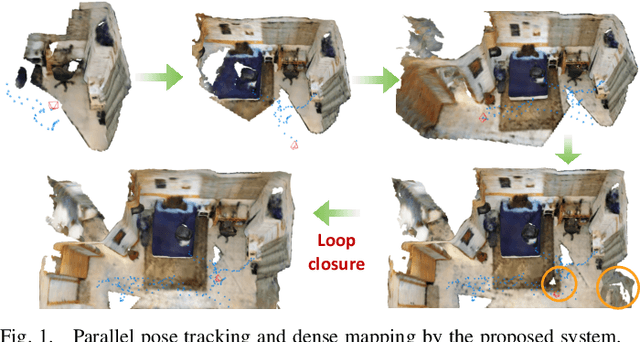
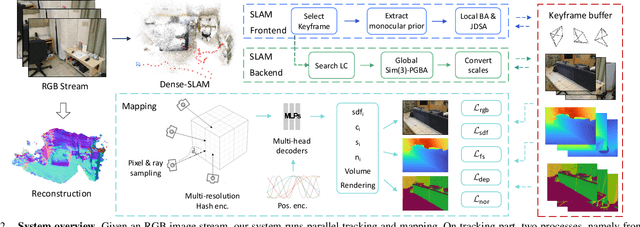


In this letter, we present a neural field-based real-time monocular mapping framework for accurate and dense Simultaneous Localization and Mapping (SLAM). Recent neural mapping frameworks show promising results, but rely on RGB-D or pose inputs, or cannot run in real-time. To address these limitations, our approach integrates dense-SLAM with neural implicit fields. Specifically, our dense SLAM approach runs parallel tracking and global optimization, while a neural field-based map is constructed incrementally based on the latest SLAM estimates. For the efficient construction of neural fields, we employ multi-resolution grid encoding and signed distance function (SDF) representation. This allows us to keep the map always up-to-date and adapt instantly to global updates via loop closing. For global consistency, we propose an efficient Sim(3)-based pose graph bundle adjustment (PGBA) approach to run online loop closing and mitigate the pose and scale drift. To enhance depth accuracy further, we incorporate learned monocular depth priors. We propose a novel joint depth and scale adjustment (JDSA) module to solve the scale ambiguity inherent in depth priors. Extensive evaluations across synthetic and real-world datasets validate that our approach outperforms existing methods in accuracy and map completeness while preserving real-time performance.