 Add to Chrome
 Add to Firefox
 Add to Edge
Extreme-MIMO Field Trials in 7 GHz Band: Unlocking the Potential of New Spectrum for 6G
Mar 23, 2026
The frequency range around 7 GHz has emerged as a promising upper mid-band spectrum for 6th generation (6G), offering a practical balance between coverage and capacity. To fully exploit this band, however, future systems require substantially stronger beamforming and spatial multiplexing capability than today's 5G 64-port commercial deployments. This article investigates extreme multiple-input multiple-output (X-MIMO) with 256 digital ports as a practical 6G architecture for 7 GHz operation. First, through system-level simulations, we examine the throughput benefits and design trade-offs of increasing the number of base station (BS) and user equipment (UE) digital antenna ports, including comparisons between 128-port and 256-port configurations. We then present a 256-port 7 GHz BS and UE prototype and report field-trial results obtained in urban outdoor environments. The measurements demonstrate the feasibility of 8-layer downlink single-user MIMO over a 100 MHz bandwidth, achieving more than 3 Gbps for a single user under urban outdoor propagation conditions. Channel analysis based on measured data further suggests how the large digital aperture of X-MIMO supports high-order spatial multiplexing even with limited dominant angular clusters. Finally, we identify key challenges and outline research directions toward practical deployment of 7 GHz X-MIMO systems for 6G.

An Ultra-Wideband Study of Vegetation Impact on Upper Midband / FR3 Communication
Dec 20, 2024Growing demand for high data rates is driving interest in the upper mid-band (FR 3) spectrum (6-24 GHz). While some propagation measurements exist in literature, the impact of vegetation on link performance remains under-explored. This study examines vegetation-induced losses in an urban scenario across 6-18 GHz. A simple method for calculating vegetation depth is introduced, along with a model that quantifies additional attenuation based on vegetation depth and frequency, divided into 1 GHz sub-bands. We see that excess vegetation loss increases with vegetation depth and higher frequencies. These findings provide insights for designing reliable, foliage-aware communication networks in FR 3.
Joint Phase Time Array: Opportunities, Challenges and System Design Considerations
Dec 02, 2024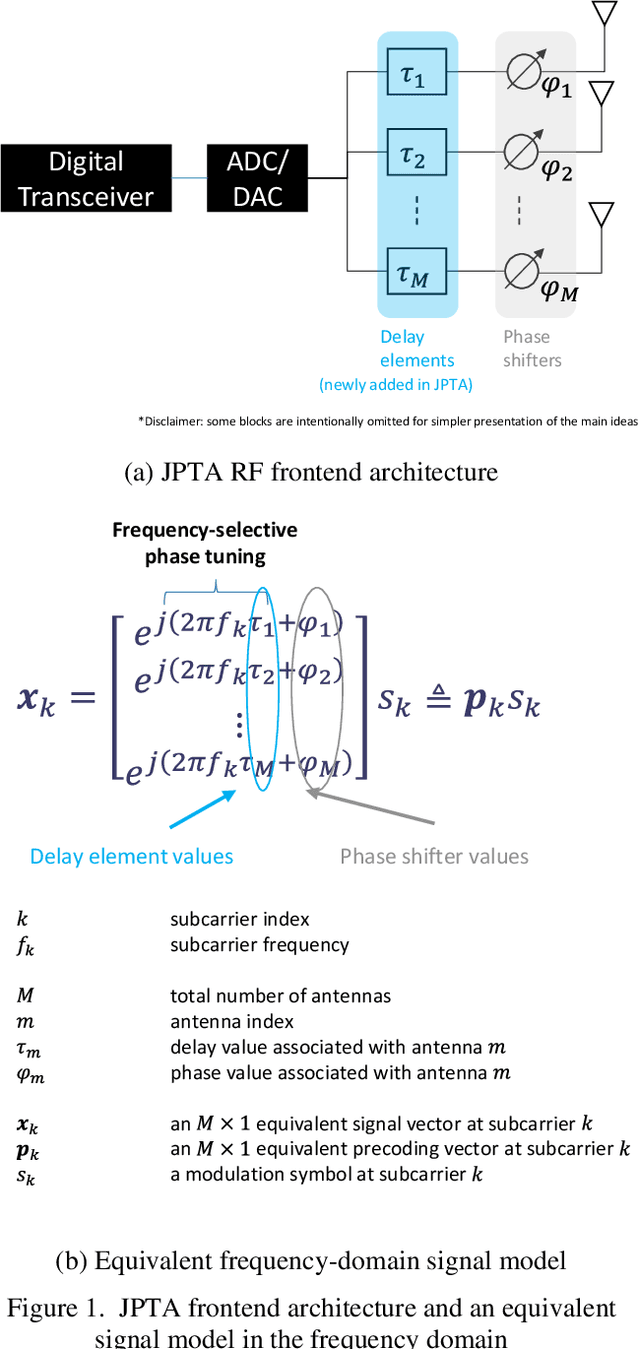

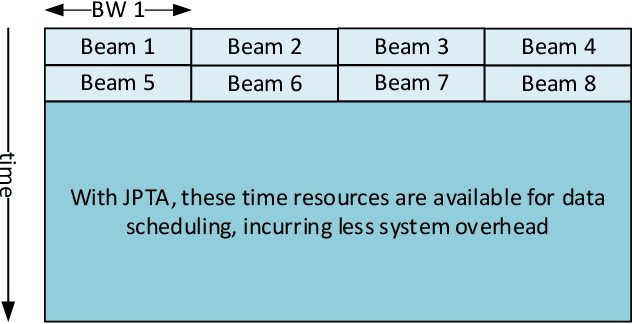

This paper presents a novel approach to designing millimeter-wave (mmWave) cellular communication systems, based on joint phase time array (JPTA) radio frequency (RF) frontend architecture. JPTA architecture comprises time-delay components appended to conventional phase shifters, which offer extra degrees of freedom to be exploited for designing frequency-selective analog beams. Hence, a mmWave device equipped with JPTA can receive and transmit signals in multiple directions in a single time slot per RF chain, one direction per frequency subband, which alleviates the traditional constraint of one analog beam per transceiver chain per time slot. The utilization of subband-specific analog beams offers a new opportunity in designing mmWave systems, allowing for enhanced cell capacity and reduced pilot overhead. To understand the practical feasibility of JPTA, a few challenges and system design considerations are discussed in relation to the performance and complexity of the JPTA systems. For example, frequency-selective beam gain losses are present for the subband analog beams, e.g., up to 1 dB losses for 2 subband cases, even with the state-of-the-art JPTA delay and phase optimization methods. Despite these side effects, system-level analysis reveals that the JPTA system is capable of improving cell capacity: the 5%-tile throughput by up to 65%.