 Add to Chrome
 Add to Firefox
 Add to Edge
K-EXAONE 2.0 Technical Report
Aug 05, 2026
This technical report presents K-EXAONE 2.0, an open-weight multilingual foundation model developed by LG AI Research as a step in our effort toward global frontier-scale foundation models. Rather than training from scratch, we upcycle K-EXAONE and expand its architecture, yielding a Mixture-of-Experts (MoE) model with 750B total parameters and approximately 37B activated per token---more than three times the capacity of its predecessor. K-EXAONE 2.0 supports context lengths of up to 256K tokens and expands multilingual coverage from six to ten languages. Its training pipeline combines continual pre-training, difficulty-focused mid-training, and post-training to strengthen reasoning, agentic coding, multilingual capability, and safety grounded in Korean sociocultural contexts. Across nine evaluation categories selected to reflect the conditions of practical use, K-EXAONE 2.0 improves over K-EXAONE and remains competitive with open-weight models, showing its largest gains in agentic coding and long-context understanding and its clearest strengths in long-context retrieval and safety. Released under the Apache 2.0 license, K-EXAONE 2.0 enables the wider AI ecosystem to evaluate, deploy, adapt, and build upon it, while marking the beginning---rather than the endpoint---of our challenge toward the global frontier.

TheBioCollection: Unified Pre-Training Scale LLM Corpus for Biology
Jul 09, 2026The push toward large language models for biology (BioLM) has created a need for training corpora that can endow models with a genuine understanding of biology. However, existing biological resources, such as molecular databases, protein repositories, genomic annotations, single-cell atlases, and pathway databases, are scattered across heterogeneous formats and remain unorganized into a cohesive corpus for language model training. We present TheBioCollection, a 52.6B-token pre-training-scale corpus that converts these disparate resources into a unified, training-ready form spanning small molecules, proteins, genomic sequences, cells, and pathways. Beyond consolidating existing data, TheBioCollection enriches each record with tool-computed biological properties and introduces new instruction tasks for capabilities that current corpora barely cover. We pair the corpus with TheBioCollection-Eval, a matched suite probing recognition, generation, and prediction across molecular, protein, genomic, cellular, and cross-domain settings. Holding the base Gravity-16B-A3B architecture fixed, training on TheBioCollection more than doubles its overall score on TheBioCollection-Eval with gains in every domain, while leaving general linguistic ability nearly intact.
EXAONE 4.5 Technical Report
Apr 09, 2026This technical report introduces EXAONE 4.5, the first open-weight vision language model released by LG AI Research. EXAONE 4.5 is architected by integrating a dedicated visual encoder into the existing EXAONE 4.0 framework, enabling native multimodal pretraining over both visual and textual modalities. The model is trained on large-scale data with careful curation, particularly emphasizing document-centric corpora that align with LG's strategic application domains. This targeted data design enables substantial performance gains in document understanding and related tasks, while also delivering broad improvements across general language capabilities. EXAONE 4.5 extends context length up to 256K tokens, facilitating long-context reasoning and enterprise-scale use cases. Comparative evaluations demonstrate that EXAONE 4.5 achieves competitive performance in general benchmarks while outperforming state-of-the-art models of similar scale in document understanding and Korean contextual reasoning. As part of LG's ongoing effort toward practical industrial deployment, EXAONE 4.5 is designed to be continuously extended with additional domains and application scenarios to advance AI for a better life.
MalCL: Leveraging GAN-Based Generative Replay to Combat Catastrophic Forgetting in Malware Classification
Jan 02, 2025
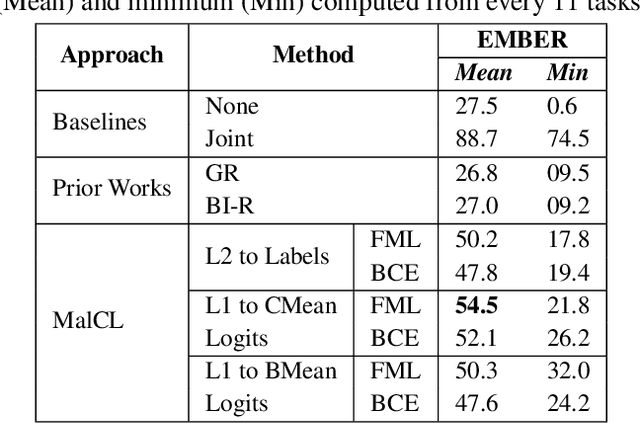


Continual Learning (CL) for malware classification tackles the rapidly evolving nature of malware threats and the frequent emergence of new types. Generative Replay (GR)-based CL systems utilize a generative model to produce synthetic versions of past data, which are then combined with new data to retrain the primary model. Traditional machine learning techniques in this domain often struggle with catastrophic forgetting, where a model's performance on old data degrades over time. In this paper, we introduce a GR-based CL system that employs Generative Adversarial Networks (GANs) with feature matching loss to generate high-quality malware samples. Additionally, we implement innovative selection schemes for replay samples based on the model's hidden representations. Our comprehensive evaluation across Windows and Android malware datasets in a class-incremental learning scenario -- where new classes are introduced continuously over multiple tasks -- demonstrates substantial performance improvements over previous methods. For example, our system achieves an average accuracy of 55% on Windows malware samples, significantly outperforming other GR-based models by 28%. This study provides practical insights for advancing GR-based malware classification systems. The implementation is available at \url {https://github.com/MalwareReplayGAN/MalCL}\footnote{The code will be made public upon the presentation of the paper}.
* Accepted paper at AAAI 2025. 9 pages, Figure 6, Table 1