 Add to Chrome
 Add to Firefox
 Add to Edge
Do Counterfactually Fair Image Classifiers Satisfy Group Fairness? -- A Theoretical and Empirical Study
Jul 07, 2026
The notion of algorithmic fairness has been actively explored from various aspects of fairness, such as counterfactual fairness (CF) and group fairness (GF). However, the exact relationship between CF and GF remains to be unclear, especially in image classification tasks; the reason is because we often cannot collect counterfactual samples regarding a sensitive attribute, essential for evaluating CF, from the existing images (\eg, a photo of the same person but with different secondary sex characteristics). In this paper, we construct new image datasets for evaluating CF by using a high-quality image editing method and carefully labeling with human annotators. Our datasets, \oursceleb and \ourslfw, build upon the popular image GF benchmarks; hence, we can evaluate CF and GF simultaneously. We empirically observe that CF does not imply GF in image classification, whereas previous studies on tabular datasets observed the opposite. We theoretically show that it could be due to the existence of a latent attribute $G$ that is correlated with, but not caused by, the sensitive attribute (\eg, secondary sex characteristics are highly correlated with hair length). From this observation, we propose a simple baseline, Counterfactual Knowledge Distillation (CKD), to mitigate such correlation with the sensitive attributes. Extensive experimental results on \oursceleb and \ourslfw demonstrate that CF-achieving models satisfy GF if we successfully reduce the reliance on $G$ (\eg, using CKD).

PopResume: Causal Fairness Evaluation of LLM/VLM Resume Screeners with Population-Representative Dataset
Mar 24, 2026We present PopResume, a population-representative resume dataset for causal fairness auditing of LLM- and VLM-based resume screening systems. Unlike existing benchmarks that rely on manually injected demographic information and outcome-level disparities, PopResume is grounded in population statistics and preserves natural attribute relationships, enabling path-specific effect (PSE)-based fairness evaluation. We decompose the effect of a protected attribute on resume scores into two paths: the business necessity path, mediated by job-relevant qualifications, and the redlining path, mediated by demographic proxies. This distinction allows auditors to separate legally permissible from impermissible sources of disparity. Evaluating four LLMs and four VLMs on PopResume's 60.8K resumes across five occupations, we identify five representative discrimination patterns that aggregate metrics fail to capture. Our results demonstrate that PSE-based evaluation reveals fairness issues masked by outcome-level measures, underscoring the need for causally-grounded auditing frameworks in AI-assisted hiring.
SP-Guard: Selective Prompt-adaptive Guidance for Safe Text-to-Image Generation
Nov 14, 2025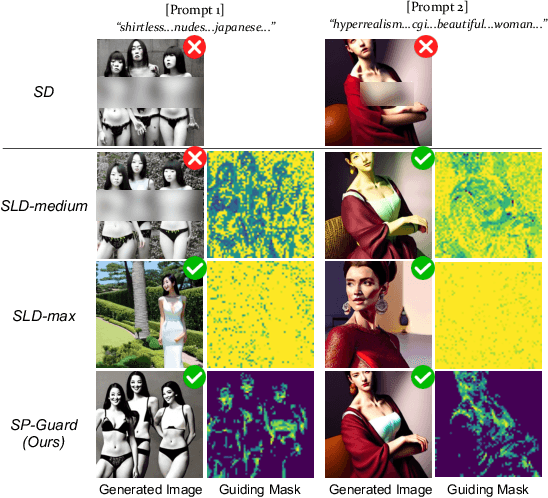
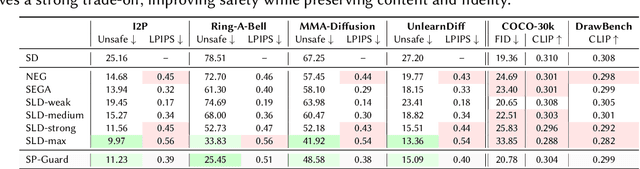
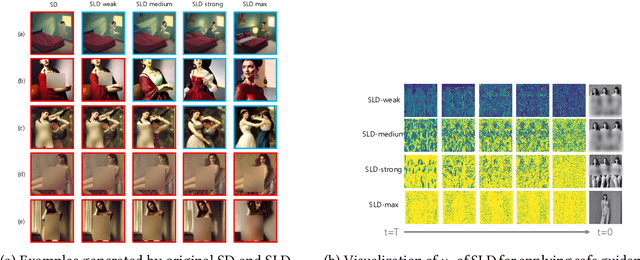
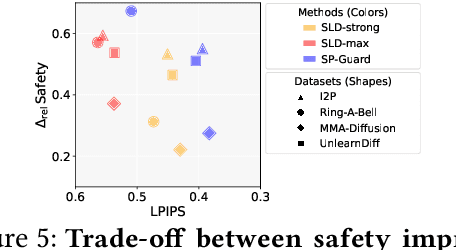
While diffusion-based T2I models have achieved remarkable image generation quality, they also enable easy creation of harmful content, raising social concerns and highlighting the need for safer generation. Existing inference-time guiding methods lack both adaptivity--adjusting guidance strength based on the prompt--and selectivity--targeting only unsafe regions of the image. Our method, SP-Guard, addresses these limitations by estimating prompt harmfulness and applying a selective guidance mask to guide only unsafe areas. Experiments show that SP-Guard generates safer images than existing methods while minimizing unintended content alteration. Beyond improving safety, our findings highlight the importance of transparency and controllability in image generation.