 Add to Chrome
 Add to Firefox
 Add to Edge
DiffNR: Diffusion-Enhanced Neural Representation Optimization for Sparse-View 3D Tomographic Reconstruction
Apr 23, 2026
Neural representations (NRs), such as neural fields and 3D Gaussians, effectively model volumetric data in computed tomography (CT) but suffer from severe artifacts under sparse-view settings. To address this, we propose DiffNR, a novel framework that enhances NR optimization with diffusion priors. At its core is SliceFixer, a single-step diffusion model designed to correct artifacts in degraded slices. We integrate specialized conditioning layers into the network and develop tailored data curation strategies to support model finetuning. During reconstruction, SliceFixer periodically generates pseudo-reference volumes, providing auxiliary 3D perceptual supervision to fix underconstrained regions. Compared to prior methods that embed CT solvers into time-consuming iterative denoising, our repair-and-augment strategy avoids frequent diffusion model queries, leading to better runtime performance. Extensive experiments show that DiffNR improves PSNR by 3.99 dB on average, generalizes well across domains, and maintains efficient optimization.

Towards Realistic and Consistent Orbital Video Generation via 3D Foundation Priors
Apr 14, 2026We present a novel method for generating geometrically realistic and consistent orbital videos from a single image of an object. Existing video generation works mostly rely on pixel-wise attention to enforce view consistency across frames. However, such mechanism does not impose sufficient constraints for long-range extrapolation, e.g. rear-view synthesis, in which pixel correspondences to the input image are limited. Consequently, these works often fail to produce results with a plausible and coherent structure. To tackle this issue, we propose to leverage rich shape priors from a 3D foundational generative model as an auxiliary constraint, motivated by its capability of modeling realistic object shape distributions learned from large 3D asset corpora. Specifically, we prompt the video generation with two scales of latent features encoded by the 3D foundation model: (i) a denoised global latent vector as an overall structural guidance, and (ii) a set of latent images projected from volumetric features to provide view-dependent and fine-grained geometry details. In contrast to commonly used 2.5D representations such as depth or normal maps, these compact features can model complete object shapes, and help to improve inference efficiency by avoiding explicit mesh extraction. To achieve effective shape conditioning, we introduce a multi-scale 3D adapter to inject feature tokens to the base video model via cross-attention, which retains its capabilities from general video pretraining and enables a simple and model-agonistic fine-tuning process. Extensive experiments on multiple benchmarks show that our method achieves superior visual quality, shape realism and multi-view consistency compared to state-of-the-art methods, and robustly generalizes to complex camera trajectories and in-the-wild images.
MoRe-3DGSMR: Motion-resolved reconstruction framework for free-breathing pulmonary MRI based on 3D Gaussian representation
May 08, 2025This study presents an unsupervised, motion-resolved reconstruction framework for high-resolution, free-breathing pulmonary magnetic resonance imaging (MRI), utilizing a three-dimensional Gaussian representation (3DGS). The proposed method leverages 3DGS to address the challenges of motion-resolved 3D isotropic pulmonary MRI reconstruction by enabling data smoothing between voxels for continuous spatial representation. Pulmonary MRI data acquisition is performed using a golden-angle radial sampling trajectory, with respiratory motion signals extracted from the center of k-space in each radial spoke. Based on the estimated motion signal, the k-space data is sorted into multiple respiratory phases. A 3DGS framework is then applied to reconstruct a reference image volume from the first motion state. Subsequently, a patient-specific convolutional neural network is trained to estimate the deformation vector fields (DVFs), which are used to generate the remaining motion states through spatial transformation of the reference volume. The proposed reconstruction pipeline is evaluated on six datasets from six subjects and bench-marked against three state-of-the-art reconstruction methods. The experimental findings demonstrate that the proposed reconstruction framework effectively reconstructs high-resolution, motion-resolved pulmonary MR images. Compared with existing approaches, it achieves superior image quality, reflected by higher signal-to-noise ratio and contrast-to-noise ratio. The proposed unsupervised 3DGS-based reconstruction method enables accurate motion-resolved pulmonary MRI with isotropic spatial resolution. Its superior performance in image quality metrics over state-of-the-art methods highlights its potential as a robust solution for clinical pulmonary MR imaging.
IXGS-Intraoperative 3D Reconstruction from Sparse, Arbitrarily Posed Real X-rays
Apr 20, 2025Spine surgery is a high-risk intervention demanding precise execution, often supported by image-based navigation systems. Recently, supervised learning approaches have gained attention for reconstructing 3D spinal anatomy from sparse fluoroscopic data, significantly reducing reliance on radiation-intensive 3D imaging systems. However, these methods typically require large amounts of annotated training data and may struggle to generalize across varying patient anatomies or imaging conditions. Instance-learning approaches like Gaussian splatting could offer an alternative by avoiding extensive annotation requirements. While Gaussian splatting has shown promise for novel view synthesis, its application to sparse, arbitrarily posed real intraoperative X-rays has remained largely unexplored. This work addresses this limitation by extending the $R^2$-Gaussian splatting framework to reconstruct anatomically consistent 3D volumes under these challenging conditions. We introduce an anatomy-guided radiographic standardization step using style transfer, improving visual consistency across views, and enhancing reconstruction quality. Notably, our framework requires no pretraining, making it inherently adaptable to new patients and anatomies. We evaluated our approach using an ex-vivo dataset. Expert surgical evaluation confirmed the clinical utility of the 3D reconstructions for navigation, especially when using 20 to 30 views, and highlighted the standardization's benefit for anatomical clarity. Benchmarking via quantitative 2D metrics (PSNR/SSIM) confirmed performance trade-offs compared to idealized settings, but also validated the improvement gained from standardization over raw inputs. This work demonstrates the feasibility of instance-based volumetric reconstruction from arbitrary sparse-view X-rays, advancing intraoperative 3D imaging for surgical navigation.
X$^{2}$-Gaussian: 4D Radiative Gaussian Splatting for Continuous-time Tomographic Reconstruction
Mar 27, 2025Four-dimensional computed tomography (4D CT) reconstruction is crucial for capturing dynamic anatomical changes but faces inherent limitations from conventional phase-binning workflows. Current methods discretize temporal resolution into fixed phases with respiratory gating devices, introducing motion misalignment and restricting clinical practicality. In this paper, We propose X$^2$-Gaussian, a novel framework that enables continuous-time 4D-CT reconstruction by integrating dynamic radiative Gaussian splatting with self-supervised respiratory motion learning. Our approach models anatomical dynamics through a spatiotemporal encoder-decoder architecture that predicts time-varying Gaussian deformations, eliminating phase discretization. To remove dependency on external gating devices, we introduce a physiology-driven periodic consistency loss that learns patient-specific breathing cycles directly from projections via differentiable optimization. Extensive experiments demonstrate state-of-the-art performance, achieving a 9.93 dB PSNR gain over traditional methods and 2.25 dB improvement against prior Gaussian splatting techniques. By unifying continuous motion modeling with hardware-free period learning, X$^2$-Gaussian advances high-fidelity 4D CT reconstruction for dynamic clinical imaging. Project website at: https://x2-gaussian.github.io/.
X-LRM: X-ray Large Reconstruction Model for Extremely Sparse-View Computed Tomography Recovery in One Second
Mar 09, 2025Sparse-view 3D CT reconstruction aims to recover volumetric structures from a limited number of 2D X-ray projections. Existing feedforward methods are constrained by the limited capacity of CNN-based architectures and the scarcity of large-scale training datasets. In this paper, we propose an X-ray Large Reconstruction Model (X-LRM) for extremely sparse-view (<10 views) CT reconstruction. X-LRM consists of two key components: X-former and X-triplane. Our X-former can handle an arbitrary number of input views using an MLP-based image tokenizer and a Transformer-based encoder. The output tokens are then upsampled into our X-triplane representation, which models the 3D radiodensity as an implicit neural field. To support the training of X-LRM, we introduce Torso-16K, a large-scale dataset comprising over 16K volume-projection pairs of various torso organs. Extensive experiments demonstrate that X-LRM outperforms the state-of-the-art method by 1.5 dB and achieves 27x faster speed and better flexibility. Furthermore, the downstream evaluation of lung segmentation tasks also suggests the practical value of our approach. Our code, pre-trained models, and dataset will be released at https://github.com/caiyuanhao1998/X-LRM
Three-Dimensional MRI Reconstruction with Gaussian Representations: Tackling the Undersampling Problem
Feb 10, 2025

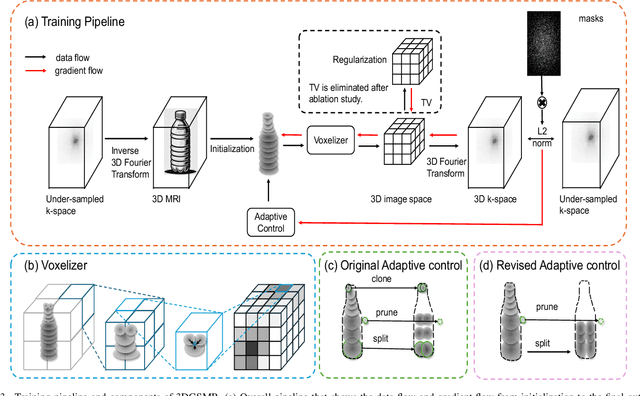

Three-Dimensional Gaussian Splatting (3DGS) has shown substantial promise in the field of computer vision, but remains unexplored in the field of magnetic resonance imaging (MRI). This study explores its potential for the reconstruction of isotropic resolution 3D MRI from undersampled k-space data. We introduce a novel framework termed 3D Gaussian MRI (3DGSMR), which employs 3D Gaussian distributions as an explicit representation for MR volumes. Experimental evaluations indicate that this method can effectively reconstruct voxelized MR images, achieving a quality on par with that of well-established 3D MRI reconstruction techniques found in the literature. Notably, the 3DGSMR scheme operates under a self-supervised framework, obviating the need for extensive training datasets or prior model training. This approach introduces significant innovations to the domain, notably the adaptation of 3DGS to MRI reconstruction and the novel application of the existing 3DGS methodology to decompose MR signals, which are presented in a complex-valued format.
4DRGS: 4D Radiative Gaussian Splatting for Efficient 3D Vessel Reconstruction from Sparse-View Dynamic DSA Images
Dec 17, 2024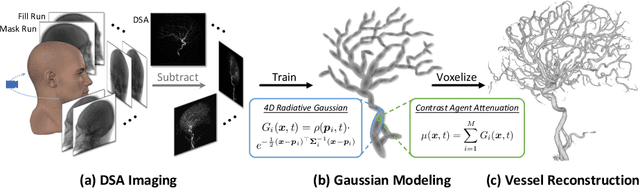

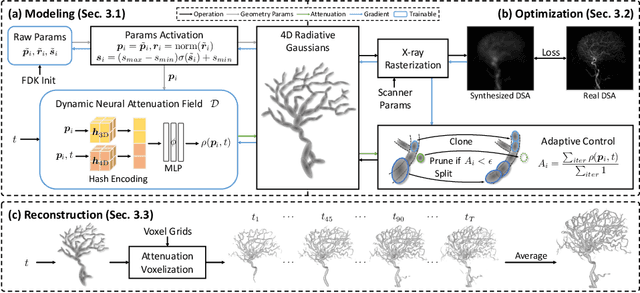
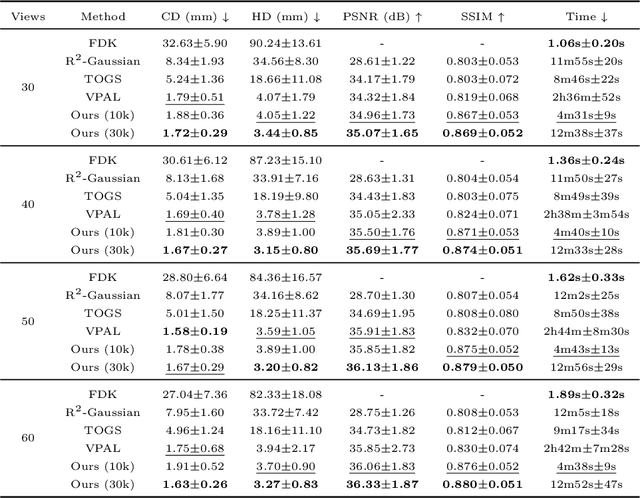
Reconstructing 3D vessel structures from sparse-view dynamic digital subtraction angiography (DSA) images enables accurate medical assessment while reducing radiation exposure. Existing methods often produce suboptimal results or require excessive computation time. In this work, we propose 4D radiative Gaussian splatting (4DRGS) to achieve high-quality reconstruction efficiently. In detail, we represent the vessels with 4D radiative Gaussian kernels. Each kernel has time-invariant geometry parameters, including position, rotation, and scale, to model static vessel structures. The time-dependent central attenuation of each kernel is predicted from a compact neural network to capture the temporal varying response of contrast agent flow. We splat these Gaussian kernels to synthesize DSA images via X-ray rasterization and optimize the model with real captured ones. The final 3D vessel volume is voxelized from the well-trained kernels. Moreover, we introduce accumulated attenuation pruning and bounded scaling activation to improve reconstruction quality. Extensive experiments on real-world patient data demonstrate that 4DRGS achieves impressive results in 5 minutes training, which is 32x faster than the state-of-the-art method. This underscores the potential of 4DRGS for real-world clinics.
R$^2$-Gaussian: Rectifying Radiative Gaussian Splatting for Tomographic Reconstruction
May 31, 20243D Gaussian splatting (3DGS) has shown promising results in image rendering and surface reconstruction. However, its potential in volumetric reconstruction tasks, such as X-ray computed tomography, remains under-explored. This paper introduces R2-Gaussian, the first 3DGS-based framework for sparse-view tomographic reconstruction. By carefully deriving X-ray rasterization functions, we discover a previously unknown integration bias in the standard 3DGS formulation, which hampers accurate volume retrieval. To address this issue, we propose a novel rectification technique via refactoring the projection from 3D to 2D Gaussians. Our new method presents three key innovations: (1) introducing tailored Gaussian kernels, (2) extending rasterization to X-ray imaging, and (3) developing a CUDA-based differentiable voxelizer. Extensive experiments demonstrate that our method outperforms state-of-the-art approaches by 0.93 dB in PSNR and 0.014 in SSIM. Crucially, it delivers high-quality results in 3 minutes, which is 12x faster than NeRF-based methods and on par with traditional algorithms. The superior performance and rapid convergence of our method highlight its practical value.
EndoSurf: Neural Surface Reconstruction of Deformable Tissues with Stereo Endoscope Videos
Jul 21, 2023Reconstructing soft tissues from stereo endoscope videos is an essential prerequisite for many medical applications. Previous methods struggle to produce high-quality geometry and appearance due to their inadequate representations of 3D scenes. To address this issue, we propose a novel neural-field-based method, called EndoSurf, which effectively learns to represent a deforming surface from an RGBD sequence. In EndoSurf, we model surface dynamics, shape, and texture with three neural fields. First, 3D points are transformed from the observed space to the canonical space using the deformation field. The signed distance function (SDF) field and radiance field then predict their SDFs and colors, respectively, with which RGBD images can be synthesized via differentiable volume rendering. We constrain the learned shape by tailoring multiple regularization strategies and disentangling geometry and appearance. Experiments on public endoscope datasets demonstrate that EndoSurf significantly outperforms existing solutions, particularly in reconstructing high-fidelity shapes. Code is available at https://github.com/Ruyi-Zha/endosurf.git.