 Add to Chrome
 Add to Firefox
 Add to Edge
Electromagnetic Navigation for Femoral Osteotomy Using High-Accuracy X-ray-to-CT Registration
Jun 02, 2026
Accurate execution of preoperative plans in corrective femoral osteotomies remains challenging. Current techniques are limited by variable accuracy, invasiveness, and radiation exposure, with free-hand methods and patient-specific instrumentation (PSI) often requiring >30 and >6 fluoroscopic images, respectively. We present an integrated, electromagnetic tracking (EMT)-based navigation system for femoral osteotomies that minimizes dissection and intraoperative fluoroscopy. The system couples CT-based preoperative planning with one-time intraoperative C-arm calibration and accurate X-ray-to-CT registration from two fluoroscopic images acquired at initialization. This enables real-time, fluoroscopy-free EMT navigation of the saw blade and bone fragments relative to the preoperative plan, and is compatible with uniplanar and biplanar osteotomies. In a feasibility study using 18 synthetic femora, EMT guidance significantly outperformed free-hand execution in total angular error ($(3.05 \pm 0.75)^\circ$ vs.\ $(6.32 \pm 2.36)^\circ$, $p=0.031$), assuming the same minimal surgical exposure for both. No EMT-guided trials exceeded the >5° clinical threshold, whereas free-hand produced 4 outliers of 6 trials. The system achieved statistical equivalence ($\pm 2^\circ$, $\pm 2,\text{mm}$) to PSI for total angular ($p \le 0.02$) and total translational ($p=0.048$) errors, with no significant differences in user questionnaire scores. By transferring preoperative plans using only two fluoroscopic images while matching PSI accuracy without additional surgical exposure, the proposed system motivates subsequent cadaveric and clinical validation.

Training-free Detection and 6D Pose Estimation of Unseen Surgical Instruments
Mar 26, 2026Purpose: Accurate detection and 6D pose estimation of surgical instruments are crucial for many computer-assisted interventions. However, supervised methods lack flexibility for new or unseen tools and require extensive annotated data. This work introduces a training-free pipeline for accurate multi-view 6D pose estimation of unseen surgical instruments, which only requires a textured CAD model as prior knowledge. Methods: Our pipeline consists of two main stages. First, for detection, we generate object mask proposals in each view and score their similarity to rendered templates using a pre-trained feature extractor. Detections are matched across views, triangulated into 3D instance candidates, and filtered using multi-view geometric consistency. Second, for pose estimation, a set of pose hypotheses is iteratively refined and scored using feature-metric scores with cross-view attention. The best hypothesis undergoes a final refinement using a novel multi-view, occlusion-aware contour registration, which minimizes reprojection errors of unoccluded contour points. Results: The proposed method was rigorously evaluated on real-world surgical data from the MVPSP dataset. The method achieves millimeter-accurate pose estimates that are on par with supervised methods under controlled conditions, while maintaining full generalization to unseen instruments. These results demonstrate the feasibility of training-free, marker-less detection and tracking in surgical scenes, and highlight the unique challenges in surgical environments. Conclusion: We present a novel and flexible pipeline that effectively combines state-of-the-art foundational models, multi-view geometry, and contour-based refinement for high-accuracy 6D pose estimation of surgical instruments without task-specific training. This approach enables robust instrument tracking and scene understanding in dynamic clinical environments.
A Multi-View Pipeline and Benchmark Dataset for 3D Hand Pose Estimation in Surgery
Jan 22, 2026Purpose: Accurate 3D hand pose estimation supports surgical applications such as skill assessment, robot-assisted interventions, and geometry-aware workflow analysis. However, surgical environments pose severe challenges, including intense and localized lighting, frequent occlusions by instruments or staff, and uniform hand appearance due to gloves, combined with a scarcity of annotated datasets for reliable model training. Method: We propose a robust multi-view pipeline for 3D hand pose estimation in surgical contexts that requires no domain-specific fine-tuning and relies solely on off-the-shelf pretrained models. The pipeline integrates reliable person detection, whole-body pose estimation, and state-of-the-art 2D hand keypoint prediction on tracked hand crops, followed by a constrained 3D optimization. In addition, we introduce a novel surgical benchmark dataset comprising over 68,000 frames and 3,000 manually annotated 2D hand poses with triangulated 3D ground truth, recorded in a replica operating room under varying levels of scene complexity. Results: Quantitative experiments demonstrate that our method consistently outperforms baselines, achieving a 31% reduction in 2D mean joint error and a 76% reduction in 3D mean per-joint position error. Conclusion: Our work establishes a strong baseline for 3D hand pose estimation in surgery, providing both a training-free pipeline and a comprehensive annotated dataset to facilitate future research in surgical computer vision.
RocSync: Millisecond-Accurate Temporal Synchronization for Heterogeneous Camera Systems
Nov 18, 2025Accurate spatiotemporal alignment of multi-view video streams is essential for a wide range of dynamic-scene applications such as multi-view 3D reconstruction, pose estimation, and scene understanding. However, synchronizing multiple cameras remains a significant challenge, especially in heterogeneous setups combining professional and consumer-grade devices, visible and infrared sensors, or systems with and without audio, where common hardware synchronization capabilities are often unavailable. This limitation is particularly evident in real-world environments, where controlled capture conditions are not feasible. In this work, we present a low-cost, general-purpose synchronization method that achieves millisecond-level temporal alignment across diverse camera systems while supporting both visible (RGB) and infrared (IR) modalities. The proposed solution employs a custom-built \textit{LED Clock} that encodes time through red and infrared LEDs, allowing visual decoding of the exposure window (start and end times) from recorded frames for millisecond-level synchronization. We benchmark our method against hardware synchronization and achieve a residual error of 1.34~ms RMSE across multiple recordings. In further experiments, our method outperforms light-, audio-, and timecode-based synchronization approaches and directly improves downstream computer vision tasks, including multi-view pose estimation and 3D reconstruction. Finally, we validate the system in large-scale surgical recordings involving over 25 heterogeneous cameras spanning both IR and RGB modalities. This solution simplifies and streamlines the synchronization pipeline and expands access to advanced vision-based sensing in unconstrained environments, including industrial and clinical applications.
NeuralBoneReg: A Novel Self-Supervised Method for Robust and Accurate Multi-Modal Bone Surface Registration
Nov 18, 2025In computer- and robot-assisted orthopedic surgery (CAOS), patient-specific surgical plans derived from preoperative imaging define target locations and implant trajectories. During surgery, these plans must be accurately transferred, relying on precise cross-registration between preoperative and intraoperative data. However, substantial modality heterogeneity across imaging modalities makes this registration challenging and error-prone. Robust, automatic, and modality-agnostic bone surface registration is therefore clinically important. We propose NeuralBoneReg, a self-supervised, surface-based framework that registers bone surfaces using 3D point clouds as a modality-agnostic representation. NeuralBoneReg includes two modules: an implicit neural unsigned distance field (UDF) that learns the preoperative bone model, and an MLP-based registration module that performs global initialization and local refinement by generating transformation hypotheses to align the intraoperative point cloud with the neural UDF. Unlike SOTA supervised methods, NeuralBoneReg operates in a self-supervised manner, without requiring inter-subject training data. We evaluated NeuralBoneReg against baseline methods on two publicly available multi-modal datasets: a CT-ultrasound dataset of the fibula and tibia (UltraBones100k) and a CT-RGB-D dataset of spinal vertebrae (SpineDepth). The evaluation also includes a newly introduced CT--ultrasound dataset of cadaveric subjects containing femur and pelvis (UltraBones-Hip), which will be made publicly available. NeuralBoneReg matches or surpasses existing methods across all datasets, achieving mean RRE/RTE of 1.68°/1.86 mm on UltraBones100k, 1.88°/1.89 mm on UltraBones-Hip, and 3.79°/2.45 mm on SpineDepth. These results demonstrate strong generalizability across anatomies and modalities, providing robust and accurate cross-modal alignment for CAOS.
Automatic Multi-View X-Ray/CT Registration Using Bone Substructure Contours
Jun 16, 2025Purpose: Accurate intraoperative X-ray/CT registration is essential for surgical navigation in orthopedic procedures. However, existing methods struggle with consistently achieving sub-millimeter accuracy, robustness under broad initial pose estimates or need manual key-point annotations. This work aims to address these challenges by proposing a novel multi-view X-ray/CT registration method for intraoperative bone registration. Methods: The proposed registration method consists of a multi-view, contour-based iterative closest point (ICP) optimization. Unlike previous methods, which attempt to match bone contours across the entire silhouette in both imaging modalities, we focus on matching specific subcategories of contours corresponding to bone substructures. This leads to reduced ambiguity in the ICP matches, resulting in a more robust and accurate registration solution. This approach requires only two X-ray images and operates fully automatically. Additionally, we contribute a dataset of 5 cadaveric specimens, including real X-ray images, X-ray image poses and the corresponding CT scans. Results: The proposed registration method is evaluated on real X-ray images using mean reprojection error (mRPD). The method consistently achieves sub-millimeter accuracy with a mRPD 0.67mm compared to 5.35mm by a commercial solution requiring manual intervention. Furthermore, the method offers improved practical applicability, being fully automatic. Conclusion: Our method offers a practical, accurate, and efficient solution for multi-view X-ray/CT registration in orthopedic surgeries, which can be easily combined with tracking systems. By improving registration accuracy and minimizing manual intervention, it enhances intraoperative navigation, contributing to more accurate and effective surgical outcomes in computer-assisted surgery (CAS).
Multi-view Surface Reconstruction Using Normal and Reflectance Cues
Jun 04, 2025Achieving high-fidelity 3D surface reconstruction while preserving fine details remains challenging, especially in the presence of materials with complex reflectance properties and without a dense-view setup. In this paper, we introduce a versatile framework that incorporates multi-view normal and optionally reflectance maps into radiance-based surface reconstruction. Our approach employs a pixel-wise joint re-parametrization of reflectance and surface normals, representing them as a vector of radiances under simulated, varying illumination. This formulation enables seamless incorporation into standard surface reconstruction pipelines, such as traditional multi-view stereo (MVS) frameworks or modern neural volume rendering (NVR) ones. Combined with the latter, our approach achieves state-of-the-art performance on multi-view photometric stereo (MVPS) benchmark datasets, including DiLiGenT-MV, LUCES-MV and Skoltech3D. In particular, our method excels in reconstructing fine-grained details and handling challenging visibility conditions. The present paper is an extended version of the earlier conference paper by Brument et al. (in Proceedings of the IEEE/CVF Conference on Computer Vision and Pattern Recognition (CVPR), 2024), featuring an accelerated and more robust algorithm as well as a broader empirical evaluation. The code and data relative to this article is available at https://github.com/RobinBruneau/RNb-NeuS2.
UltraBoneUDF: Self-supervised Bone Surface Reconstruction from Ultrasound Based on Neural Unsigned Distance Functions
May 23, 2025Background: Bone surface reconstruction plays a critical role in computer-assisted orthopedic surgery. Compared to traditional imaging modalities such as CT and MRI, ultrasound offers a radiation-free, cost-effective, and portable alternative. Continuous bone surface reconstruction can be employed for many clinical applications. However, due to the inherent limitations of ultrasound imaging, B-mode ultrasound typically capture only partial bone surfaces. Existing reconstruction methods struggle with such incomplete data, leading to artifacts and increased reconstruction errors. Effective techniques for accurately reconstructing thin and open bone surfaces from real-world 3D ultrasound volumes remain lacking. Methods: We propose UltraBoneUDF, a self-supervised framework designed for reconstructing open bone surfaces from ultrasound using neural Unsigned Distance Functions. To enhance reconstruction quality, we introduce a novel global feature extractor that effectively fuses ultrasound-specific image characteristics. Additionally, we present a novel loss function based on local tangent plane optimization that substantially improves surface reconstruction quality. UltraBoneUDF and baseline models are extensively evaluated on four open-source datasets. Results: Qualitative results highlight the limitations of the state-of-the-art methods for open bone surface reconstruction and demonstrate the effectiveness of UltraBoneUDF. Quantitatively, UltraBoneUDF significantly outperforms competing methods across all evaluated datasets for both open and closed bone surface reconstruction in terms of mean Chamfer distance error: 1.10 mm on the UltraBones100k dataset (39.6\% improvement compared to the SOTA), 0.23 mm on the OpenBoneCT dataset (69.3\% improvement), 0.18 mm on the ClosedBoneCT dataset (70.2\% improvement), and 0.05 mm on the Prostate dataset (55.3\% improvement).
IXGS-Intraoperative 3D Reconstruction from Sparse, Arbitrarily Posed Real X-rays
Apr 20, 2025Spine surgery is a high-risk intervention demanding precise execution, often supported by image-based navigation systems. Recently, supervised learning approaches have gained attention for reconstructing 3D spinal anatomy from sparse fluoroscopic data, significantly reducing reliance on radiation-intensive 3D imaging systems. However, these methods typically require large amounts of annotated training data and may struggle to generalize across varying patient anatomies or imaging conditions. Instance-learning approaches like Gaussian splatting could offer an alternative by avoiding extensive annotation requirements. While Gaussian splatting has shown promise for novel view synthesis, its application to sparse, arbitrarily posed real intraoperative X-rays has remained largely unexplored. This work addresses this limitation by extending the $R^2$-Gaussian splatting framework to reconstruct anatomically consistent 3D volumes under these challenging conditions. We introduce an anatomy-guided radiographic standardization step using style transfer, improving visual consistency across views, and enhancing reconstruction quality. Notably, our framework requires no pretraining, making it inherently adaptable to new patients and anatomies. We evaluated our approach using an ex-vivo dataset. Expert surgical evaluation confirmed the clinical utility of the 3D reconstructions for navigation, especially when using 20 to 30 views, and highlighted the standardization's benefit for anatomical clarity. Benchmarking via quantitative 2D metrics (PSNR/SSIM) confirmed performance trade-offs compared to idealized settings, but also validated the improvement gained from standardization over raw inputs. This work demonstrates the feasibility of instance-based volumetric reconstruction from arbitrary sparse-view X-rays, advancing intraoperative 3D imaging for surgical navigation.
UltraBones100k: An Ultrasound Image Dataset with CT-Derived Labels for Lower Extremity Long Bone Surface Segmentation
Feb 06, 2025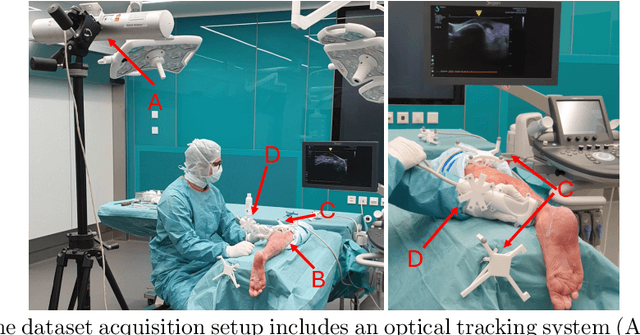
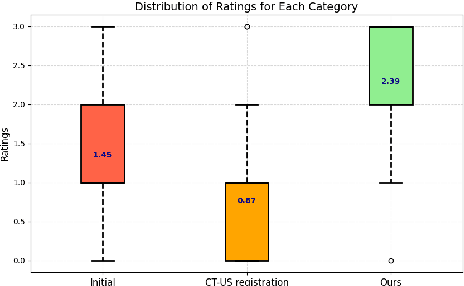
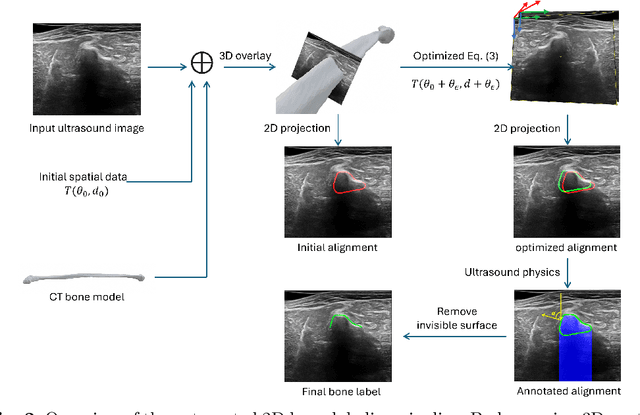
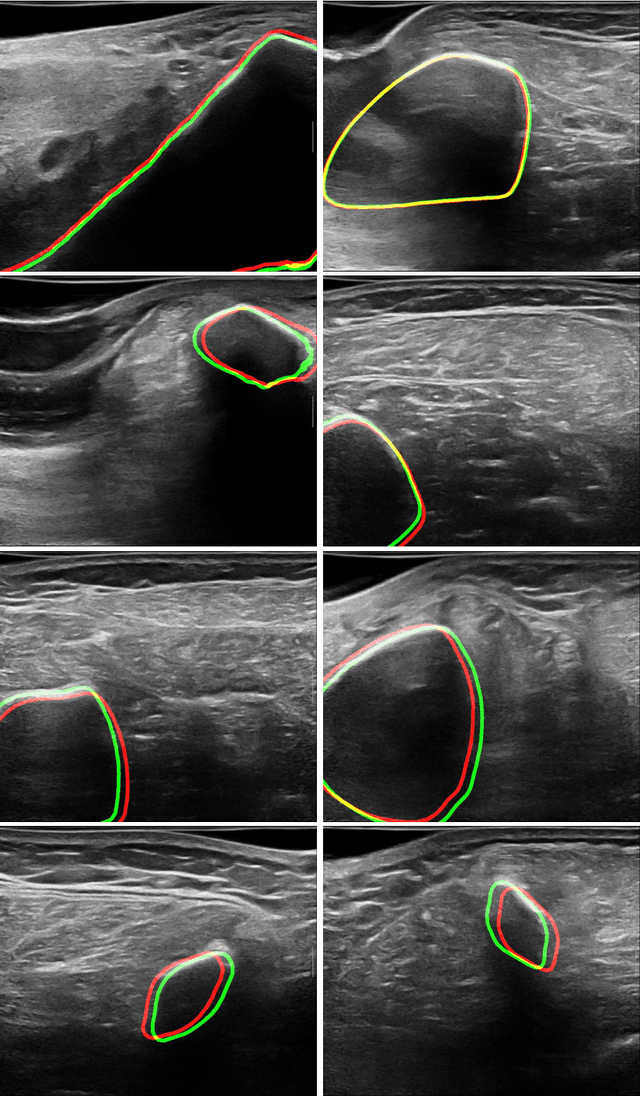
Ultrasound-based bone surface segmentation is crucial in computer-assisted orthopedic surgery. However, ultrasound images have limitations, including a low signal-to-noise ratio, and acoustic shadowing, which make interpretation difficult. Existing deep learning models for bone segmentation rely primarily on costly manual labeling by experts, limiting dataset size and model generalizability. Additionally, the complexity of ultrasound physics and acoustic shadow makes the images difficult for humans to interpret, leading to incomplete labels in anechoic regions and limiting model performance. To advance ultrasound bone segmentation and establish effective model benchmarks, larger and higher-quality datasets are needed. We propose a methodology for collecting ex-vivo ultrasound datasets with automatically generated bone labels, including anechoic regions. The proposed labels are derived by accurately superimposing tracked bone CT models onto the tracked ultrasound images. These initial labels are refined to account for ultrasound physics. A clinical evaluation is conducted by an expert physician specialized on orthopedic sonography to assess the quality of the generated bone labels. A neural network for bone segmentation is trained on the collected dataset and its predictions are compared to expert manual labels, evaluating accuracy, completeness, and F1-score. We collected the largest known dataset of 100k ultrasound images of human lower limbs with bone labels, called UltraBones100k. A Wilcoxon signed-rank test with Bonferroni correction confirmed that the bone alignment after our method significantly improved the quality of bone labeling (p < 0.001). The model trained on UltraBones100k consistently outperforms manual labeling in all metrics, particularly in low-intensity regions (320% improvement in completeness at a distance threshold of 0.5 mm).