 Add to Chrome
 Add to Firefox
 Add to Edge
FrontierSmith: Synthesizing Open-Ended Coding Problems at Scale
May 14, 2026
Many real-world coding challenges are open-ended and admit no known optimal solution. Yet, recent progress in LLM coding has focused on well-defined tasks such as feature implementation, bug fixing, and competitive programming. Open-ended coding remains a weak spot for LLMs, largely because open-ended training problems are scarce and expensive to construct. Our goal is to synthesize open-ended coding problems at scale to train stronger LLM coders. We introduce FrontierSmith, an automated system for iteratively evolving open-ended problems from existing closed-ended coding tasks. Starting from competitive programming problems, FrontierSmith generates candidate open-ended variants by changing the problems'goals, restricting outputs, and generalizing inputs. It then uses a quantitative idea divergence metric to select problems that elicit genuinely diverse approaches from different solvers. Agents then generate test cases and verifiers for the surviving candidates. On two open-ended coding benchmarks, training on our synthesized data yields substantial gains over the base models: Qwen3.5-9B improves by +8.82 score on FrontierCS and +306.36 (Elo-rating-based performance) on ALE-bench; Qwen3.5-27B improves by +12.12 and +309.12, respectively. The synthesized problems also make agents take more turns and use more tokens, similar to human-curated ones, suggesting that closed-ended seeds can be a practical starting point for long-horizon coding data.

Combee: Scaling Prompt Learning for Self-Improving Language Model Agents
Apr 05, 2026Recent advances in prompt learning allow large language model agents to acquire task-relevant knowledge from inference-time context without parameter changes. For example, existing methods (like ACE or GEPA) can learn system prompts to improve accuracy based on previous agent runs. However, these methods primarily focus on single-agent or low-parallelism settings. This fundamentally limits their ability to efficiently learn from a large set of collected agentic traces. It would be efficient and beneficial to run prompt learning in parallel to accommodate the growing trend of learning from many agentic traces or parallel agent executions. Yet without a principled strategy for scaling, current methods suffer from quality degradation with high parallelism. To improve both the efficiency and quality of prompt learning, we propose Combee, a novel framework to scale parallel prompt learning for self-improving agents. Combee speeds up learning and enables running many agents in parallel while learning from their aggregate traces without quality degradation. To achieve this, Combee leverages parallel scans and employs an augmented shuffle mechanism; Combee also introduces a dynamic batch size controller to balance quality and delay. Evaluations on AppWorld, Terminal-Bench, Formula, and FiNER demonstrate that Combee achieves up to 17x speedup over previous methods with comparable or better accuracy and equivalent cost.
FrontierCS: Evolving Challenges for Evolving Intelligence
Dec 17, 2025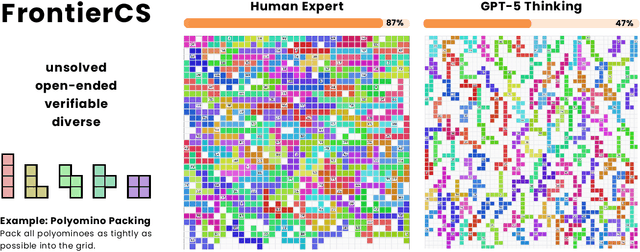

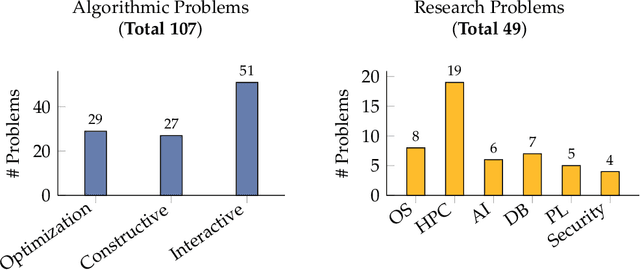

We introduce FrontierCS, a benchmark of 156 open-ended problems across diverse areas of computer science, designed and reviewed by experts, including CS PhDs and top-tier competitive programming participants and problem setters. Unlike existing benchmarks that focus on tasks with known optimal solutions, FrontierCS targets problems where the optimal solution is unknown, but the quality of a solution can be objectively evaluated. Models solve these tasks by implementing executable programs rather than outputting a direct answer. FrontierCS includes algorithmic problems, which are often NP-hard variants of competitive programming problems with objective partial scoring, and research problems with the same property. For each problem we provide an expert reference solution and an automatic evaluator. Combining open-ended design, measurable progress, and expert curation, FrontierCS provides a benchmark at the frontier of computer-science difficulty. Empirically, we find that frontier reasoning models still lag far behind human experts on both the algorithmic and research tracks, that increasing reasoning budgets alone does not close this gap, and that models often over-optimize for generating merely workable code instead of discovering high-quality algorithms and system designs.
In-depth Analysis of Graph-based RAG in a Unified Framework
Mar 06, 2025Graph-based Retrieval-Augmented Generation (RAG) has proven effective in integrating external knowledge into large language models (LLMs), improving their factual accuracy, adaptability, interpretability, and trustworthiness. A number of graph-based RAG methods have been proposed in the literature. However, these methods have not been systematically and comprehensively compared under the same experimental settings. In this paper, we first summarize a unified framework to incorporate all graph-based RAG methods from a high-level perspective. We then extensively compare representative graph-based RAG methods over a range of questing-answering (QA) datasets -- from specific questions to abstract questions -- and examine the effectiveness of all methods, providing a thorough analysis of graph-based RAG approaches. As a byproduct of our experimental analysis, we are also able to identify new variants of the graph-based RAG methods over specific QA and abstract QA tasks respectively, by combining existing techniques, which outperform the state-of-the-art methods. Finally, based on these findings, we offer promising research opportunities. We believe that a deeper understanding of the behavior of existing methods can provide new valuable insights for future research.