 Add to Chrome
 Add to Firefox
 Add to Edge
Converted, Not Equivalent: Benchmarking Codebase Conversion via Observational Equivalence
May 27, 2026
Coding agents increasingly act as codebase-scale collaborators that can assist with codebase conversion, but this progress has exposed a critical weakness: agents often over-trust their own local validation routines and declare success on artifacts that satisfy surface checks while violating the semantic contracts users actually care about. This problem is especially acute in codebase conversion, where prior evaluation is largely outcome-driven and therefore unstable: two implementations can match on a shallow outcome, such as a single forward loss, while diverging in gradients, optimizer behavior, or short-horizon training dynamics. We introduce T2J-Bench, a benchmark for codebase conversion that reformulates conversion as transfer under a fixed equivalence contract. A fixed verifier then compares source and converted codebases through three ordered stages: Spec (interface admissibility), Numeric (forward outputs, losses, gradients, and objective-specific tensors), and Behavioral (short training dynamics under fixed seeds). Across 355 blind conversion attempts, the best system reaches only 26.7--28.9% overall pass rate despite Spec pass rates up to 91.1%; a 4.7x token-budget spread yields only a 2.2x pass-rate spread; and all systems overestimate success by 66.6--97.8 points relative to the fixed evaluator. This suggests that failures stem more from contract-misaligned self-validation than from limited budget or backbone strength.

ScientistOne: Towards Human-Level Autonomous Research via Chain-of-Evidence
May 25, 2026Autonomous research agents produce competitive solutions and professional-looking manuscripts, yet their outputs contain verifiability failures undetectable by surface-level evaluation: fabricated citations, unreproducible scores, and method descriptions that diverge from the implementation. We address this through three contributions. First, Chain-of-Evidence (CoE), a verifiability framework requiring every claim to be traceable to its evidence source. Second, ScientistOne, an end-to-end autonomous research system that maintains evidence chains by construction throughout literature review, solution discovery, and paper writing. Third, CoE Audit, a post-hoc audit whose four integrity checks -- score verification, specification violation, reference verification, and method-code alignment -- apply uniformly to all systems. Across 75 papers spanning five systems and five frontier research tasks, every baseline exhibits at least one systematic failure mode: hallucinated reference rates reach 21%, score verification passes in as few as 42% of papers, and method-code alignment ranges from 20% to 80%. ScientistOne achieves zero hallucinated references (0/337), perfect score verification (12/12), and the highest method-code alignment (14/15), while matching or exceeding human expert performance on all five tasks. ScientistOne further generalizes to six additional tasks spanning medical imaging, fine-grained recognition, 3D perception, and language modeling, achieving state-of-the-art on Parameter Golf and gold medals on MLE-Bench tasks where baselines fail entirely.
LiSA: Lifelong Safety Adaptation via Conservative Policy Induction
May 14, 2026As AI agents move from chat interfaces to systems that read private data, call tools, and execute multi-step workflows, guardrails become a last line of defense against concrete deployment harms. In these settings, guardrail failures are no longer merely answer-quality errors: they can leak secrets, authorize unsafe actions, or block legitimate work. The hardest failures are often contextual: whether an action is acceptable depends on local privacy norms, organizational policies, and user expectations that resist pre-deployment specification. This creates a practical gap: guardrails must adapt to their own operating environments, yet deployment feedback is typically limited to sparse, noisy user-reported failures, and repeated fine-tuning is often impractical. To address this gap, we propose LiSA (Lifelong Safety Adaptation), a conservative policy induction framework that improves a fixed base guardrail through structured memory. LiSA converts occasional failures into reusable policy abstractions so that sparse reports can generalize beyond individual cases, adds conflict-aware local rules to prevent overgeneralization in mixed-label contexts, and applies evidence-aware confidence gating via a posterior lower bound, so that memory reuse scales with accumulated evidence rather than empirical accuracy alone. Across PrivacyLens+, ConFaide+, and AgentHarm, LiSA consistently outperforms strong memory-based baselines under sparse feedback, remains robust under noisy user feedback even at 20% label-flip rates, and pushes the latency--performance frontier beyond backbone model scaling. Ultimately, LiSA offers a practical path to secure AI agents against the unpredictable long tail of real-world edge risks.
RubricEM: Meta-RL with Rubric-guided Policy Decomposition beyond Verifiable Rewards
May 11, 2026Training deep research agents, namely systems that plan, search, evaluate evidence, and synthesize long-form reports, pushes reinforcement learning beyond the regime of verifiable rewards. Their outputs lack ground-truth answers, their trajectories span many tool-augmented decisions, and standard post-training offers little mechanism for turning past attempts into reusable experience. In this work, we argue that rubrics should serve not merely as final-answer evaluators, but as the shared interface that structures policy execution, judge feedback, and agent memory. Based on this view, we introduce RubricEM, a rubric-guided reinforcement learning framework that combines stagewise policy decomposition with reflection-based meta-policy evolution. RubricEM first makes research trajectories stage-aware by conditioning planning, evidence gathering, review, and synthesis on self-generated rubrics. It then assigns credit with Stage-Structured GRPO, which uses stagewise rubric judgments to provide denser semantic feedback for long-horizon optimization. In parallel, RubricEM trains a shared-backbone reflection meta-policy that distills judged trajectories into reusable rubric-grounded guidance for future attempts. The resulting RubricEM-8B achieves strong performance across four long-form research benchmarks, outperforming comparable open models and approaching proprietary deep-research systems. Beyond final performance, we perform thorough analyses to understand the key ingredients of RubricEM.
SkillOS: Learning Skill Curation for Self-Evolving Agents
May 07, 2026LLM-based agents are increasingly deployed to handle streaming tasks, yet they often remain one-off problem solvers that fail to learn from past interactions. Reusable skills distilled from experience provide a natural substrate for self-evolution, where high-quality skill curation serves as the key bottleneck. Existing approaches either rely on manual skill curation, prescribe heuristic skill operations, or train for short-horizon skill operations. However, they still struggle to learn complex long-term curation policies from indirect and delayed feedback. To tackle this challenge, we propose SkillOS, an experience-driven RL training recipe for learning skill curation in self-evolving agents. SkillOS pairs a frozen agent executor that retrieves and applies skills with a trainable skill curator that updates an external SkillRepo from accumulated experience. To provide learning signals for curation, we design composite rewards and train on grouped task streams based on skill-relevant task dependencies, where earlier trajectories update the SkillRepo, and later related tasks evaluate these updates. Across multi-turn agentic tasks and single-turn reasoning tasks, SkillOS consistently outperforms memory-free and strong memory-based baselines in both effectiveness and efficiency, with the learned skill curator generalizing across different executor backbones and task domains. Further analyses show that the learned curator produces more targeted skill use, while the skills in SkillRepo evolve into more richly structured Markdown files that encode higher-level meta-skills over time.
LitPivot: Developing Well-Situated Research Ideas Through Dynamic Contextualization and Critique within the Literature Landscape
Apr 03, 2026Developing a novel research idea is hard. It must be distinct enough from prior work to claim a contribution while also building on it. This requires iteratively reviewing literature and refining an idea based on what a researcher reads; yet when an idea changes, the literature that matters often changes with it. Most tools offer limited support for this interplay: literature tools help researchers understand a fixed body of work, while ideation tools evaluate ideas against a static, pre-curated set of papers. We introduce literature-initiated pivots, a mechanism where engagement with literature prompts revision to a developing idea, and where that revision changes which literature is relevant. We operationalize this in LitPivot, where researchers concurrently draft and vet an idea. LitPivot dynamically retrieves clusters of papers relevant to a selected part of the idea and proposes literature-informed critiques for how to revise it. A lab study ($n{=}17$) shows researchers produced higher-rated ideas with stronger self-reported understanding of the literature space; an open-ended study ($n{=}5$) reveals how researchers use LitPivot to iteratively evolve their own ideas.
MARS: Modular Agent with Reflective Search for Automated AI Research
Feb 02, 2026Automating AI research differs from general software engineering due to computationally expensive evaluation (e.g., model training) and opaque performance attribution. Current LLM-based agents struggle here, often generating monolithic scripts that ignore execution costs and causal factors. We introduce MARS (Modular Agent with Reflective Search), a framework optimized for autonomous AI research. MARS relies on three pillars: (1) Budget-Aware Planning via cost-constrained Monte Carlo Tree Search (MCTS) to explicitly balance performance with execution expense; (2) Modular Construction, employing a "Design-Decompose-Implement" pipeline to manage complex research repositories; and (3) Comparative Reflective Memory, which addresses credit assignment by analyzing solution differences to distill high-signal insights. MARS achieves state-of-the-art performance among open-source frameworks on MLE-Bench under comparable settings, maintaining competitiveness with the global leaderboard's top methods. Furthermore, the system exhibits qualitative "Aha!" moments, where 63% of all utilized lessons originate from cross-branch transfer, demonstrating that the agent effectively generalizes insights across search paths.
HARPA: A Testability-Driven, Literature-Grounded Framework for Research Ideation
Oct 01, 2025While there has been a surge of interest in automated scientific discovery (ASD), especially with the emergence of LLMs, it remains challenging for tools to generate hypotheses that are both testable and grounded in the scientific literature. Additionally, existing ideation tools are not adaptive to prior experimental outcomes. We developed HARPA to address these challenges by incorporating the ideation workflow inspired by human researchers. HARPA first identifies emerging research trends through literature mining, then explores hypothesis design spaces, and finally converges on precise, testable hypotheses by pinpointing research gaps and justifying design choices. Our evaluations show that HARPA-generated hypothesis-driven research proposals perform comparably to a strong baseline AI-researcher across most qualitative dimensions (e.g., specificity, novelty, overall quality), but achieve significant gains in feasibility(+0.78, p$<0.05$, bootstrap) and groundedness (+0.85, p$<0.01$, bootstrap) on a 10-point Likert scale. When tested with the ASD agent (CodeScientist), HARPA produced more successful executions (20 vs. 11 out of 40) and fewer failures (16 vs. 21 out of 40), showing that expert feasibility judgments track with actual execution success. Furthermore, to simulate how researchers continuously refine their understanding of what hypotheses are both testable and potentially interesting from experience, HARPA learns a reward model that scores new hypotheses based on prior experimental outcomes, achieving approx. a 28\% absolute gain over HARPA's untrained baseline scorer. Together, these methods represent a step forward in the field of AI-driven scientific discovery.
HypER: Literature-grounded Hypothesis Generation and Distillation with Provenance
Jun 15, 2025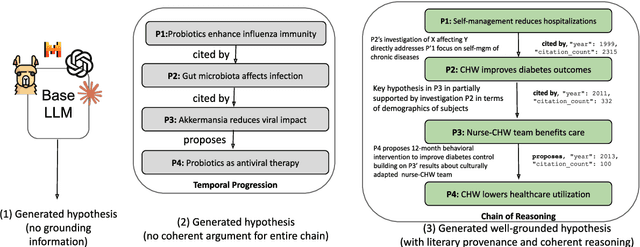
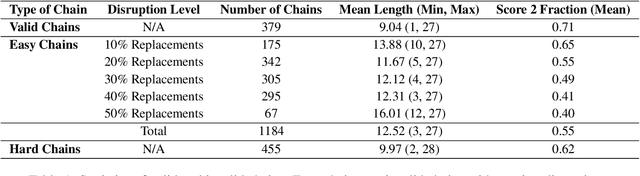
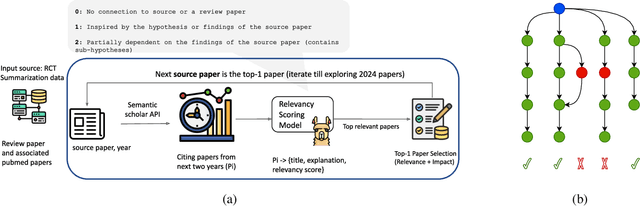
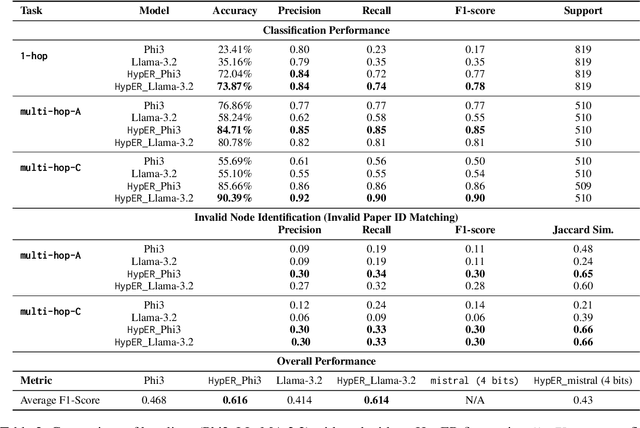
Large Language models have demonstrated promising performance in research ideation across scientific domains. Hypothesis development, the process of generating a highly specific declarative statement connecting a research idea with empirical validation, has received relatively less attention. Existing approaches trivially deploy retrieval augmentation and focus only on the quality of the final output ignoring the underlying reasoning process behind ideation. We present $\texttt{HypER}$ ($\textbf{Hyp}$othesis Generation with $\textbf{E}$xplanation and $\textbf{R}$easoning), a small language model (SLM) trained for literature-guided reasoning and evidence-based hypothesis generation. $\texttt{HypER}$ is trained in a multi-task setting to discriminate between valid and invalid scientific reasoning chains in presence of controlled distractions. We find that $\texttt{HypER}$ outperformes the base model, distinguishing valid from invalid reasoning chains (+22\% average absolute F1), generates better evidence-grounded hypotheses (0.327 vs. 0.305 base model) with high feasibility and impact as judged by human experts ($>$3.5 on 5-point Likert scale).
Latent Factor Models Meets Instructions:Goal-conditioned Latent Factor Discovery without Task Supervision
Feb 21, 2025Instruction-following LLMs have recently allowed systems to discover hidden concepts from a collection of unstructured documents based on a natural language description of the purpose of the discovery (i.e., goal). Still, the quality of the discovered concepts remains mixed, as it depends heavily on LLM's reasoning ability and drops when the data is noisy or beyond LLM's knowledge. We present Instruct-LF, a goal-oriented latent factor discovery system that integrates LLM's instruction-following ability with statistical models to handle large, noisy datasets where LLM reasoning alone falls short. Instruct-LF uses LLMs to propose fine-grained, goal-related properties from documents, estimates their presence across the dataset, and applies gradient-based optimization to uncover hidden factors, where each factor is represented by a cluster of co-occurring properties. We evaluate latent factors produced by Instruct-LF on movie recommendation, text-world navigation, and legal document categorization tasks. These interpretable representations improve downstream task performance by 5-52% than the best baselines and were preferred 1.8 times as often as the best alternative, on average, in human evaluation.