 Add to Chrome
 Add to Firefox
 Add to Edge
MeEvo: Metacognitive Evolution Combined with Natural Evolution for Automatic Heuristic Design
Jun 12, 2026
Large Language Models (LLMs) have advanced Automatic Heuristic Design (AHD) by enabling heuristic generation through reasoning and code synthesis. Existing LLM-based AHD architectures mainly follow two paradigms: Natural Evolution, which uses crossover and mutation to explore heuristic programs, and Metacognitive Evolution, which refines reasoning through reflection. However, Natural Evolution discards reasoning traces, weakening knowledge inheritance and exploitation, while Metacognitive Evolution lacks population-level recombination, limiting exploration and increasing the risk of premature convergence. These limitations reduce search efficiency, stability, and solution quality on complex problems. To address this gap, we propose MeEvo, a dual-layer AHD framework that cyclically couples Natural Evolution and Metacognitive Evolution. Natural Evolution explores heuristic code while recording reasoning traces, fitness values, and errors into a shared history; Metacognitive Evolution then reflects on this history to generate improved heuristics that re-enter the parent pool for the next cycle. This design enables population-driven exploration and reflection-driven refinement to reinforce each other. Experiments on five optimization problems with two LLM backbones show that MeEvo achieves stronger and more stable performance than existing LLM-based AHD architectures, especially on complex constrained tasks.

MotionMERGE: A Multi-granular Framework for Human Motion Editing, Reasoning, Generation, and Explanation
May 18, 2026Recent motion-language models unify tasks like comprehension and generation but operate at a coarse granularity, lacking fine-grained understanding and nuanced control over body parts needed for animation or interaction. This stems from fundamental issues in both the model and the data, in which the model can't focus on motion's localized pattern, and the training data lacks fine-grained supervision. To tackle this, we propose MotionMERGE, a unified framework that bridges the granularity gap. First, we pioneer the study of fine-grained languageguided motion control, including detailed understanding and localized editing, by explicitly modeling motion at part and temporal levels within a single LLM, thereby endowing the model with robust priors for precise control. Second, we design ReasoningAware Granularity-Synergy pre-training, a novel strategy that employs joint supervision for cross-granularity alignment, temporal grounding, localized alignment, motion coherency, and motion-grounded chain-of-thought (CoT) reasoning. This equips the model with fine-grained motion-language alignment, crossgranularity synergy, and explicit reasoning ability. Third, we curate MotionFineEdit, a large-scale dataset (837K atomic + 144K complex triplets) with the first fine-grained spatio-temporal corrective instructions and motion-grounded CoT annotations, establishing a new benchmark for fine-grained text-driven motion editing and motion-grounded reasoning. Extensive experiments demonstrate the capability of MotionMERGE for more precise motion generation, understanding, and editing, and compelling zero-shot generalization to other complex motion tasks. This work represents a significant step toward models that interact with motion in finer granularity and human-like reasoning.
X-PCR: A Benchmark for Cross-modality Progressive Clinical Reasoning in Ophthalmic Diagnosis
Apr 22, 2026Despite significant progress in Multi-modal Large Language Models (MLLMs), their clinical reasoning capacity for multi-modal diagnosis remains largely unexamined. Current benchmarks, mostly single-modality data, can't evaluate progressive reasoning and cross-modal integration essential for clinical practice. We introduce the Cross-Modality Progressive Clinical Reasoning (X-PCR) benchmark, the first comprehensive evaluation of MLLMs through a complete ophthalmology diagnostic workflow, with two reasoning tasks: 1) a six-stage progressive reasoning chain spanning image quality assessment to clinical decision-making, and 2) a cross-modality reasoning task integrating six imaging modalities. The benchmark comprises 26,415 images and 177,868 expert-verified VQA pairs curated from 51 public datasets, covering 52 ophthalmic diseases. Evaluation of 21 MLLMs reveals critical gaps in progressive reasoning and cross-modal integration. Dataset and code: https://github.com/CVI-SZU/X-PCR.
SurgCoT: Advancing Spatiotemporal Reasoning in Surgical Videos through a Chain-of-Thought Benchmark
Apr 22, 2026Fine-grained spatiotemporal reasoning on surgical videos is critical, yet the capabilities of Multi-modal Large Language Models (MLLMs) in this domain remain largely unexplored. To bridge this gap, we introduce SurgCoT, a unified benchmark for evaluating chain-of-thought (CoT) reasoning in MLLMs across 7 surgical specialties and 35 diverse procedures. SurgCoT assesses five core reasoning dimensions: Causal Action Ordering, Cue-Action Alignment, Affordance Mapping, Micro-Transition Localization, and Anomaly Onset Tracking, through a structured CoT framework with an intensive annotation protocol (Question-Option-Knowledge-Clue-Answer), where the Knowledge field provides essential background context and Clue provides definitive spatiotemporal evidence. Evaluation of 10 leading MLLMs shows: 1) commercial models outperform open-source and medical-specialized variants; 2) significant gaps exist in surgical CoT reasoning; 3) SurgCoT enables effective evaluation and enhances progressive spatiotemporal reasoning. SurgCoT provides a reproducible testbed to narrow the gap between MLLM capabilities and clinical reasoning demands. Code: https://github.com/CVI-SZU/SurgCoT.
Preference-Agile Multi-Objective Optimization for Real-time Vehicle Dispatching
Apr 12, 2026Multi-objective optimization (MOO) has been widely studied in literature because of its versatility in human-centered decision making in real-life applications. Recently, demand for dynamic MOO is fast-emerging due to tough market dynamics that require real-time re-adjustments of priorities for different objectives. However, most existing studies focus either on deterministic MOO problems which are not practical, or non-sequential dynamic MOO decision problems that cannot deal with some real-life complexities. To address these challenges, a preference-agile multi-objective optimization (PAMOO) is proposed in this paper to permit users to dynamically adjust and interactively assign the preferences on the fly. To achieve this, a novel uniform model within a deep reinforcement learning (DRL) framework is proposed that can take as inputs users' dynamic preference vectors explicitly. Additionally, a calibration function is fitted to ensure high quality alignment between the preference vector inputs and the output DRL decision policy. Extensive experiments on challenging real-life vehicle dispatching problems at a container terminal showed that PAMOO obtains superior performance and generalization ability when compared with two most popular MOO methods. Our method presents the first dynamic MOO method for challenging \rev{dynamic sequential MOO decision problems
ReactMotion: Generating Reactive Listener Motions from Speaker Utterance
Mar 16, 2026In this paper, we introduce a new task, Reactive Listener Motion Generation from Speaker Utterance, which aims to generate naturalistic listener body motions that appropriately respond to a speaker's utterance. However, modeling such nonverbal listener behaviors remains underexplored and challenging due to the inherently non-deterministic nature of human reactions. To facilitate this task, we present ReactMotionNet, a large-scale dataset that pairs speaker utterances with multiple candidate listener motions annotated with varying degrees of appropriateness. This dataset design explicitly captures the one-to-many nature of listener behavior and provides supervision beyond a single ground-truth motion. Building on this dataset design, we develop preference-oriented evaluation protocols tailored to evaluate reactive appropriateness, where conventional motion metrics focusing on input-motion alignment ignore. We further propose ReactMotion, a unified generative framework that jointly models text, audio, emotion, and motion, and is trained with preference-based objectives to encourage both appropriate and diverse listener responses. Extensive experiments show that ReactMotion outperforms retrieval baselines and cascaded LLM-based pipelines, generating more natural, diverse, and appropriate listener motions.
FreqDINO: Frequency-Guided Adaptation for Generalized Boundary-Aware Ultrasound Image Segmentation
Dec 12, 2025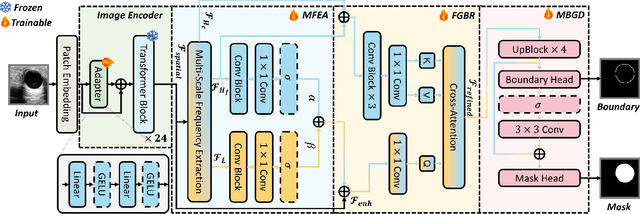
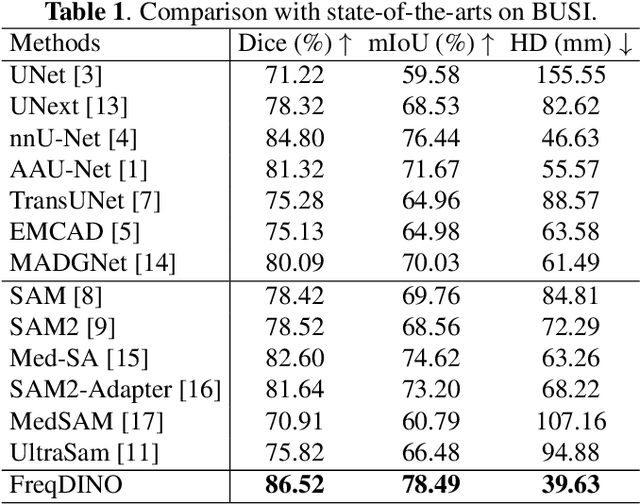
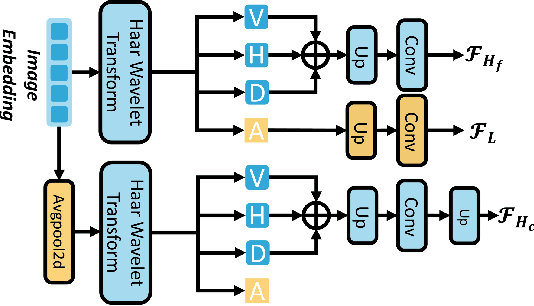
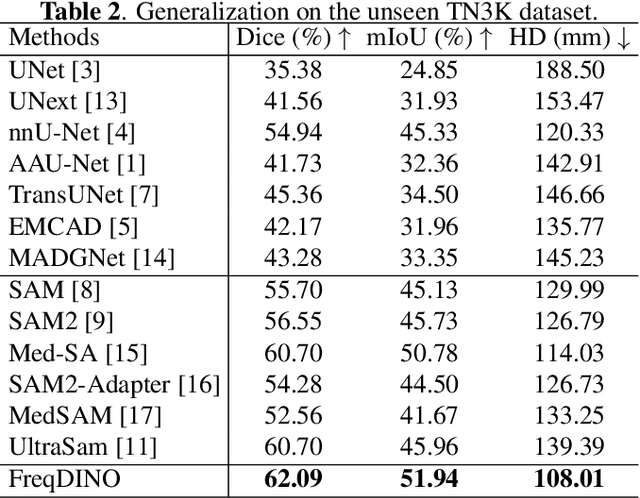
Ultrasound image segmentation is pivotal for clinical diagnosis, yet challenged by speckle noise and imaging artifacts. Recently, DINOv3 has shown remarkable promise in medical image segmentation with its powerful representation capabilities. However, DINOv3, pre-trained on natural images, lacks sensitivity to ultrasound-specific boundary degradation. To address this limitation, we propose FreqDINO, a frequency-guided segmentation framework that enhances boundary perception and structural consistency. Specifically, we devise a Multi-scale Frequency Extraction and Alignment (MFEA) strategy to separate low-frequency structures and multi-scale high-frequency boundary details, and align them via learnable attention. We also introduce a Frequency-Guided Boundary Refinement (FGBR) module that extracts boundary prototypes from high-frequency components and refines spatial features. Furthermore, we design a Multi-task Boundary-Guided Decoder (MBGD) to ensure spatial coherence between boundary and semantic predictions. Extensive experiments demonstrate that FreqDINO surpasses state-of-the-art methods with superior achieves remarkable generalization capability. The code is at https://github.com/MingLang-FD/FreqDINO.
CoMA: Complementary Masking and Hierarchical Dynamic Multi-Window Self-Attention in a Unified Pre-training Framework
Nov 08, 2025Masked Autoencoders (MAE) achieve self-supervised learning of image representations by randomly removing a portion of visual tokens and reconstructing the original image as a pretext task, thereby significantly enhancing pretraining efficiency and yielding excellent adaptability across downstream tasks. However, MAE and other MAE-style paradigms that adopt random masking generally require more pre-training epochs to maintain adaptability. Meanwhile, ViT in MAE suffers from inefficient parameter use due to fixed spatial resolution across layers. To overcome these limitations, we propose the Complementary Masked Autoencoders (CoMA), which employ a complementary masking strategy to ensure uniform sampling across all pixels, thereby improving effective learning of all features and enhancing the model's adaptability. Furthermore, we introduce DyViT, a hierarchical vision transformer that employs a Dynamic Multi-Window Self-Attention (DM-MSA), significantly reducing the parameters and FLOPs while improving fine-grained feature learning. Pre-trained on ImageNet-1K with CoMA, DyViT matches the downstream performance of MAE using only 12% of the pre-training epochs, demonstrating more effective learning. It also attains a 10% reduction in pre-training time per epoch, further underscoring its superior pre-training efficiency.
EyePCR: A Comprehensive Benchmark for Fine-Grained Perception, Knowledge Comprehension and Clinical Reasoning in Ophthalmic Surgery
Sep 19, 2025MLLMs (Multimodal Large Language Models) have showcased remarkable capabilities, but their performance in high-stakes, domain-specific scenarios like surgical settings, remains largely under-explored. To address this gap, we develop \textbf{EyePCR}, a large-scale benchmark for ophthalmic surgery analysis, grounded in structured clinical knowledge to evaluate cognition across \textit{Perception}, \textit{Comprehension} and \textit{Reasoning}. EyePCR offers a richly annotated corpus with more than 210k VQAs, which cover 1048 fine-grained attributes for multi-view perception, medical knowledge graph of more than 25k triplets for comprehension, and four clinically grounded reasoning tasks. The rich annotations facilitate in-depth cognitive analysis, simulating how surgeons perceive visual cues and combine them with domain knowledge to make decisions, thus greatly improving models' cognitive ability. In particular, \textbf{EyePCR-MLLM}, a domain-adapted variant of Qwen2.5-VL-7B, achieves the highest accuracy on MCQs for \textit{Perception} among compared models and outperforms open-source models in \textit{Comprehension} and \textit{Reasoning}, rivalling commercial models like GPT-4.1. EyePCR reveals the limitations of existing MLLMs in surgical cognition and lays the foundation for benchmarking and enhancing clinical reliability of surgical video understanding models.
PGU-SGP: A Pheno-Geno Unified Surrogate Genetic Programming For Real-life Container Terminal Truck Scheduling
Apr 15, 2025Data-driven genetic programming (GP) has proven highly effective in solving combinatorial optimization problems under dynamic and uncertain environments. A central challenge lies in fast fitness evaluations on large training datasets, especially for complex real-world problems involving time-consuming simulations. Surrogate models, like phenotypic characterization (PC)-based K-nearest neighbors (KNN), have been applied to reduce computational cost. However, the PC-based similarity measure is confined to behavioral characteristics, overlooking genotypic differences, which can limit surrogate quality and impair performance. To address these issues, this paper proposes a pheno-geno unified surrogate GP algorithm, PGU-SGP, integrating phenotypic and genotypic characterization (GC) to enhance surrogate sample selection and fitness prediction. A novel unified similarity metric combining PC and GC distances is proposed, along with an effective and efficient GC representation. Experimental results of a real-life vehicle scheduling problem demonstrate that PGU-SGP reduces training time by approximately 76% while achieving comparable performance to traditional GP. With the same training time, PGU-SGP significantly outperforms traditional GP and the state-of-the-art algorithm on most datasets. Additionally, PGU-SGP shows faster convergence and improved surrogate quality by maintaining accurate fitness rankings and appropriate selection pressure, further validating its effectiveness.