 Add to Chrome
 Add to Firefox
 Add to Edge
Preference-Agile Multi-Objective Optimization for Real-time Vehicle Dispatching
Apr 12, 2026
Multi-objective optimization (MOO) has been widely studied in literature because of its versatility in human-centered decision making in real-life applications. Recently, demand for dynamic MOO is fast-emerging due to tough market dynamics that require real-time re-adjustments of priorities for different objectives. However, most existing studies focus either on deterministic MOO problems which are not practical, or non-sequential dynamic MOO decision problems that cannot deal with some real-life complexities. To address these challenges, a preference-agile multi-objective optimization (PAMOO) is proposed in this paper to permit users to dynamically adjust and interactively assign the preferences on the fly. To achieve this, a novel uniform model within a deep reinforcement learning (DRL) framework is proposed that can take as inputs users' dynamic preference vectors explicitly. Additionally, a calibration function is fitted to ensure high quality alignment between the preference vector inputs and the output DRL decision policy. Extensive experiments on challenging real-life vehicle dispatching problems at a container terminal showed that PAMOO obtains superior performance and generalization ability when compared with two most popular MOO methods. Our method presents the first dynamic MOO method for challenging \rev{dynamic sequential MOO decision problems

Analytics and Machine Learning in Vehicle Routing Research
Feb 19, 2021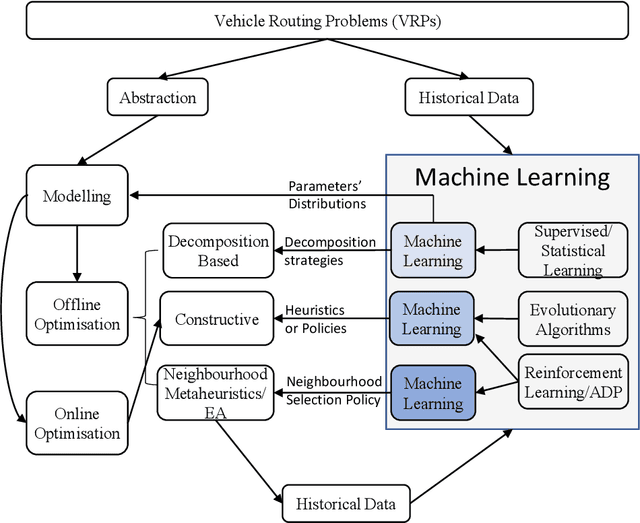
The Vehicle Routing Problem (VRP) is one of the most intensively studied combinatorial optimisation problems for which numerous models and algorithms have been proposed. To tackle the complexities, uncertainties and dynamics involved in real-world VRP applications, Machine Learning (ML) methods have been used in combination with analytical approaches to enhance problem formulations and algorithmic performance across different problem solving scenarios. However, the relevant papers are scattered in several traditional research fields with very different, sometimes confusing, terminologies. This paper presents a first, comprehensive review of hybrid methods that combine analytical techniques with ML tools in addressing VRP problems. Specifically, we review the emerging research streams on ML-assisted VRP modelling and ML-assisted VRP optimisation. We conclude that ML can be beneficial in enhancing VRP modelling, and improving the performance of algorithms for both online and offline VRP optimisations. Finally, challenges and future opportunities of VRP research are discussed.