 Add to Chrome
 Add to Firefox
 Add to Edge
STS-NET: Spatio-Temporal Stress Network for Self-Supervised Crop Stress Detection using Satellite Image Time Series
Jul 21, 2026
Early and accurate detection of crop stress is essential to improve agricultural productivity and ensure global food security. However, collecting a large labeled crop stress dataset is a challenging task. To address this challenge, we introduce a novel spatial-temporal stress network (STS-NET), built on a self-supervised 3D-convolutional autoencoder (3D-CAE), designed to utilize Satellite Image Time Series (SITS) data for crop stress detection. STS-NET exploits four vegetation indices: Normalized Difference Vegetation Index (NDVI), Normalized Difference Vegetation Index (GNDVI), Red-Edge Chlorophyll Index (RECI) and Normalized Difference Red-Edge Index (NDRE) obtained from high resolution Planetscope imagery to capture spatiotemporal stress patterns. The model is trained on our BSPT (Barnala Spatial-Temporal) dataset and evaluated on a real-world sugarcane dataset collected over a year from a 2.5-acre test plot located in Lakhimpur-Kheri (LK) district in Uttar Pradesh in India. STS-NET achieved a precision of 97. 98\% for water stress, 85.08\% for nitrogen stress, and 83.47\% for combined stress. The results demonstrate the potential of STS-NET in effectively detecting stress in sugarcane crops with minimal reliance on labeled data. Furthermore, STS-NET can serve as a robust feature extractor for simpler models.

CGMap: A Geospatially Aware Deep Learning Framework for Crop Gap Mapping Using UAV
Jul 21, 2026In India, crop germination is primarily monitored by visual inspection and manual counting, which are prone to errors, despite their crucial role in determining eventual yield potential. This paper highlights a deep learning based pipeline which uses object detection methods and drone imagery to assess and provide a precise count of sugarcane germination in fields. The approch uses a pre-trained AI model to find germinated plant sampling and identify gaps, also known as ``bald spots'', which restricts field productivity. The techniques used here relies on the YOLOV8 architecture, which was trained on a carefully selected dataset of UAV photos taken in various agroclimatic zones of India. Here, we bring upon a novel orientation-normalization technique that uses minimum Spanning Trees (MST) to account for variations in planting geometry, allowing for dependable row and column extraction across a variety of field layouts. By converting detected seedlings into spatial point clouds, emergence gaps can be inferred from the anticipated spacing between plants. A geospatial germination map exported in Well-Known Text (WKT) format is the end result, and it can be easily incorporated into GIS platforms used by sugar mills and agronomists to direct transplant initiatives. Timely interventions based on the insights provided by the algorithm can significantly increase yield, resulting in higher profits. Hence, support proper allocation of resources, avoid wastage, and enhance long-term sustainability.
Adaptive Joint Compression and Synchronisation in Federated Split Learning for IoT Rainfall Prediction
Jun 23, 2026Federated split learning (FSL) enables collaborative training across bandwidth-constrained IoT devices, but repeated activation and gradient exchange creates a communication bot-tleneck. Prior work optimises either activation compression or synchronisation frequency in isolation. This paper presents an FSL framework for IoT rainfall prediction that jointly regulates activation compression and the synchronisation interval \r{ho} via a latency driven scheduler on a server with per client EMA smoothing. The system is evaluated on hourly ERA5 data from 11 weather stations through a 17 scenario simulation matrix and a four scenario Raspberry Pi deployment over a real wide-area link. The simulation matrix validates scheduler switching across low, high, and mixed latency profiles, while the Pi deployment validates the high latency endpoint selected by the same policy. AUPRC varies only slightly across configurations (0.6381-0.6484 in simulation; within 0.011 on Pi), indicating that aggressive quantisation and sparser aggregation do not materially degrade predictive quality in this setting. On Pi, the selected endpoint (int8 with rho=3) achieves an 87% reduction in activation upload payload and a 54% reduction in synchronisation traffic relative to the float32 baseline, while reducing runtime jitter from +/-688 s to +/-10 s.
D2R: dual regularization loss with collaborative adversarial generation for model robustness
Jun 08, 2025The robustness of Deep Neural Network models is crucial for defending models against adversarial attacks. Recent defense methods have employed collaborative learning frameworks to enhance model robustness. Two key limitations of existing methods are (i) insufficient guidance of the target model via loss functions and (ii) non-collaborative adversarial generation. We, therefore, propose a dual regularization loss (D2R Loss) method and a collaborative adversarial generation (CAG) strategy for adversarial training. D2R loss includes two optimization steps. The adversarial distribution and clean distribution optimizations enhance the target model's robustness by leveraging the strengths of different loss functions obtained via a suitable function space exploration to focus more precisely on the target model's distribution. CAG generates adversarial samples using a gradient-based collaboration between guidance and target models. We conducted extensive experiments on three benchmark databases, including CIFAR-10, CIFAR-100, Tiny ImageNet, and two popular target models, WideResNet34-10 and PreActResNet18. Our results show that D2R loss with CAG produces highly robust models.
Benchmarking of CPU-intensive Stream Data Processing in The Edge Computing Systems
May 12, 2025Edge computing has emerged as a pivotal technology, offering significant advantages such as low latency, enhanced data security, and reduced reliance on centralized cloud infrastructure. These benefits are crucial for applications requiring real-time data processing or strict security measures. Despite these advantages, edge devices operating within edge clusters are often underutilized. This inefficiency is mainly due to the absence of a holistic performance profiling mechanism which can help dynamically adjust the desired system configuration for a given workload. Since edge computing environments involve a complex interplay between CPU frequency, power consumption, and application performance, a deeper understanding of these correlations is essential. By uncovering these relationships, it becomes possible to make informed decisions that enhance both computational efficiency and energy savings. To address this gap, this paper evaluates the power consumption and performance characteristics of a single processing node within an edge cluster using a synthetic microbenchmark by varying the workload size and CPU frequency. The results show how an optimal measure can lead to optimized usage of edge resources, given both performance and power consumption.
D2Fusion: Dual-domain Fusion with Feature Superposition for Deepfake Detection
Mar 21, 2025Deepfake detection is crucial for curbing the harm it causes to society. However, current Deepfake detection methods fail to thoroughly explore artifact information across different domains due to insufficient intrinsic interactions. These interactions refer to the fusion and coordination after feature extraction processes across different domains, which are crucial for recognizing complex forgery clues. Focusing on more generalized Deepfake detection, in this work, we introduce a novel bi-directional attention module to capture the local positional information of artifact clues from the spatial domain. This enables accurate artifact localization, thus addressing the coarse processing with artifact features. To further address the limitation that the proposed bi-directional attention module may not well capture global subtle forgery information in the artifact feature (e.g., textures or edges), we employ a fine-grained frequency attention module in the frequency domain. By doing so, we can obtain high-frequency information in the fine-grained features, which contains the global and subtle forgery information. Although these features from the diverse domains can be effectively and independently improved, fusing them directly does not effectively improve the detection performance. Therefore, we propose a feature superposition strategy that complements information from spatial and frequency domains. This strategy turns the feature components into the form of wave-like tokens, which are updated based on their phase, such that the distinctions between authentic and artifact features can be amplified. Our method demonstrates significant improvements over state-of-the-art (SOTA) methods on five public Deepfake datasets in capturing abnormalities across different manipulated operations and real-life.
FedSCA: Federated Tuning with Similarity-guided Collaborative Aggregation for Heterogeneous Medical Image Segmentation
Mar 19, 2025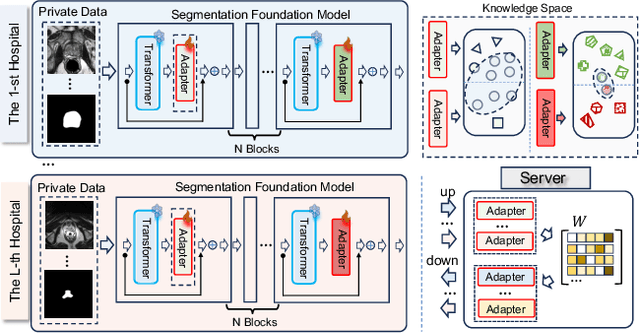
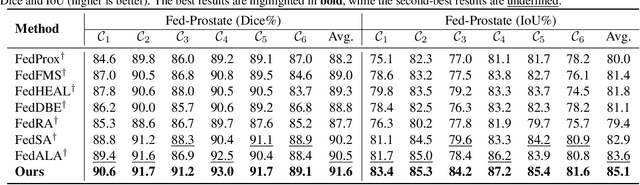
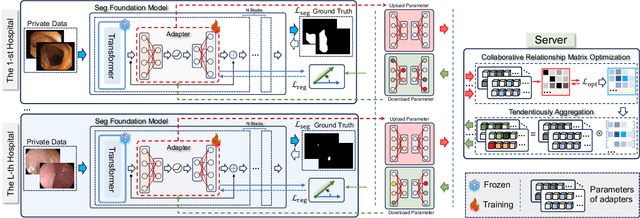
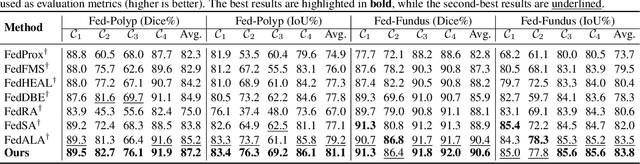
Transformer-based foundation models (FMs) have recently demonstrated remarkable performance in medical image segmentation. However, scaling these models is challenging due to the limited size of medical image datasets within isolated hospitals, where data centralization is restricted due to privacy concerns. These constraints, combined with the data-intensive nature of FMs, hinder their broader application. Integrating federated learning (FL) with foundation models (FLFM) fine-tuning offers a potential solution to these challenges by enabling collaborative model training without data sharing, thus allowing FMs to take advantage of a diverse pool of sensitive medical image data across hospitals/clients. However, non-independent and identically distributed (non-IID) data among clients, paired with computational and communication constraints in federated environments, presents an additional challenge that limits further performance improvements and remains inadequately addressed in existing studies. In this work, we propose a novel FLFM fine-tuning framework, \underline{\textbf{Fed}}erated tuning with \underline{\textbf{S}}imilarity-guided \underline{\textbf{C}}ollaborative \underline{\textbf{A}}ggregation (FedSCA), encompassing all phases of the FL process. This includes (1) specially designed parameter-efficient fine-tuning (PEFT) for local client training to enhance computational efficiency; (2) partial low-level adapter transmission for communication efficiency; and (3) similarity-guided collaborative aggregation (SGCA) on the server side to address non-IID issues. Extensive experiments on three FL benchmarks for medical image segmentation demonstrate the effectiveness of our proposed FedSCA, establishing new SOTA performance.
A Circular Construction Product Ontology for End-of-Life Decision-Making
Mar 17, 2025Efficient management of end-of-life (EoL) products is critical for advancing circularity in supply chains, particularly within the construction industry where EoL strategies are hindered by heterogenous lifecycle data and data silos. Current tools like Environmental Product Declarations (EPDs) and Digital Product Passports (DPPs) are limited by their dependency on seamless data integration and interoperability which remain significant challenges. To address these, we present the Circular Construction Product Ontology (CCPO), an applied framework designed to overcome semantic and data heterogeneity challenges in EoL decision-making for construction products. CCPO standardises vocabulary and facilitates data integration across supply chain stakeholders enabling lifecycle assessments (LCA) and robust decision-making. By aggregating disparate data into a unified product provenance, CCPO enables automated EoL recommendations through customisable SWRL rules aligned with European standards and stakeholder-specific circularity SLAs, demonstrating its scalability and integration capabilities. The adopted circular product scenario depicts CCPO's application while competency question evaluations show its superior performance in generating accurate EoL suggestions highlighting its potential to greatly improve decision-making in circular supply chains and its applicability in real-world construction environments.
Laser: Efficient Language-Guided Segmentation in Neural Radiance Fields
Jan 31, 2025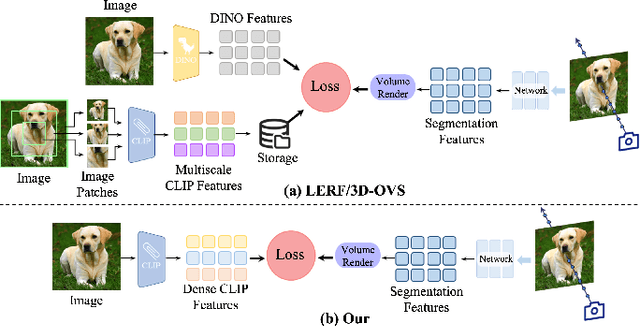

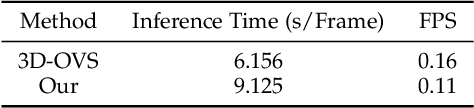
In this work, we propose a method that leverages CLIP feature distillation, achieving efficient 3D segmentation through language guidance. Unlike previous methods that rely on multi-scale CLIP features and are limited by processing speed and storage requirements, our approach aims to streamline the workflow by directly and effectively distilling dense CLIP features, thereby achieving precise segmentation of 3D scenes using text. To achieve this, we introduce an adapter module and mitigate the noise issue in the dense CLIP feature distillation process through a self-cross-training strategy. Moreover, to enhance the accuracy of segmentation edges, this work presents a low-rank transient query attention mechanism. To ensure the consistency of segmentation for similar colors under different viewpoints, we convert the segmentation task into a classification task through label volume, which significantly improves the consistency of segmentation in color-similar areas. We also propose a simplified text augmentation strategy to alleviate the issue of ambiguity in the correspondence between CLIP features and text. Extensive experimental results show that our method surpasses current state-of-the-art technologies in both training speed and performance. Our code is available on: https://github.com/xingy038/Laser.git.
Exemplar-condensed Federated Class-incremental Learning
Dec 25, 2024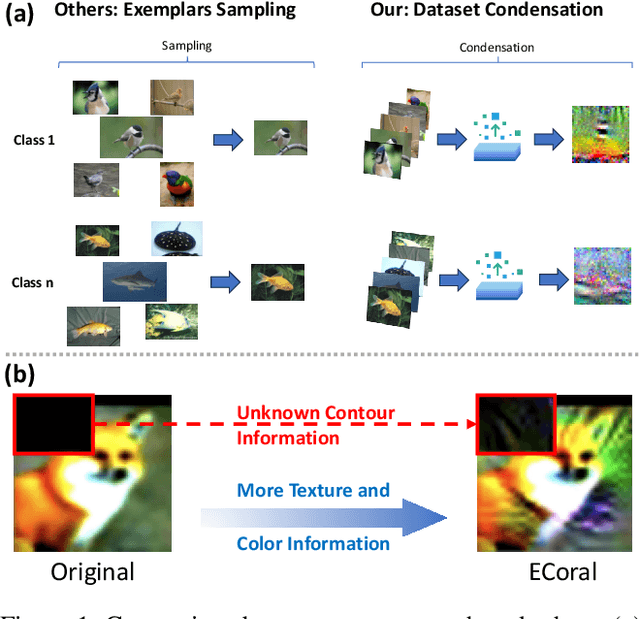

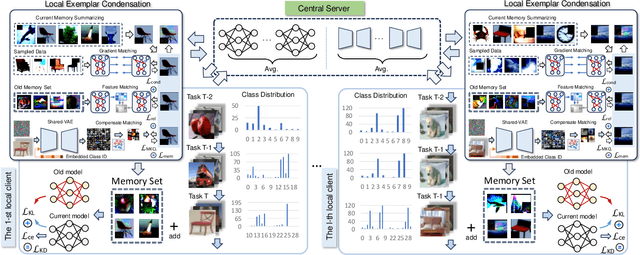

We propose Exemplar-Condensed federated class-incremental learning (ECoral) to distil the training characteristics of real images from streaming data into informative rehearsal exemplars. The proposed method eliminates the limitations of exemplar selection in replay-based approaches for mitigating catastrophic forgetting in federated continual learning (FCL). The limitations particularly related to the heterogeneity of information density of each summarized data. Our approach maintains the consistency of training gradients and the relationship to past tasks for the summarized exemplars to represent the streaming data compared to the original images effectively. Additionally, our approach reduces the information-level heterogeneity of the summarized data by inter-client sharing of the disentanglement generative model. Extensive experiments show that our ECoral outperforms several state-of-the-art methods and can be seamlessly integrated with many existing approaches to enhance performance.