 Add to Chrome
 Add to Firefox
 Add to Edge
Beyond One-Model-Fits-All: A Survey of Domain Specialization for Large Language Models
May 31, 2023
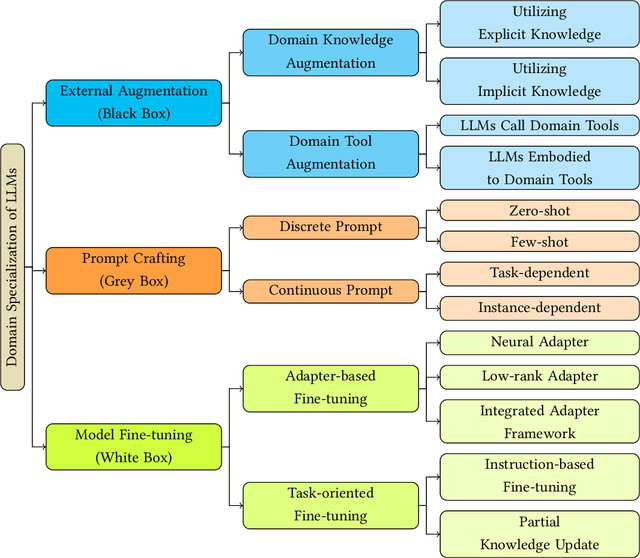
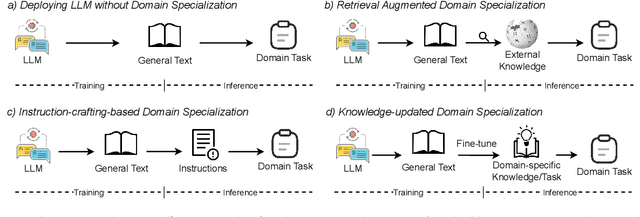
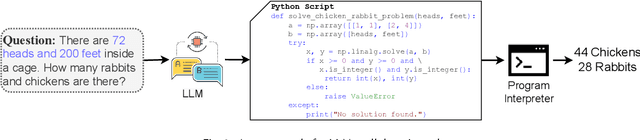
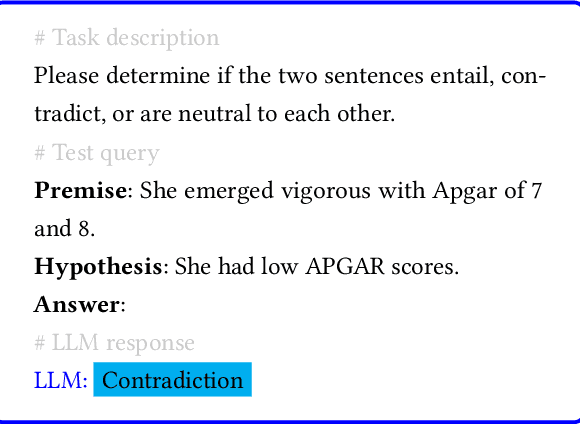
Large language models (LLMs) have significantly advanced the field of natural language processing (NLP), providing a highly useful, task-agnostic foundation for a wide range of applications. The great promise of LLMs as general task solvers motivated people to extend their functionality largely beyond just a ``chatbot'', and use it as an assistant or even replacement for domain experts and tools in specific domains such as healthcare, finance, and education. However, directly applying LLMs to solve sophisticated problems in specific domains meets many hurdles, caused by the heterogeneity of domain data, the sophistication of domain knowledge, the uniqueness of domain objectives, and the diversity of the constraints (e.g., various social norms, cultural conformity, religious beliefs, and ethical standards in the domain applications). To fill such a gap, explosively-increase research, and practices have been conducted in very recent years on the domain specialization of LLMs, which, however, calls for a comprehensive and systematic review to better summarizes and guide this promising domain. In this survey paper, first, we propose a systematic taxonomy that categorizes the LLM domain-specialization techniques based on the accessibility to LLMs and summarizes the framework for all the subcategories as well as their relations and differences to each other. We also present a comprehensive taxonomy of critical application domains that can benefit from specialized LLMs, discussing their practical significance and open challenges. Furthermore, we offer insights into the current research status and future trends in this area.

Uniform-PAC Guarantees for Model-Based RL with Bounded Eluder Dimension
May 15, 2023Recently, there has been remarkable progress in reinforcement learning (RL) with general function approximation. However, all these works only provide regret or sample complexity guarantees. It is still an open question if one can achieve stronger performance guarantees, i.e., the uniform probably approximate correctness (Uniform-PAC) guarantee that can imply both a sub-linear regret bound and a polynomial sample complexity for any target learning accuracy. We study this problem by proposing algorithms for both nonlinear bandits and model-based episodic RL using the general function class with a bounded eluder dimension. The key idea of the proposed algorithms is to assign each action to different levels according to its width with respect to the confidence set. The achieved uniform-PAC sample complexity is tight in the sense that it matches the state-of-the-art regret bounds or sample complexity guarantees when reduced to the linear case. To the best of our knowledge, this is the first work for uniform-PAC guarantees on bandit and RL that goes beyond linear cases.
Horizon-free Reinforcement Learning in Adversarial Linear Mixture MDPs
May 15, 2023Recent studies have shown that episodic reinforcement learning (RL) is no harder than bandits when the total reward is bounded by $1$, and proved regret bounds that have a polylogarithmic dependence on the planning horizon $H$. However, it remains an open question that if such results can be carried over to adversarial RL, where the reward is adversarially chosen at each episode. In this paper, we answer this question affirmatively by proposing the first horizon-free policy search algorithm. To tackle the challenges caused by exploration and adversarially chosen reward, our algorithm employs (1) a variance-uncertainty-aware weighted least square estimator for the transition kernel; and (2) an occupancy measure-based technique for the online search of a \emph{stochastic} policy. We show that our algorithm achieves an $\tilde{O}\big((d+\log (|\mathcal{S}|^2 |\mathcal{A}|))\sqrt{K}\big)$ regret with full-information feedback, where $d$ is the dimension of a known feature mapping linearly parametrizing the unknown transition kernel of the MDP, $K$ is the number of episodes, $|\mathcal{S}|$ and $|\mathcal{A}|$ are the cardinalities of the state and action spaces. We also provide hardness results and regret lower bounds to justify the near optimality of our algorithm and the unavoidability of $\log|\mathcal{S}|$ and $\log|\mathcal{A}|$ in the regret bound.
Cooperative Multi-Agent Reinforcement Learning: Asynchronous Communication and Linear Function Approximation
May 12, 2023We study multi-agent reinforcement learning in the setting of episodic Markov decision processes, where multiple agents cooperate via communication through a central server. We propose a provably efficient algorithm based on value iteration that enable asynchronous communication while ensuring the advantage of cooperation with low communication overhead. With linear function approximation, we prove that our algorithm enjoys an $\tilde{\mathcal{O}}(d^{3/2}H^2\sqrt{K})$ regret with $\tilde{\mathcal{O}}(dHM^2)$ communication complexity, where $d$ is the feature dimension, $H$ is the horizon length, $M$ is the total number of agents, and $K$ is the total number of episodes. We also provide a lower bound showing that a minimal $\Omega(dM)$ communication complexity is required to improve the performance through collaboration.
Personalized Federated Learning under Mixture of Distributions
May 01, 2023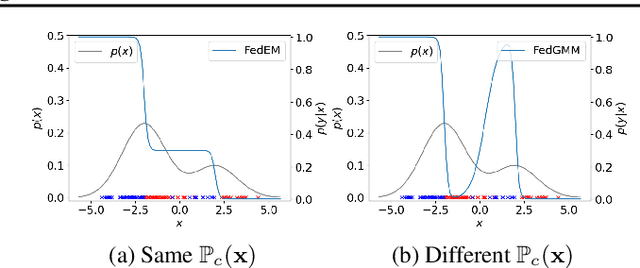

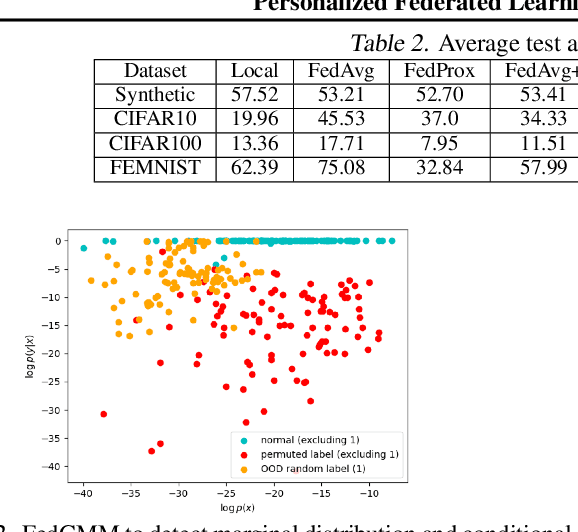
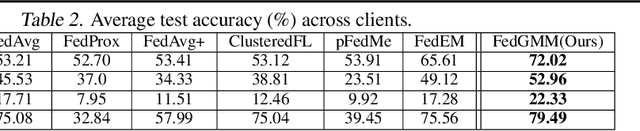
The recent trend towards Personalized Federated Learning (PFL) has garnered significant attention as it allows for the training of models that are tailored to each client while maintaining data privacy. However, current PFL techniques primarily focus on modeling the conditional distribution heterogeneity (i.e. concept shift), which can result in suboptimal performance when the distribution of input data across clients diverges (i.e. covariate shift). Additionally, these techniques often lack the ability to adapt to unseen data, further limiting their effectiveness in real-world scenarios. To address these limitations, we propose a novel approach, FedGMM, which utilizes Gaussian mixture models (GMM) to effectively fit the input data distributions across diverse clients. The model parameters are estimated by maximum likelihood estimation utilizing a federated Expectation-Maximization algorithm, which is solved in closed form and does not assume gradient similarity. Furthermore, FedGMM possesses an additional advantage of adapting to new clients with minimal overhead, and it also enables uncertainty quantification. Empirical evaluations on synthetic and benchmark datasets demonstrate the superior performance of our method in both PFL classification and novel sample detection.
Optimal Horizon-Free Reward-Free Exploration for Linear Mixture MDPs
Mar 17, 2023We study reward-free reinforcement learning (RL) with linear function approximation, where the agent works in two phases: (1) in the exploration phase, the agent interacts with the environment but cannot access the reward; and (2) in the planning phase, the agent is given a reward function and is expected to find a near-optimal policy based on samples collected in the exploration phase. The sample complexities of existing reward-free algorithms have a polynomial dependence on the planning horizon, which makes them intractable for long planning horizon RL problems. In this paper, we propose a new reward-free algorithm for learning linear mixture Markov decision processes (MDPs), where the transition probability can be parameterized as a linear combination of known feature mappings. At the core of our algorithm is uncertainty-weighted value-targeted regression with exploration-driven pseudo-reward and a high-order moment estimator for the aleatoric and epistemic uncertainties. When the total reward is bounded by $1$, we show that our algorithm only needs to explore $\tilde O( d^2\varepsilon^{-2})$ episodes to find an $\varepsilon$-optimal policy, where $d$ is the dimension of the feature mapping. The sample complexity of our algorithm only has a polylogarithmic dependence on the planning horizon and therefore is ``horizon-free''. In addition, we provide an $\Omega(d^2\varepsilon^{-2})$ sample complexity lower bound, which matches the sample complexity of our algorithm up to logarithmic factors, suggesting that our algorithm is optimal.
On the Interplay Between Misspecification and Sub-optimality Gap in Linear Contextual Bandits
Mar 16, 2023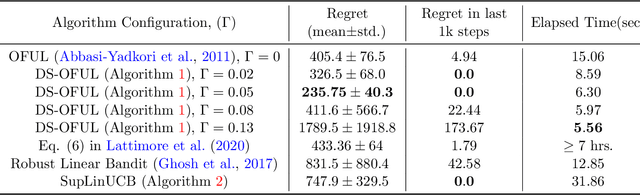
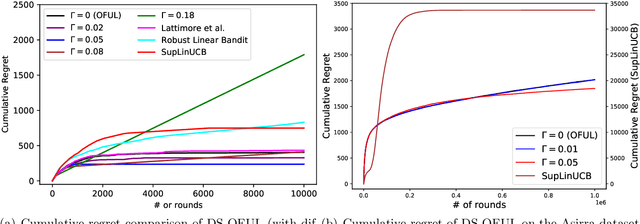
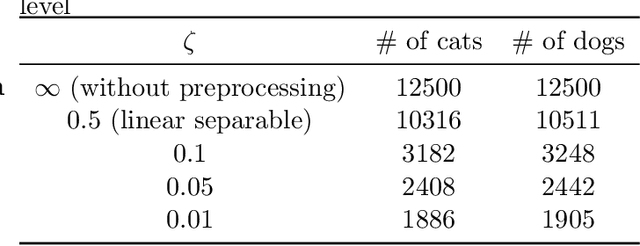
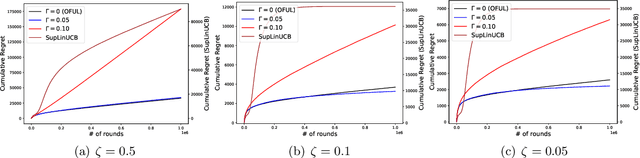
We study linear contextual bandits in the misspecified setting, where the expected reward function can be approximated by a linear function class up to a bounded misspecification level $\zeta>0$. We propose an algorithm based on a novel data selection scheme, which only selects the contextual vectors with large uncertainty for online regression. We show that, when the misspecification level $\zeta$ is dominated by $\tilde O (\Delta / \sqrt{d})$ with $\Delta$ being the minimal sub-optimality gap and $d$ being the dimension of the contextual vectors, our algorithm enjoys the same gap-dependent regret bound $\tilde O (d^2/\Delta)$ as in the well-specified setting up to logarithmic factors. In addition, we show that an existing algorithm SupLinUCB (Chu et al., 2011) can also achieve a gap-dependent constant regret bound without the knowledge of sub-optimality gap $\Delta$. Together with a lower bound adapted from Lattimore et al. (2020), our result suggests an interplay between misspecification level and the sub-optimality gap: (1) the linear contextual bandit model is efficiently learnable when $\zeta \leq \tilde O(\Delta / \sqrt{d})$; and (2) it is not efficiently learnable when $\zeta \geq \tilde \Omega({\Delta} / {\sqrt{d}})$. Experiments on both synthetic and real-world datasets corroborate our theoretical results.
Borda Regret Minimization for Generalized Linear Dueling Bandits
Mar 15, 2023Dueling bandits are widely used to model preferential feedback that is prevalent in machine learning applications such as recommendation systems and ranking. In this paper, we study the Borda regret minimization problem for dueling bandits, which aims to identify the item with the highest Borda score while minimizing the cumulative regret. We propose a new and highly expressive generalized linear dueling bandits model, which covers many existing models. Surprisingly, the Borda regret minimization problem turns out to be difficult, as we prove a regret lower bound of order $\Omega(d^{2/3} T^{2/3})$, where $d$ is the dimension of contextual vectors and $T$ is the time horizon. To attain the lower bound, we propose an explore-then-commit type algorithm, which has a nearly matching regret upper bound $\tilde{O}(d^{2/3} T^{2/3})$. When the number of items/arms $K$ is small, our algorithm can achieve a smaller regret $\tilde{O}( (d \log K)^{1/3} T^{2/3})$ with proper choices of hyperparameters. We also conduct empirical experiments on both synthetic data and a simulated real-world environment, which corroborate our theoretical analysis.
The Benefits of Mixup for Feature Learning
Mar 15, 2023Mixup, a simple data augmentation method that randomly mixes two data points via linear interpolation, has been extensively applied in various deep learning applications to gain better generalization. However, the theoretical underpinnings of its efficacy are not yet fully understood. In this paper, we aim to seek a fundamental understanding of the benefits of Mixup. We first show that Mixup using different linear interpolation parameters for features and labels can still achieve similar performance to the standard Mixup. This indicates that the intuitive linearity explanation in Zhang et al., (2018) may not fully explain the success of Mixup. Then we perform a theoretical study of Mixup from the feature learning perspective. We consider a feature-noise data model and show that Mixup training can effectively learn the rare features (appearing in a small fraction of data) from its mixture with the common features (appearing in a large fraction of data). In contrast, standard training can only learn the common features but fails to learn the rare features, thus suffering from bad generalization performance. Moreover, our theoretical analysis also shows that the benefits of Mixup for feature learning are mostly gained in the early training phase, based on which we propose to apply early stopping in Mixup. Experimental results verify our theoretical findings and demonstrate the effectiveness of the early-stopped Mixup training.
Benign Overfitting for Two-layer ReLU Networks
Mar 07, 2023Modern deep learning models with great expressive power can be trained to overfit the training data but still generalize well. This phenomenon is referred to as benign overfitting. Recently, a few studies have attempted to theoretically understand benign overfitting in neural networks. However, these works are either limited to neural networks with smooth activation functions or to the neural tangent kernel regime. How and when benign overfitting can occur in ReLU neural networks remains an open problem. In this work, we seek to answer this question by establishing algorithm-dependent risk bounds for learning two-layer ReLU convolutional neural networks with label-flipping noise. We show that, under mild conditions, the neural network trained by gradient descent can achieve near-zero training loss and Bayes optimal test risk. Our result also reveals a sharp transition between benign and harmful overfitting under different conditions on data distribution in terms of test risk. Experiments on synthetic data back up our theory.