 Add to Chrome
 Add to Firefox
 Add to Edge
VisionCreator-R1: A Reflection-Enhanced Native Visual-Generation Agentic Model
Mar 09, 2026
Visual content generation has advanced from single-image to multi-image workflows, yet existing agents remain largely plan-driven and lack systematic reflection mechanisms to correct mid-trajectory visual errors. To address this limitation, we propose VisionCreator-R1, a native visual generation agent with explicit reflection, together with a Reflection-Plan Co-Optimization (RPCO) training methodology. Through extensive experiments and trajectory-level analysis, we uncover reflection-plan optimization asymmetry in reinforcement learning (RL): planning can be reliably optimized via plan rewards, while reflection learning is hindered by noisy credit assignment. Guided by this insight, our RPCO first trains on the self-constructed VCR-SFT dataset with reflection-strong single-image trajectories and planning-strong multi-image trajectories, then co-optimization on VCR-RL dataset via RL. This yields our unified VisionCreator-R1 agent, which consistently outperforms Gemini2.5Pro on existing benchmarks and our VCR-bench covering single-image and multi-image tasks.

VisionCreator: A Native Visual-Generation Agentic Model with Understanding, Thinking, Planning and Creation
Mar 03, 2026Visual content creation tasks demand a nuanced understanding of design conventions and creative workflows-capabilities challenging for general models, while workflow-based agents lack specialized knowledge for autonomous creative planning. To overcome these challenges, we propose VisionCreator, a native visual-generation agentic model that unifies Understanding, Thinking, Planning, and Creation (UTPC) capabilities within an end-to-end learnable framework. Our work introduces four key contributions: (i) VisGenData-4k and its construction methodology using metacognition-based VisionAgent to generate high-quality creation trajectories with explicit UTPC structures; (ii) The VisionCreator agentic model, optimized through Progressive Specialization Training (PST) and Virtual Reinforcement Learning (VRL) within a high-fidelity simulated environment, enabling stable and efficient acquisition of UTPC capabilities for complex creation tasks; (iii) VisGenBench, a comprehensive benchmark featuring 1.2k test samples across diverse scenarios for standardized evaluation of multi-step visual creation capabilities; (iv) Remarkably, our VisionCreator-8B/32B models demonstrate superior performance over larger closed-source models across multiple evaluation dimensions. Overall, this work provides a foundation for future research in visual-generation agentic systems.
Noise Calibration: Plug-and-play Content-Preserving Video Enhancement using Pre-trained Video Diffusion Models
Jul 14, 2024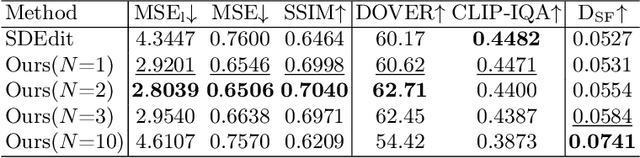
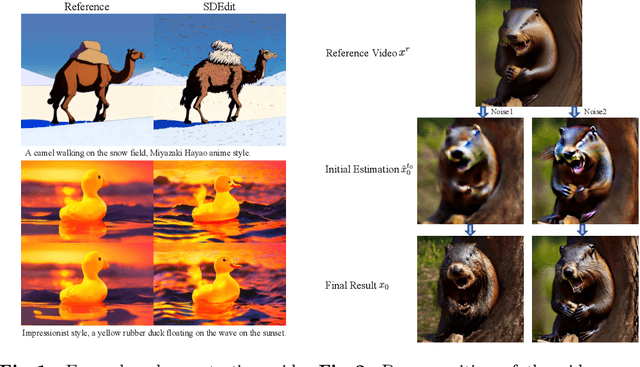
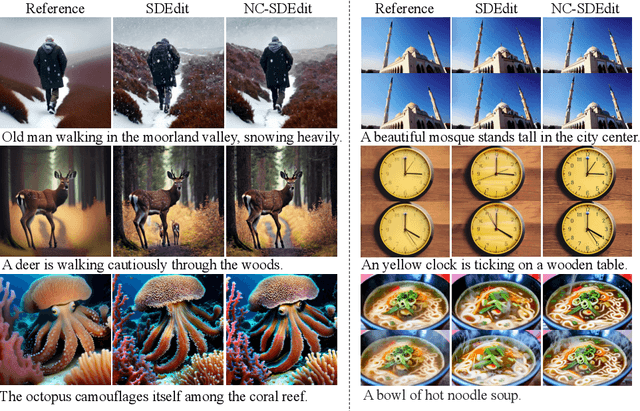

In order to improve the quality of synthesized videos, currently, one predominant method involves retraining an expert diffusion model and then implementing a noising-denoising process for refinement. Despite the significant training costs, maintaining consistency of content between the original and enhanced videos remains a major challenge. To tackle this challenge, we propose a novel formulation that considers both visual quality and consistency of content. Consistency of content is ensured by a proposed loss function that maintains the structure of the input, while visual quality is improved by utilizing the denoising process of pretrained diffusion models. To address the formulated optimization problem, we have developed a plug-and-play noise optimization strategy, referred to as Noise Calibration. By refining the initial random noise through a few iterations, the content of original video can be largely preserved, and the enhancement effect demonstrates a notable improvement. Extensive experiments have demonstrated the effectiveness of the proposed method.
Learning A Coarse-to-Fine Diffusion Transformer for Image Restoration
Aug 29, 2023Recent years have witnessed the remarkable performance of diffusion models in various vision tasks. However, for image restoration that aims to recover clear images with sharper details from given degraded observations, diffusion-based methods may fail to recover promising results due to inaccurate noise estimation. Moreover, simple constraining noises cannot effectively learn complex degradation information, which subsequently hinders the model capacity. To solve the above problems, we propose a coarse-to-fine diffusion Transformer (C2F-DFT) for image restoration. Specifically, our C2F-DFT contains diffusion self-attention (DFSA) and diffusion feed-forward network (DFN) within a new coarse-to-fine training scheme. The DFSA and DFN respectively capture the long-range diffusion dependencies and learn hierarchy diffusion representation to facilitate better restoration. In the coarse training stage, our C2F-DFT estimates noises and then generates the final clean image by a sampling algorithm. To further improve the restoration quality, we propose a simple yet effective fine training scheme. It first exploits the coarse-trained diffusion model with fixed steps to generate restoration results, which then would be constrained with corresponding ground-truth ones to optimize the models to remedy the unsatisfactory results affected by inaccurate noise estimation. Extensive experiments show that C2F-DFT significantly outperforms diffusion-based restoration method IR-SDE and achieves competitive performance compared with Transformer-based state-of-the-art methods on $3$ tasks, including deraining, deblurring, and real denoising. The code is available at https://github.com/wlydlut/C2F-DFT.