 Add to Chrome
 Add to Firefox
 Add to Edge
VisionCreator-R1: A Reflection-Enhanced Native Visual-Generation Agentic Model
Mar 09, 2026
Visual content generation has advanced from single-image to multi-image workflows, yet existing agents remain largely plan-driven and lack systematic reflection mechanisms to correct mid-trajectory visual errors. To address this limitation, we propose VisionCreator-R1, a native visual generation agent with explicit reflection, together with a Reflection-Plan Co-Optimization (RPCO) training methodology. Through extensive experiments and trajectory-level analysis, we uncover reflection-plan optimization asymmetry in reinforcement learning (RL): planning can be reliably optimized via plan rewards, while reflection learning is hindered by noisy credit assignment. Guided by this insight, our RPCO first trains on the self-constructed VCR-SFT dataset with reflection-strong single-image trajectories and planning-strong multi-image trajectories, then co-optimization on VCR-RL dataset via RL. This yields our unified VisionCreator-R1 agent, which consistently outperforms Gemini2.5Pro on existing benchmarks and our VCR-bench covering single-image and multi-image tasks.

VisionCreator: A Native Visual-Generation Agentic Model with Understanding, Thinking, Planning and Creation
Mar 03, 2026Visual content creation tasks demand a nuanced understanding of design conventions and creative workflows-capabilities challenging for general models, while workflow-based agents lack specialized knowledge for autonomous creative planning. To overcome these challenges, we propose VisionCreator, a native visual-generation agentic model that unifies Understanding, Thinking, Planning, and Creation (UTPC) capabilities within an end-to-end learnable framework. Our work introduces four key contributions: (i) VisGenData-4k and its construction methodology using metacognition-based VisionAgent to generate high-quality creation trajectories with explicit UTPC structures; (ii) The VisionCreator agentic model, optimized through Progressive Specialization Training (PST) and Virtual Reinforcement Learning (VRL) within a high-fidelity simulated environment, enabling stable and efficient acquisition of UTPC capabilities for complex creation tasks; (iii) VisGenBench, a comprehensive benchmark featuring 1.2k test samples across diverse scenarios for standardized evaluation of multi-step visual creation capabilities; (iv) Remarkably, our VisionCreator-8B/32B models demonstrate superior performance over larger closed-source models across multiple evaluation dimensions. Overall, this work provides a foundation for future research in visual-generation agentic systems.
Hunyuan-DiT: A Powerful Multi-Resolution Diffusion Transformer with Fine-Grained Chinese Understanding
May 14, 2024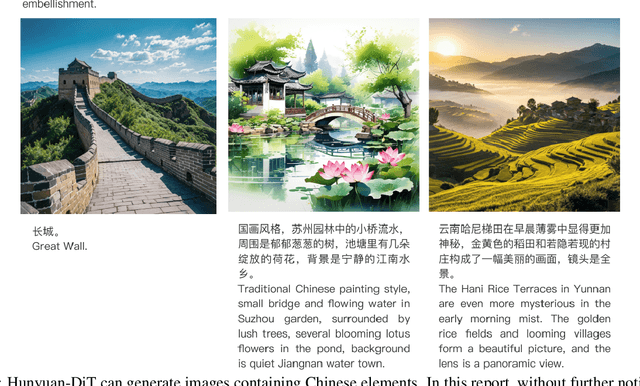
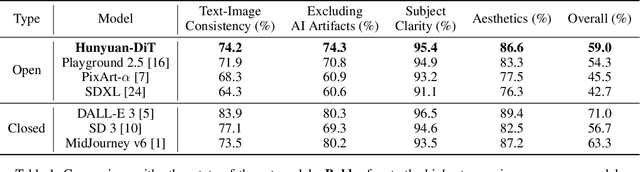

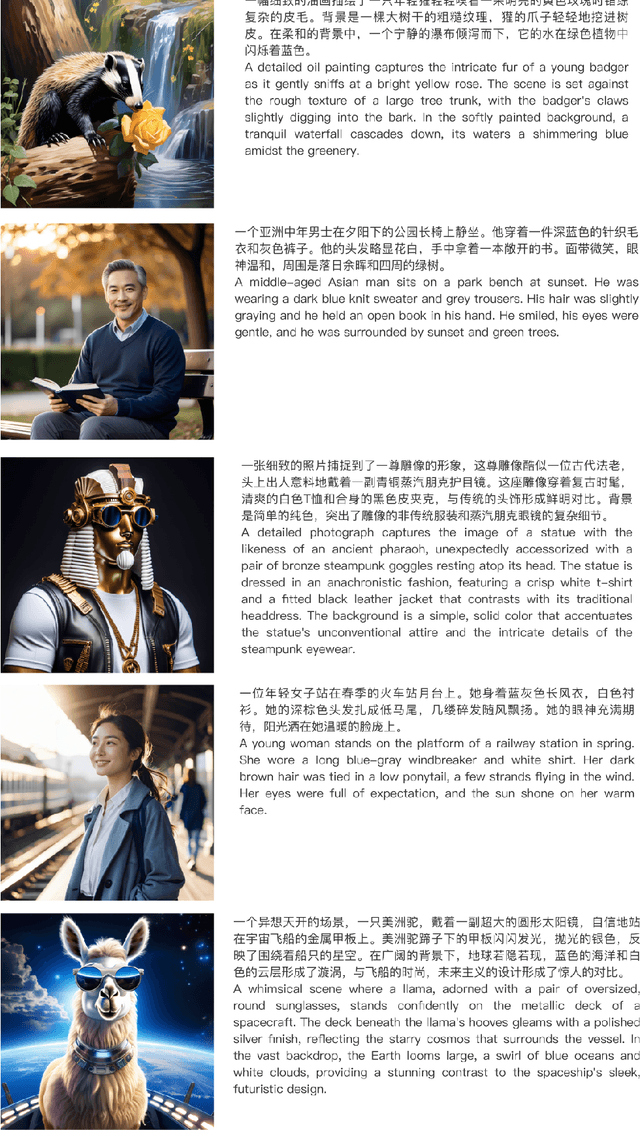
We present Hunyuan-DiT, a text-to-image diffusion transformer with fine-grained understanding of both English and Chinese. To construct Hunyuan-DiT, we carefully design the transformer structure, text encoder, and positional encoding. We also build from scratch a whole data pipeline to update and evaluate data for iterative model optimization. For fine-grained language understanding, we train a Multimodal Large Language Model to refine the captions of the images. Finally, Hunyuan-DiT can perform multi-turn multimodal dialogue with users, generating and refining images according to the context. Through our holistic human evaluation protocol with more than 50 professional human evaluators, Hunyuan-DiT sets a new state-of-the-art in Chinese-to-image generation compared with other open-source models. Code and pretrained models are publicly available at github.com/Tencent/HunyuanDiT
Tencent AVS: A Holistic Ads Video Dataset for Multi-modal Scene Segmentation
Dec 09, 2022


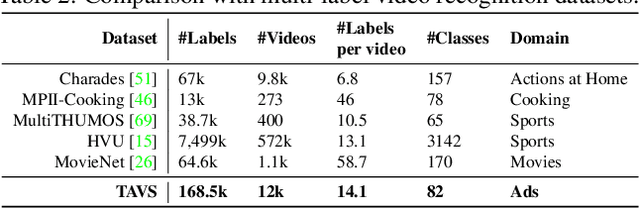
Temporal video segmentation and classification have been advanced greatly by public benchmarks in recent years. However, such research still mainly focuses on human actions, failing to describe videos in a holistic view. In addition, previous research tends to pay much attention to visual information yet ignores the multi-modal nature of videos. To fill this gap, we construct the Tencent `Ads Video Segmentation'~(TAVS) dataset in the ads domain to escalate multi-modal video analysis to a new level. TAVS describes videos from three independent perspectives as `presentation form', `place', and `style', and contains rich multi-modal information such as video, audio, and text. TAVS is organized hierarchically in semantic aspects for comprehensive temporal video segmentation with three levels of categories for multi-label classification, e.g., `place' - `working place' - `office'. Therefore, TAVS is distinguished from previous temporal segmentation datasets due to its multi-modal information, holistic view of categories, and hierarchical granularities. It includes 12,000 videos, 82 classes, 33,900 segments, 121,100 shots, and 168,500 labels. Accompanied with TAVS, we also present a strong multi-modal video segmentation baseline coupled with multi-label class prediction. Extensive experiments are conducted to evaluate our proposed method as well as existing representative methods to reveal key challenges of our dataset TAVS.