 Add to Chrome
 Add to Firefox
 Add to Edge
InTrain: Intrinsic Trainability for Zero-Cost Neural Architecture Search
Jun 17, 2026
Training-free neural architecture search promises efficient discovery of high-performance networks without costly training. However, existing zero-cost proxies rely on fragmented heuristics that fail to capture the fundamental question: what makes an architecture trainable? This paper introduces Intrinsic Trainability (InTrain), a unified theoretical proxy that formalizes trainability as an architectural invariant emerging from two synergistic components: geometric capacity and optimization resilience. We operationalize intrinsic trainability through analysis of neural information processing. Geometric capacity is quantified via the participation ratio of activation covariance eigenspectrum, capturing the effective dimensionality of representation manifolds. Optimization resilience is measured through cumulative gradient health, assessing the robustness of backpropagation across network depth. InTrain synthesizes these dimensions through a scale-invariant multiplicative coupling, which we hypothesize is essential for capturing their synergistic, non-additive relationship. Extensive experiments on standard NAS benchmarks and search spaces demonstrate that InTrain achieves ranking correlations on par with state-of-the-art ensemble-based proxies and outperforms other single-metric methods.

Overview of AI-Debater 2023: The Challenges of Argument Generation Tasks
Jul 24, 2024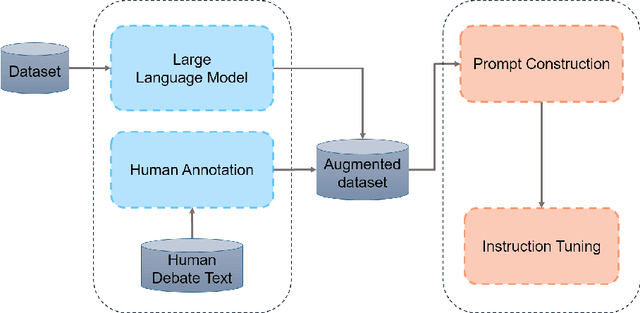
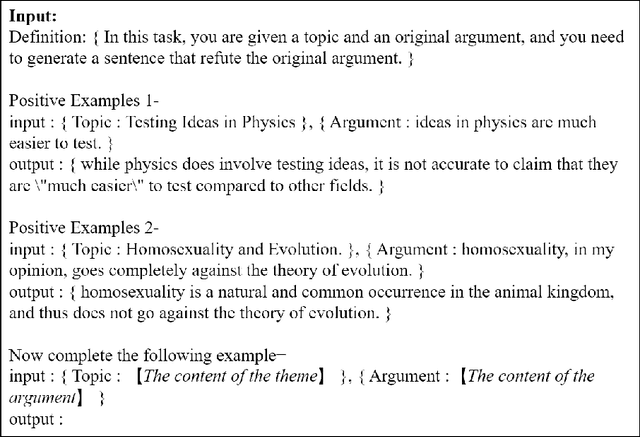
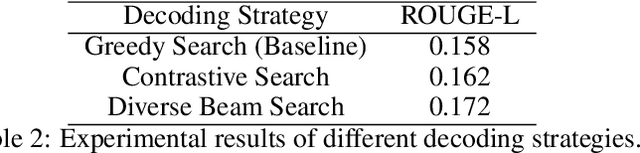
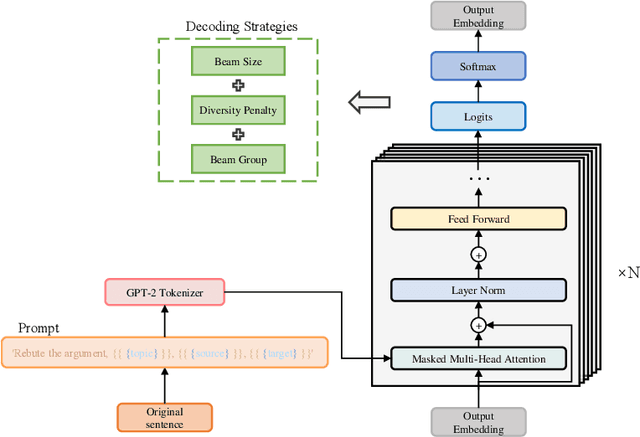
In this paper we present the results of the AI-Debater 2023 Challenge held by the Chinese Conference on Affect Computing (CCAC 2023), and introduce the related datasets. We organize two tracks to handle the argumentative generation tasks in different scenarios, namely, Counter-Argument Generation (Track 1) and Claim-based Argument Generation (Track 2). Each track is equipped with its distinct dataset and baseline model respectively. In total, 32 competing teams register for the challenge, from which we received 11 successful submissions. In this paper, we will present the results of the challenge and a summary of the systems, highlighting commonalities and innovations among participating systems. Datasets and baseline models of the AI-Debater 2023 Challenge have been already released and can be accessed through the official website of the challenge.