 Add to Chrome
 Add to Firefox
 Add to Edge
ANFI: Rethinking Neighbor Feature Interaction in Person Re-ID
Jul 28, 2026
In person re-identification, neighbor-based methods have achieved significant success by interacting with neighbor samples to obtain more robust representations. However, existing methods rely only on affinity relations, causing their success to depend heavily on the reliability of selected neighbors. We find that affinity-only interaction often fails in challenging scenarios due to the inevitable presence of noisy neighbors. To enable effective interactions under noisy neighborhoods, we revisit neighbor-based methods under distinct reliability conditions and propose a novel Adaptive Neighbor Feature Interaction (ANFI) method. The core idea of ANFI is to account for negative effects from noisy neighbors, allowing samples to remain distinguishable from false positive neighbors. Unlike existing methods, ANFI models not only affinity relations but also discrepancy relations, and employs sample-wise adaptive weighting for these two types of relations. Given that capturing negative effects from noisy neighbors differs significantly from traditional relation learning, we derive discrepancy relations from a new neighborhood similarity, which provides more information than pairwise similarity. In addition, we propose Noisy Relation Supervision (NRS) to train ANFI, gradually injecting robustness to noisy relations into the model. Extensive experiments conducted under standard, cross-modal, and cross-domain settings, including comparisons with neighbor-based methods and re-ranking methods, demonstrate the superiority of our method across various neighbor distributions.

MFEN:Multi-Frequency Expert Network for Visible-Infrared Person Re-ID
Jun 10, 2026Visible-infrared person re-identification (VI-ReID) is challenging due to the large modality discrepancy between visible and infrared images. We contend that this discrepancy is largely related to differing lighting conditions, including differences in light wavelength and light source type. Recently, frequency-based VI-ReID approaches have achieved notable success because frequency information can better extract identity-relevant contours and details while excluding irrelevant lighting and color. However, existing methods either do not distinguish different frequency bands or focus on only one band, which is insufficient under diverse lighting conditions. To perform comprehensive frequency domain learning, we propose a Multi-Frequency Expert Network (MFEN) that enables multi-frequency modulation and adaptively combines different bands through a mixture-of-experts design. We further introduce Random Frequency Augmentation (RFA) and Frequency Auxiliary Optimization (FAO) to better train MFEN. The three modules are complementary and jointly capture critical frequency-domain details for robust representation learning. Extensive experiments on three VI-ReID datasets demonstrate the effectiveness of our approach.
Lens: Rethinking Training Efficiency for Foundational Text-to-Image Models
May 20, 2026We introduce Lens, a 3.8B-parameter T2I model that achieves performance competitive with, and in several cases surpassing, state-of-the-art models with more than 6B parameters across various benchmarks, while requiring significantly less training compute. For example, Lens requires only about 19.3% of the training compute used by Z-Image. The training efficiency of Lens stems from two key strategies beyond its compact model size. First, we maximize data information density per training batch by (i) training on Lens-800M, a dataset of 800M densely captioned image-text pairs whose captions are generated by GPT-4.1 and contain approximately 109 words on average, providing richer semantic supervision than conventional short captions, and (ii) constructing each batch from images with multiple resolutions and diverse aspect ratios, thereby enlarging the effective visual coverage of each optimization step. Second, we improve convergence speed through careful architectural choices, including adopting a semantic VAE that provides better latent representations and employing a strong language encoder that accelerates optimization while enabling multilingual generalization from English-only training data. After pre-training, we apply RL with taxonomy-driven prompts (Lens-RL-8K) and structured reward rubrics to suppress artifacts and improve visual quality, a reasoner module with training-free system prompt search to better align user requests with the model, and distillation-based acceleration for 4-step inference. Through efficient training and systematic optimization, Lens generalizes to arbitrary aspect ratios from 1:2 to 2:1 and resolutions up to 1440^2, and supports prompts in several commonly used languages. Thanks to its compact size, Lens generates a 1024^2 image in 3.15 seconds on a single NVIDIA H100 GPU, while its distilled turbo version performs 4-step generation in 0.84 seconds.
HQ-50K: A Large-scale, High-quality Dataset for Image Restoration
Jun 08, 2023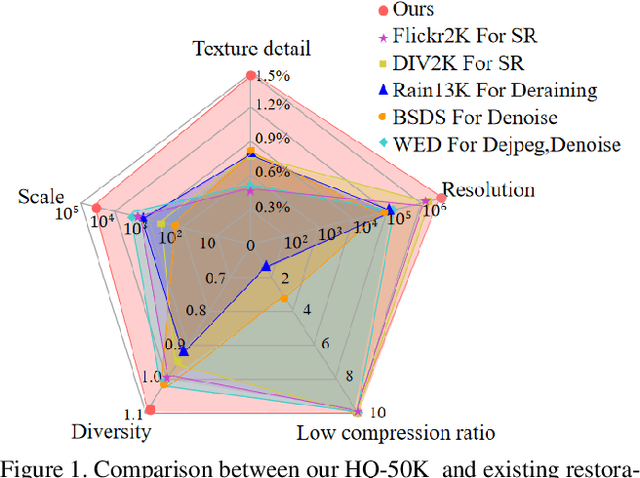
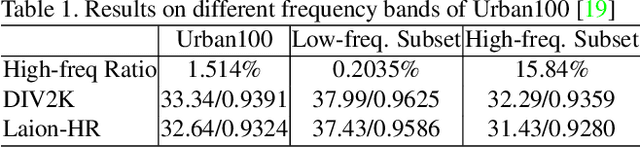
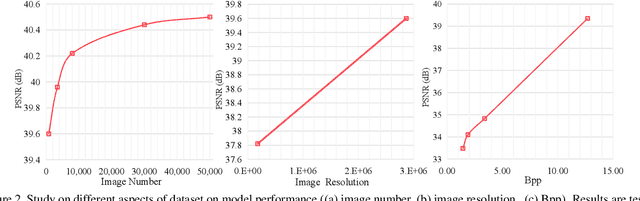
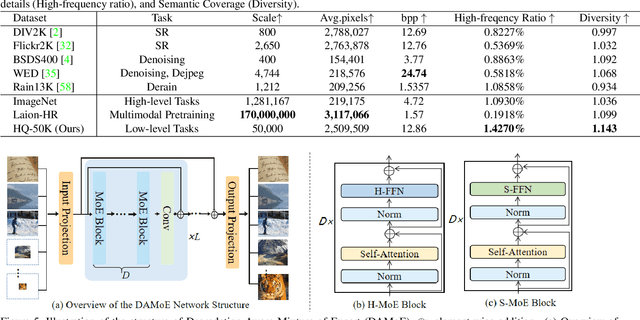
This paper introduces a new large-scale image restoration dataset, called HQ-50K, which contains 50,000 high-quality images with rich texture details and semantic diversity. We analyze existing image restoration datasets from five different perspectives, including data scale, resolution, compression rates, texture details, and semantic coverage. However, we find that all of these datasets are deficient in some aspects. In contrast, HQ-50K considers all of these five aspects during the data curation process and meets all requirements. We also present a new Degradation-Aware Mixture of Expert (DAMoE) model, which enables a single model to handle multiple corruption types and unknown levels. Our extensive experiments demonstrate that HQ-50K consistently improves the performance on various image restoration tasks, such as super-resolution, denoising, dejpeg, and deraining. Furthermore, our proposed DAMoE, trained on our \dataset, outperforms existing state-of-the-art unified models designed for multiple restoration tasks and levels. The dataset and code are available at \url{https://github.com/littleYaang/HQ-50K}.