 Add to Chrome
 Add to Firefox
 Add to Edge
Memory-Efficient LLM Training with Online Subspace Descent
Aug 23, 2024
Recently, a wide range of memory-efficient LLM training algorithms have gained substantial popularity. These methods leverage the low-rank structure of gradients to project optimizer states into a subspace using projection matrix found by singular value decomposition (SVD). However, convergence of these algorithms is highly dependent on the update rules of their projection matrix. In this work, we provide the \emph{first} convergence guarantee for arbitrary update rules of projection matrix. This guarantee is generally applicable to optimizers that can be analyzed with Hamiltonian Descent, including most common ones, such as LION, Adam. Inspired by our theoretical understanding, we propose Online Subspace Descent, a new family of subspace descent optimizer without SVD. Instead of updating the projection matrix with eigenvectors, Online Subspace Descent updates the projection matrix with online PCA. Online Subspace Descent is flexible and introduces only minimum overhead to training. We show that for the task of pretraining LLaMA models ranging from 60M to 7B parameters on the C4 dataset, Online Subspace Descent achieves lower perplexity and better downstream tasks performance than state-of-the-art low-rank training methods across different settings and narrows the gap with full-rank baselines.

Enhancing Multi-hop Reasoning through Knowledge Erasure in Large Language Model Editing
Aug 22, 2024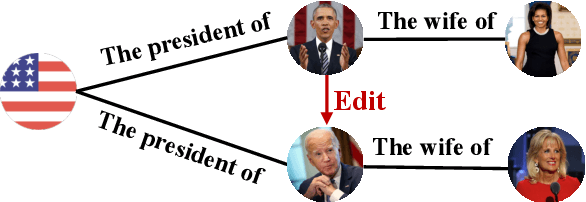


Large language models (LLMs) face challenges with internal knowledge inaccuracies and outdated information. Knowledge editing has emerged as a pivotal approach to mitigate these issues. Although current knowledge editing techniques exhibit promising performance in single-hop reasoning tasks, they show limitations when applied to multi-hop reasoning. Drawing on cognitive neuroscience and the operational mechanisms of LLMs, we hypothesize that the residual single-hop knowledge after editing causes edited models to revert to their original answers when processing multi-hop questions, thereby undermining their performance in multihop reasoning tasks. To validate this hypothesis, we conduct a series of experiments that empirically confirm our assumptions. Building on the validated hypothesis, we propose a novel knowledge editing method that incorporates a Knowledge Erasure mechanism for Large language model Editing (KELE). Specifically, we design an erasure function for residual knowledge and an injection function for new knowledge. Through joint optimization, we derive the optimal recall vector, which is subsequently utilized within a rank-one editing framework to update the parameters of targeted model layers. Extensive experiments on GPT-J and GPT-2 XL demonstrate that KELE substantially enhances the multi-hop reasoning capability of edited LLMs.
ConFIG: Towards Conflict-free Training of Physics Informed Neural Networks
Aug 20, 2024The loss functions of many learning problems contain multiple additive terms that can disagree and yield conflicting update directions. For Physics-Informed Neural Networks (PINNs), loss terms on initial/boundary conditions and physics equations are particularly interesting as they are well-established as highly difficult tasks. To improve learning the challenging multi-objective task posed by PINNs, we propose the ConFIG method, which provides conflict-free updates by ensuring a positive dot product between the final update and each loss-specific gradient. It also maintains consistent optimization rates for all loss terms and dynamically adjusts gradient magnitudes based on conflict levels. We additionally leverage momentum to accelerate optimizations by alternating the back-propagation of different loss terms. The proposed method is evaluated across a range of challenging PINN scenarios, consistently showing superior performance and runtime compared to baseline methods. We also test the proposed method in a classic multi-task benchmark, where the ConFIG method likewise exhibits a highly promising performance. Source code is available at \url{https://tum-pbs.github.io/ConFIG}.
CoRA: Collaborative Information Perception by Large Language Model's Weights for Recommendation
Aug 20, 2024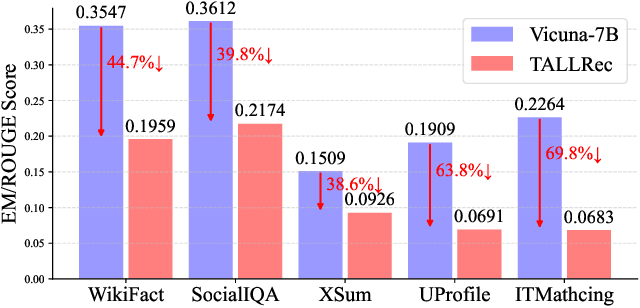
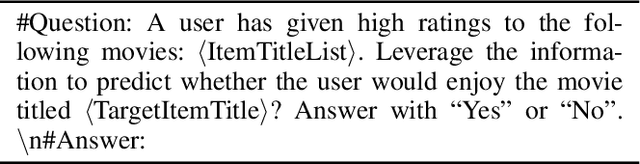
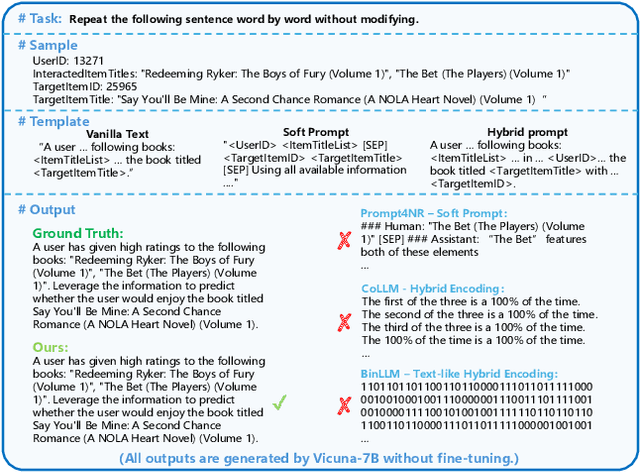
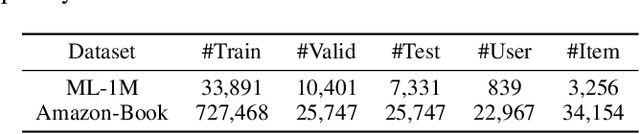
Involving collaborative information in Large Language Models (LLMs) is a promising technique for adapting LLMs for recommendation. Existing methods achieve this by concatenating collaborative features with text tokens into a unified sequence input and then fine-tuning to align these features with LLM's input space. Although effective, in this work, we identify two limitations when adapting LLMs to recommendation tasks, which hinder the integration of general knowledge and collaborative information, resulting in sub-optimal recommendation performance. (1) Fine-tuning LLM with recommendation data can undermine its inherent world knowledge and fundamental competencies, which are crucial for interpreting and inferring recommendation text. (2) Incorporating collaborative features into textual prompts disrupts the semantics of the original prompts, preventing LLM from generating appropriate outputs. In this paper, we propose a new paradigm, CoRA (an acronym for Collaborative LoRA), with a collaborative weights generator. Rather than input space alignment, this method aligns collaborative information with LLM's parameter space, representing them as incremental weights to update LLM's output. This way, LLM perceives collaborative information without altering its general knowledge and text inference capabilities. Specifically, we employ a collaborative filtering model to extract user and item embeddings, converting them into collaborative weights with low-rank properties through the collaborative weights generator. We then merge the collaborative weights into LLM's weights, enabling LLM to perceive the collaborative signals and generate personalized recommendations without fine-tuning or extra collaborative tokens in prompts. Extensive experiments confirm that CoRA effectively integrates collaborative information into LLM, enhancing recommendation performance.
NDDEs: A Deep Neural Network Framework for Solving Forward and Inverse Problems in Delay Differential Equations
Aug 17, 2024


This article proposes a solution framework for delay differential equations (DDEs) based on deep neural networks (DNNs) - the neural delay differential equations (NDDEs), aimed at solving the forward and inverse problems of delay differential equations. This framework embeds the delay differential equations into the neural networks to accommodate the diverse requirements of DDEs in terms of initial conditions, control equations, and known data. NDDEs adjust the network parameters through automatic differentiation and optimization algorithms to minimize the loss function, thereby obtaining numerical solutions to the delay differential equations without the grid dependence and discretization errors typical of traditional numerical methods. In addressing inverse problems, the NDDE framework can utilize observational data to perform precise estimation of single or multiple delay parameters. The results of multiple numerical experiments have shown that NDDEs demonstrate high precision in both forward and inverse problems, proving their effectiveness and promising potential in dealing with delayed differential equation issues.
DIVE: Subgraph Disagreement for Graph Out-of-Distribution Generalization
Aug 08, 2024This paper addresses the challenge of out-of-distribution (OOD) generalization in graph machine learning, a field rapidly advancing yet grappling with the discrepancy between source and target data distributions. Traditional graph learning algorithms, based on the assumption of uniform distribution between training and test data, falter in real-world scenarios where this assumption fails, resulting in suboptimal performance. A principal factor contributing to this suboptimal performance is the inherent simplicity bias of neural networks trained through Stochastic Gradient Descent (SGD), which prefer simpler features over more complex yet equally or more predictive ones. This bias leads to a reliance on spurious correlations, adversely affecting OOD performance in various tasks such as image recognition, natural language understanding, and graph classification. Current methodologies, including subgraph-mixup and information bottleneck approaches, have achieved partial success but struggle to overcome simplicity bias, often reinforcing spurious correlations. To tackle this, we propose DIVE, training a collection of models to focus on all label-predictive subgraphs by encouraging the models to foster divergence on the subgraph mask, which circumvents the limitation of a model solely focusing on the subgraph corresponding to simple structural patterns. Specifically, we employs a regularizer to punish overlap in extracted subgraphs across models, thereby encouraging different models to concentrate on distinct structural patterns. Model selection for robust OOD performance is achieved through validation accuracy. Tested across four datasets from GOOD benchmark and one dataset from DrugOOD benchmark, our approach demonstrates significant improvement over existing methods, effectively addressing the simplicity bias and enhancing generalization in graph machine learning.
Longhorn: State Space Models are Amortized Online Learners
Jul 19, 2024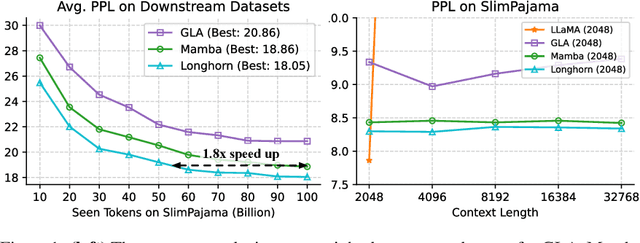
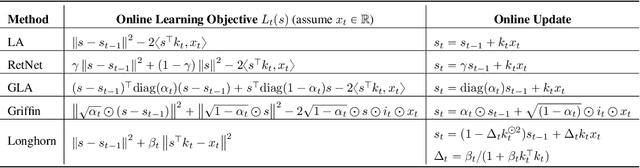
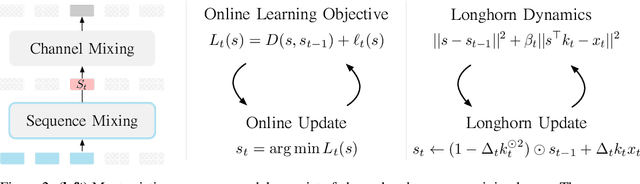

The most fundamental capability of modern AI methods such as Large Language Models (LLMs) is the ability to predict the next token in a long sequence of tokens, known as ``sequence modeling." Although the Transformers model is the current dominant approach to sequence modeling, its quadratic computational cost with respect to sequence length is a significant drawback. State-space models (SSMs) offer a promising alternative due to their linear decoding efficiency and high parallelizability during training. However, existing SSMs often rely on seemingly ad hoc linear recurrence designs. In this work, we explore SSM design through the lens of online learning, conceptualizing SSMs as meta-modules for specific online learning problems. This approach links SSM design to formulating precise online learning objectives, with state transition rules derived from optimizing these objectives. Based on this insight, we introduce a novel deep SSM architecture based on the implicit update for optimizing an online regression objective. Our experimental results show that our models outperform state-of-the-art SSMs, including the Mamba model, on standard sequence modeling benchmarks and language modeling tasks.
SlimFlow: Training Smaller One-Step Diffusion Models with Rectified Flow
Jul 18, 2024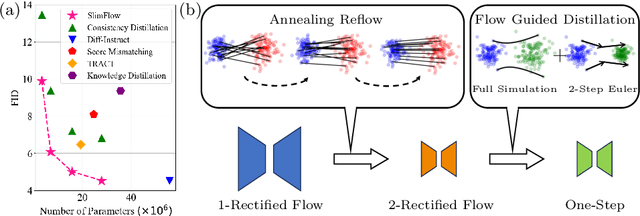


Diffusion models excel in high-quality generation but suffer from slow inference due to iterative sampling. While recent methods have successfully transformed diffusion models into one-step generators, they neglect model size reduction, limiting their applicability in compute-constrained scenarios. This paper aims to develop small, efficient one-step diffusion models based on the powerful rectified flow framework, by exploring joint compression of inference steps and model size. The rectified flow framework trains one-step generative models using two operations, reflow and distillation. Compared with the original framework, squeezing the model size brings two new challenges: (1) the initialization mismatch between large teachers and small students during reflow; (2) the underperformance of naive distillation on small student models. To overcome these issues, we propose Annealing Reflow and Flow-Guided Distillation, which together comprise our SlimFlow framework. With our novel framework, we train a one-step diffusion model with an FID of 5.02 and 15.7M parameters, outperforming the previous state-of-the-art one-step diffusion model (FID=6.47, 19.4M parameters) on CIFAR10. On ImageNet 64$\times$64 and FFHQ 64$\times$64, our method yields small one-step diffusion models that are comparable to larger models, showcasing the effectiveness of our method in creating compact, efficient one-step diffusion models.
Navigating the Noisy Crowd: Finding Key Information for Claim Verification
Jul 17, 2024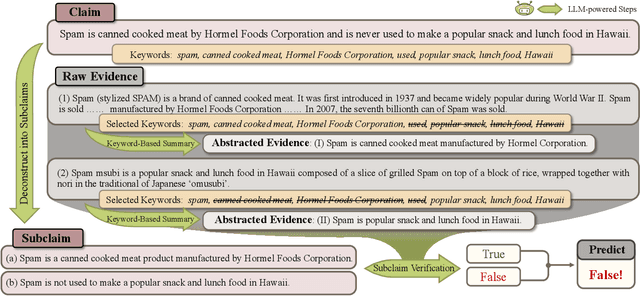
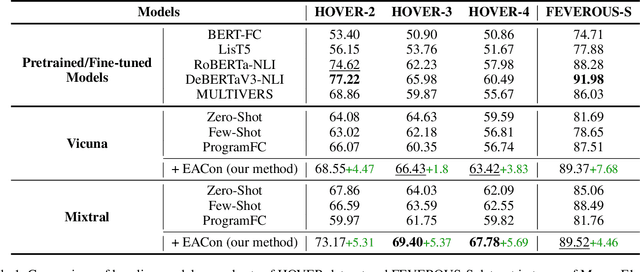
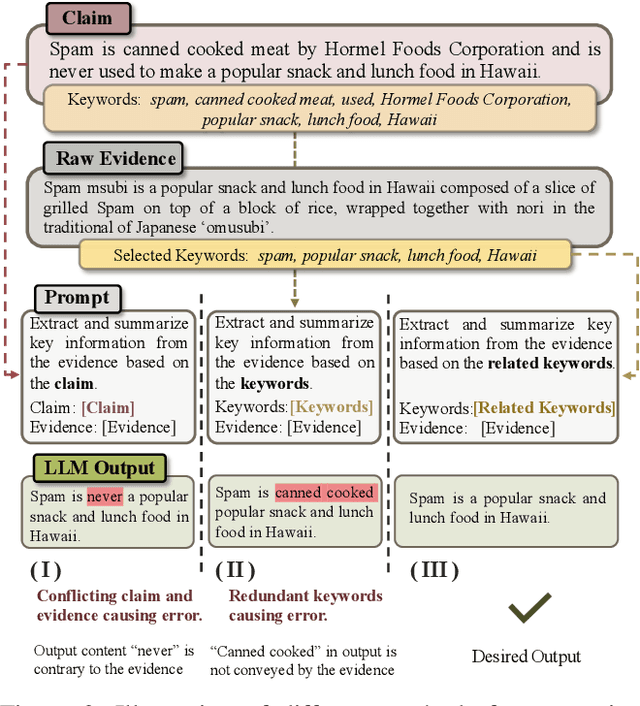
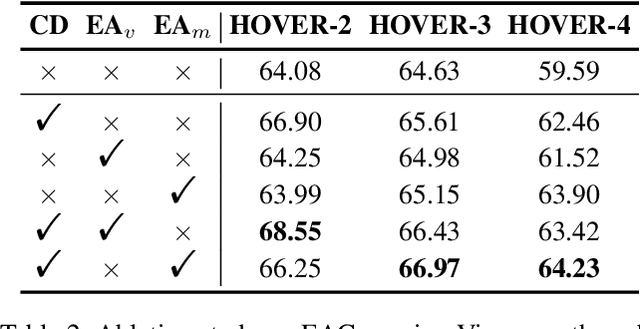
Claim verification is a task that involves assessing the truthfulness of a given claim based on multiple evidence pieces. Using large language models (LLMs) for claim verification is a promising way. However, simply feeding all the evidence pieces to an LLM and asking if the claim is factual does not yield good results. The challenge lies in the noisy nature of both the evidence and the claim: evidence passages typically contain irrelevant information, with the key facts hidden within the context, while claims often convey multiple aspects simultaneously. To navigate this "noisy crowd" of information, we propose EACon (Evidence Abstraction and Claim Deconstruction), a framework designed to find key information within evidence and verify each aspect of a claim separately. EACon first finds keywords from the claim and employs fuzzy matching to select relevant keywords for each raw evidence piece. These keywords serve as a guide to extract and summarize critical information into abstracted evidence. Subsequently, EACon deconstructs the original claim into subclaims, which are then verified against both abstracted and raw evidence individually. We evaluate EACon using two open-source LLMs on two challenging datasets. Results demonstrate that EACon consistently and substantially improve LLMs' performance in claim verification.
Rethinking Fair Graph Neural Networks from Re-balancing
Jul 16, 2024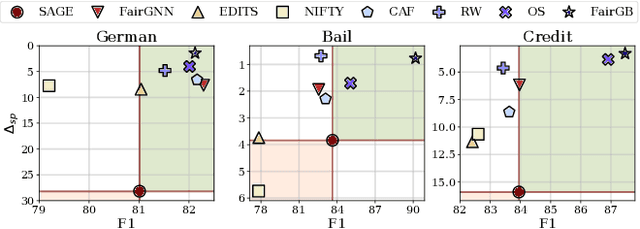
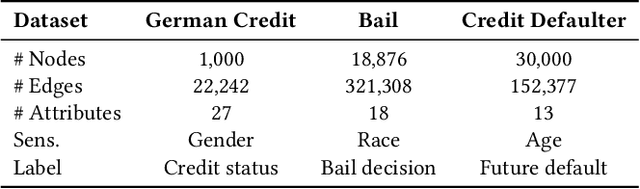
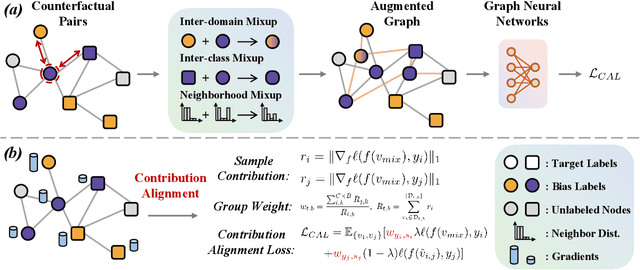
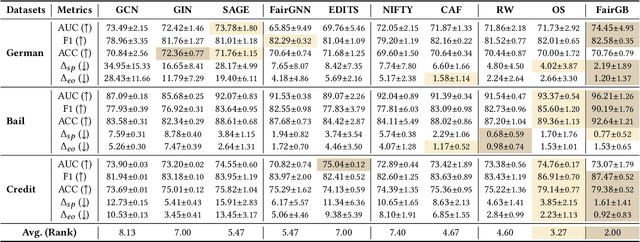
Driven by the powerful representation ability of Graph Neural Networks (GNNs), plentiful GNN models have been widely deployed in many real-world applications. Nevertheless, due to distribution disparities between different demographic groups, fairness in high-stake decision-making systems is receiving increasing attention. Although lots of recent works devoted to improving the fairness of GNNs and achieved considerable success, they all require significant architectural changes or additional loss functions requiring more hyper-parameter tuning. Surprisingly, we find that simple re-balancing methods can easily match or surpass existing fair GNN methods. We claim that the imbalance across different demographic groups is a significant source of unfairness, resulting in imbalanced contributions from each group to the parameters updating. However, these simple re-balancing methods have their own shortcomings during training. In this paper, we propose FairGB, Fair Graph Neural Network via re-Balancing, which mitigates the unfairness of GNNs by group balancing. Technically, FairGB consists of two modules: counterfactual node mixup and contribution alignment loss. Firstly, we select counterfactual pairs across inter-domain and inter-class, and interpolate the ego-networks to generate new samples. Guided by analysis, we can reveal the debiasing mechanism of our model by the causal view and prove that our strategy can make sensitive attributes statistically independent from target labels. Secondly, we reweigh the contribution of each group according to gradients. By combining these two modules, they can mutually promote each other. Experimental results on benchmark datasets show that our method can achieve state-of-the-art results concerning both utility and fairness metrics. Code is available at https://github.com/ZhixunLEE/FairGB.