 Add to Chrome
 Add to Firefox
 Add to Edge
ID Embedding as Subtle Features of Content and Structure for Multimodal Recommendation
Nov 10, 2023
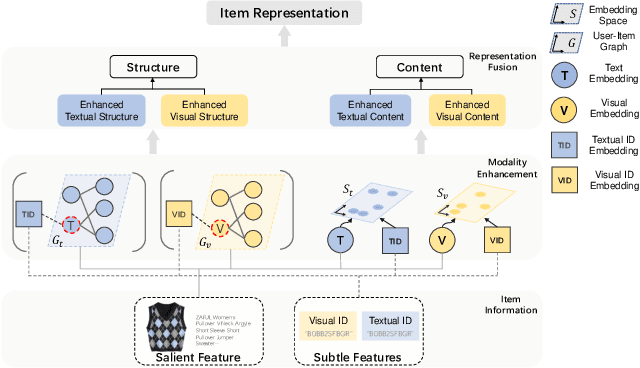
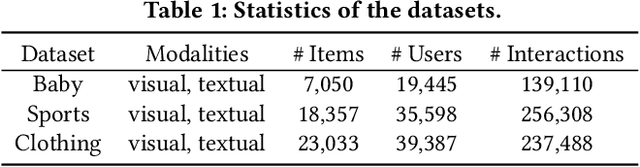
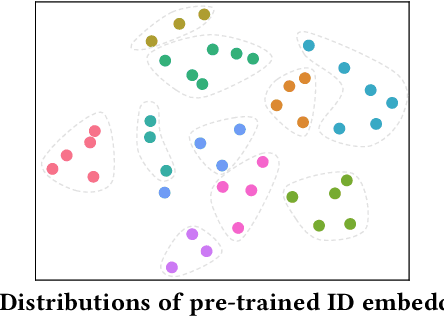
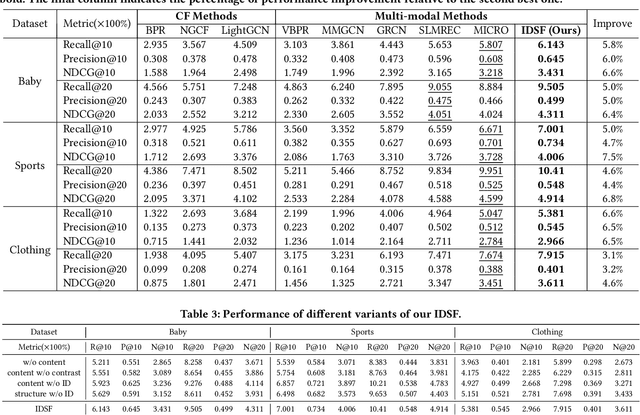
Multimodal recommendation aims to model user and item representations comprehensively with the involvement of multimedia content for effective recommendations. Existing research has shown that it is beneficial for recommendation performance to combine (user- and item-) ID embeddings with multimodal salient features, indicating the value of IDs. However, there is a lack of a thorough analysis of the ID embeddings in terms of feature semantics in the literature. In this paper, we revisit the value of ID embeddings for multimodal recommendation and conduct a thorough study regarding its semantics, which we recognize as subtle features of content and structures. Then, we propose a novel recommendation model by incorporating ID embeddings to enhance the semantic features of both content and structures. Specifically, we put forward a hierarchical attention mechanism to incorporate ID embeddings in modality fusing, coupled with contrastive learning, to enhance content representations. Meanwhile, we propose a lightweight graph convolutional network for each modality to amalgamate neighborhood and ID embeddings for improving structural representations. Finally, the content and structure representations are combined to form the ultimate item embedding for recommendation. Extensive experiments on three real-world datasets (Baby, Sports, and Clothing) demonstrate the superiority of our method over state-of-the-art multimodal recommendation methods and the effectiveness of fine-grained ID embeddings.

A Computational Framework for Solving Wasserstein Lagrangian Flows
Oct 17, 2023The dynamical formulation of the optimal transport can be extended through various choices of the underlying geometry ($\textit{kinetic energy}$), and the regularization of density paths ($\textit{potential energy}$). These combinations yield different variational problems ($\textit{Lagrangians}$), encompassing many variations of the optimal transport problem such as the Schr\"odinger bridge, unbalanced optimal transport, and optimal transport with physical constraints, among others. In general, the optimal density path is unknown, and solving these variational problems can be computationally challenging. Leveraging the dual formulation of the Lagrangians, we propose a novel deep learning based framework approaching all of these problems from a unified perspective. Our method does not require simulating or backpropagating through the trajectories of the learned dynamics, and does not need access to optimal couplings. We showcase the versatility of the proposed framework by outperforming previous approaches for the single-cell trajectory inference, where incorporating prior knowledge into the dynamics is crucial for correct predictions.
EX-FEVER: A Dataset for Multi-hop Explainable Fact Verification
Oct 15, 2023Fact verification aims to automatically probe the veracity of a claim based on several pieces of evidence. Existing works are always engaging in the accuracy improvement, let alone the explainability, a critical capability of fact verification system. Constructing an explainable fact verification system in a complex multi-hop scenario is consistently impeded by the absence of a relevant high-quality dataset. Previous dataset either suffer from excessive simplification or fail to incorporate essential considerations for explainability. To address this, we present EX-FEVER, a pioneering dataset for multi-hop explainable fact verification. With over 60,000 claims involving 2-hop and 3-hop reasoning, each is created by summarizing and modifying information from hyperlinked Wikipedia documents. Each instance is accompanied by a veracity label and an explanation that outlines the reasoning path supporting the veracity classification. Additionally, we demonstrate a novel baseline system on our EX-FEVER dataset, showcasing document retrieval, explanation generation, and claim verification and observe that existing fact verification models trained on previous datasets struggle to perform well on our dataset. Furthermore, we highlight the potential of utilizing Large Language Models in the fact verification task. We hope our dataset could make a significant contribution by providing ample opportunities to explore the integration of natural language explanations in the domain of fact verification.
Lion Secretly Solves Constrained Optimization: As Lyapunov Predicts
Oct 12, 2023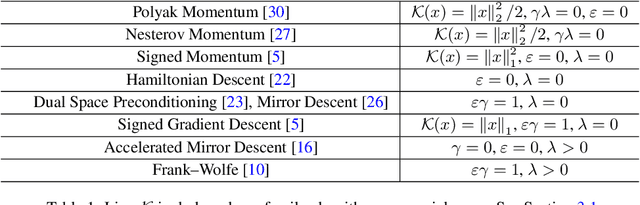


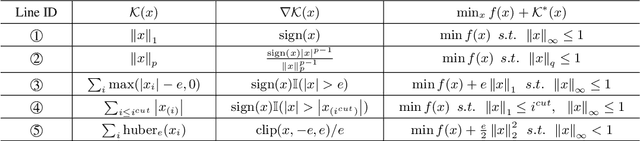
Lion (Evolved Sign Momentum), a new optimizer discovered through program search, has shown promising results in training large AI models. It performs comparably or favorably to AdamW but with greater memory efficiency. As we can expect from the results of a random search program, Lion incorporates elements from several existing algorithms, including signed momentum, decoupled weight decay, Polak, and Nesterov momentum, but does not fit into any existing category of theoretically grounded optimizers. Thus, even though Lion appears to perform well as a general-purpose optimizer for a wide range of tasks, its theoretical basis remains uncertain. This lack of theoretical clarity limits opportunities to further enhance and expand Lion's efficacy. This work aims to demystify Lion. Based on both continuous-time and discrete-time analysis, we demonstrate that Lion is a theoretically novel and principled approach for minimizing a general loss function $f(x)$ while enforcing a bound constraint $\|x\|_\infty \leq 1/\lambda$. Lion achieves this through the incorporation of decoupled weight decay, where $\lambda$ represents the weight decay coefficient. Our analysis is made possible by the development of a new Lyapunov function for the Lion updates. It applies to a broader family of Lion-$\kappa$ algorithms, where the $\text{sign}(\cdot)$ operator in Lion is replaced by the subgradient of a convex function $\kappa$, leading to the solution of a general composite optimization problem of $\min_x f(x) + \kappa^*(x)$. Our findings provide valuable insights into the dynamics of Lion and pave the way for further improvements and extensions of Lion-related algorithms.
GSLB: The Graph Structure Learning Benchmark
Oct 08, 2023Graph Structure Learning (GSL) has recently garnered considerable attention due to its ability to optimize both the parameters of Graph Neural Networks (GNNs) and the computation graph structure simultaneously. Despite the proliferation of GSL methods developed in recent years, there is no standard experimental setting or fair comparison for performance evaluation, which creates a great obstacle to understanding the progress in this field. To fill this gap, we systematically analyze the performance of GSL in different scenarios and develop a comprehensive Graph Structure Learning Benchmark (GSLB) curated from 20 diverse graph datasets and 16 distinct GSL algorithms. Specifically, GSLB systematically investigates the characteristics of GSL in terms of three dimensions: effectiveness, robustness, and complexity. We comprehensively evaluate state-of-the-art GSL algorithms in node- and graph-level tasks, and analyze their performance in robust learning and model complexity. Further, to facilitate reproducible research, we have developed an easy-to-use library for training, evaluating, and visualizing different GSL methods. Empirical results of our extensive experiments demonstrate the ability of GSL and reveal its potential benefits on various downstream tasks, offering insights and opportunities for future research. The code of GSLB is available at: https://github.com/GSL-Benchmark/GSLB.
AdaMap: High-Scalable Real-Time Cooperative Perception at the Edge
Oct 03, 2023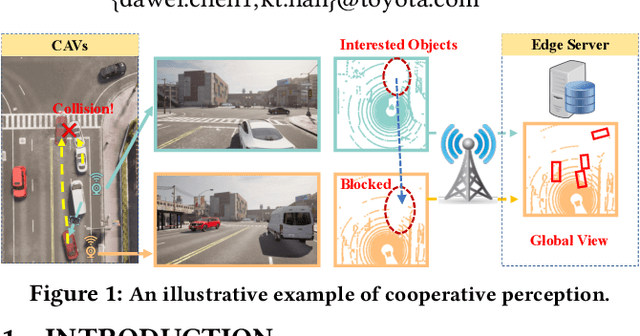
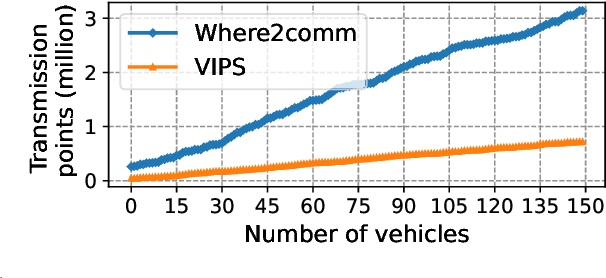

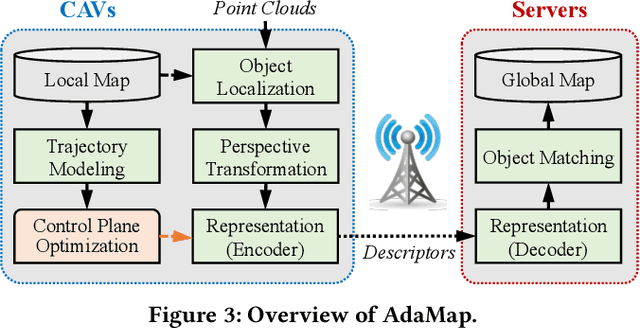
Cooperative perception is the key approach to augment the perception of connected and automated vehicles (CAVs) toward safe autonomous driving. However, it is challenging to achieve real-time perception sharing for hundreds of CAVs in large-scale deployment scenarios. In this paper, we propose AdaMap, a new high-scalable real-time cooperative perception system, which achieves assured percentile end-to-end latency under time-varying network dynamics. To achieve AdaMap, we design a tightly coupled data plane and control plane. In the data plane, we design a new hybrid localization module to dynamically switch between object detection and tracking, and a novel point cloud representation module to adaptively compress and reconstruct the point cloud of detected objects. In the control plane, we design a new graph-based object selection method to un-select excessive multi-viewed point clouds of objects, and a novel approximated gradient descent algorithm to optimize the representation of point clouds. We implement AdaMap on an emulation platform, including realistic vehicle and server computation and a simulated 5G network, under a 150-CAV trace collected from the CARLA simulator. The evaluation results show that, AdaMap reduces up to 49x average transmission data size at the cost of 0.37 reconstruction loss, as compared to state-of-the-art solutions, which verifies its high scalability, adaptability, and computation efficiency.
Uncovering Neural Scaling Laws in Molecular Representation Learning
Sep 28, 2023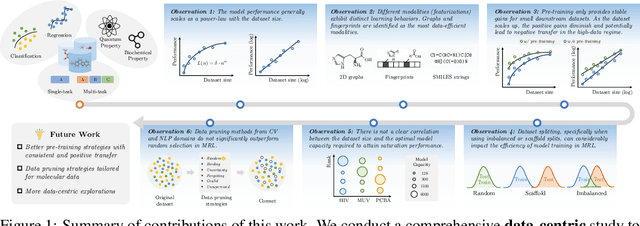
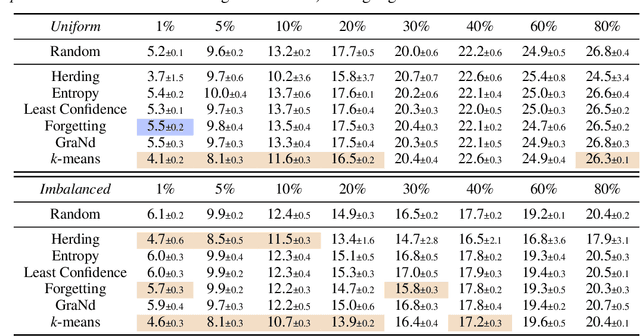
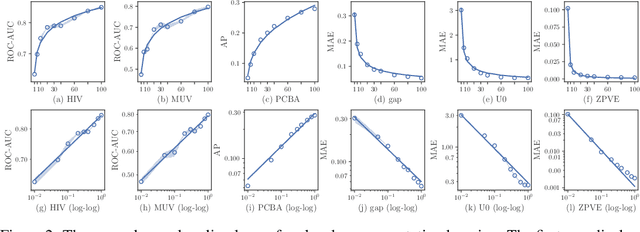
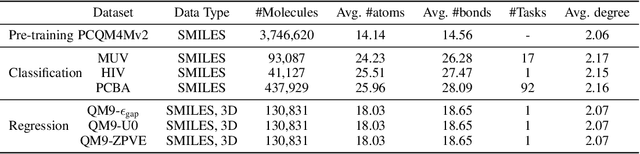
Molecular Representation Learning (MRL) has emerged as a powerful tool for drug and materials discovery in a variety of tasks such as virtual screening and inverse design. While there has been a surge of interest in advancing model-centric techniques, the influence of both data quantity and quality on molecular representations is not yet clearly understood within this field. In this paper, we delve into the neural scaling behaviors of MRL from a data-centric viewpoint, examining four key dimensions: (1) data modalities, (2) dataset splitting, (3) the role of pre-training, and (4) model capacity. Our empirical studies confirm a consistent power-law relationship between data volume and MRL performance across these dimensions. Additionally, through detailed analysis, we identify potential avenues for improving learning efficiency. To challenge these scaling laws, we adapt seven popular data pruning strategies to molecular data and benchmark their performance. Our findings underline the importance of data-centric MRL and highlight possible directions for future research.
TCGF: A unified tensorized consensus graph framework for multi-view representation learning
Sep 14, 2023
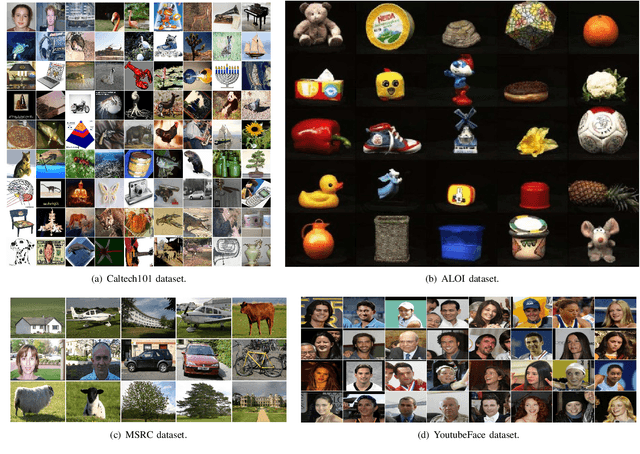
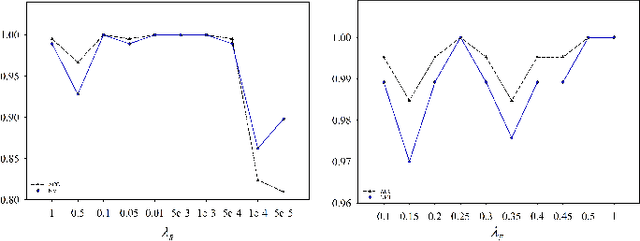
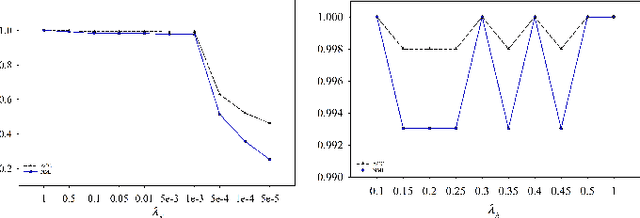
Multi-view learning techniques have recently gained significant attention in the machine learning domain for their ability to leverage consistency and complementary information across multiple views. However, there remains a lack of sufficient research on generalized multi-view frameworks that unify existing works into a scalable and robust learning framework, as most current works focus on specific styles of multi-view models. Additionally, most multi-view learning works rely heavily on specific-scale scenarios and fail to effectively comprehend multiple scales holistically. These limitations hinder the effective fusion of essential information from multiple views, resulting in poor generalization. To address these limitations, this paper proposes a universal multi-view representation learning framework named Tensorized Consensus Graph Framework (TCGF). Specifically, it first provides a unified framework for existing multi-view works to exploit the representations for individual view, which aims to be suitable for arbitrary assumptions and different-scales datasets. Then, stacks them into a tensor under alignment basics as a high-order representation, allowing for the smooth propagation of consistency and complementary information across all views. Moreover, TCGF proposes learning a consensus embedding shared by adaptively collaborating all views to uncover the essential structure of the multi-view data, which utilizes view-consensus grouping effect to regularize the view-consensus representation. To further facilitate related research, we provide a specific implementation of TCGF for large-scale datasets, which can be efficiently solved by applying the alternating optimization strategy. Experimental results conducted on seven different-scales datasets indicate the superiority of the proposed TCGF against existing state-of-the-art multi-view learning methods.
CvFormer: Cross-view transFormers with Pre-training for fMRI Analysis of Human Brain
Sep 14, 2023In recent years, functional magnetic resonance imaging (fMRI) has been widely utilized to diagnose neurological disease, by exploiting the region of interest (RoI) nodes as well as their connectivities in human brain. However, most of existing works only rely on either RoIs or connectivities, neglecting the potential for complementary information between them. To address this issue, we study how to discover the rich cross-view information in fMRI data of human brain. This paper presents a novel method for cross-view analysis of fMRI data of the human brain, called Cross-view transFormers (CvFormer). CvFormer employs RoI and connectivity encoder modules to generate two separate views of the human brain, represented as RoI and sub-connectivity tokens. Then, basic transformer modules can be used to process the RoI and sub-connectivity tokens, and cross-view modules integrate the complement information across two views. Furthermore, CvFormer uses a global token for each branch as a query to exchange information with other branches in cross-view modules, which only requires linear time for both computational and memory complexity instead of quadratic time. To enhance the robustness of the proposed CvFormer, we propose a two-stage strategy to train its parameters. To be specific, RoI and connectivity views can be firstly utilized as self-supervised information to pre-train the CvFormer by combining it with contrastive learning and then fused to finetune the CvFormer using label information. Experiment results on two public ABIDE and ADNI datasets can show clear improvements by the proposed CvFormer, which can validate its effectiveness and superiority.
TiBGL: Template-induced Brain Graph Learning for Functional Neuroimaging Analysis
Sep 14, 2023In recent years, functional magnetic resonance imaging has emerged as a powerful tool for investigating the human brain's functional connectivity networks. Related studies demonstrate that functional connectivity networks in the human brain can help to improve the efficiency of diagnosing neurological disorders. However, there still exist two challenges that limit the progress of functional neuroimaging. Firstly, there exists an abundance of noise and redundant information in functional connectivity data, resulting in poor performance. Secondly, existing brain network models have tended to prioritize either classification performance or the interpretation of neuroscience findings behind the learned models. To deal with these challenges, this paper proposes a novel brain graph learning framework called Template-induced Brain Graph Learning (TiBGL), which has both discriminative and interpretable abilities. Motivated by the related medical findings on functional connectivites, TiBGL proposes template-induced brain graph learning to extract template brain graphs for all groups. The template graph can be regarded as an augmentation process on brain networks that removes noise information and highlights important connectivity patterns. To simultaneously support the tasks of discrimination and interpretation, TiBGL further develops template-induced convolutional neural network and template-induced brain interpretation analysis. Especially, the former fuses rich information from brain graphs and template brain graphs for brain disorder tasks, and the latter can provide insightful connectivity patterns related to brain disorders based on template brain graphs. Experimental results on three real-world datasets show that the proposed TiBGL can achieve superior performance compared with nine state-of-the-art methods and keep coherent with neuroscience findings in recent literatures.