 Add to Chrome
 Add to Firefox
 Add to Edge
Generalized Regularized Evidential Deep Learning Models: Theory and Comprehensive Evaluation
Dec 27, 2025
Evidential deep learning (EDL) models, based on Subjective Logic, introduce a principled and computationally efficient way to make deterministic neural networks uncertainty-aware. The resulting evidential models can quantify fine-grained uncertainty using learned evidence. However, the Subjective-Logic framework constrains evidence to be non-negative, requiring specific activation functions whose geometric properties can induce activation-dependent learning-freeze behavior: a regime where gradients become extremely small for samples mapped into low-evidence regions. We theoretically characterize this behavior and analyze how different evidential activations influence learning dynamics. Building on this analysis, we design a general family of activation functions and corresponding evidential regularizers that provide an alternative pathway for consistent evidence updates across activation regimes. Extensive experiments on four benchmark classification problems (MNIST, CIFAR-10, CIFAR-100, and Tiny-ImageNet), two few-shot classification problems, and blind face restoration problem empirically validate the developed theory and demonstrate the effectiveness of the proposed generalized regularized evidential models.

Evidential Conditional Neural Processes
Nov 30, 2022


The Conditional Neural Process (CNP) family of models offer a promising direction to tackle few-shot problems by achieving better scalability and competitive predictive performance. However, the current CNP models only capture the overall uncertainty for the prediction made on a target data point. They lack a systematic fine-grained quantification on the distinct sources of uncertainty that are essential for model training and decision-making under the few-shot setting. We propose Evidential Conditional Neural Processes (ECNP), which replace the standard Gaussian distribution used by CNP with a much richer hierarchical Bayesian structure through evidential learning to achieve epistemic-aleatoric uncertainty decomposition. The evidential hierarchical structure also leads to a theoretically justified robustness over noisy training tasks. Theoretical analysis on the proposed ECNP establishes the relationship with CNP while offering deeper insights on the roles of the evidential parameters. Extensive experiments conducted on both synthetic and real-world data demonstrate the effectiveness of our proposed model in various few-shot settings.
Uncertainty-Aware Multiple Instance Learning from Large-Scale Long Time Series Data
Nov 21, 2021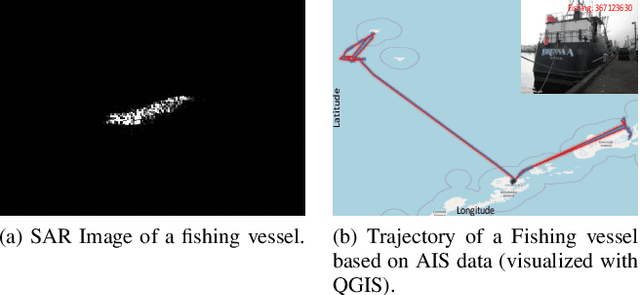
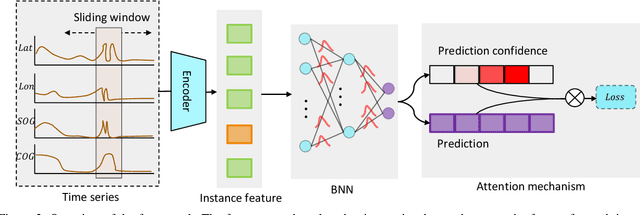
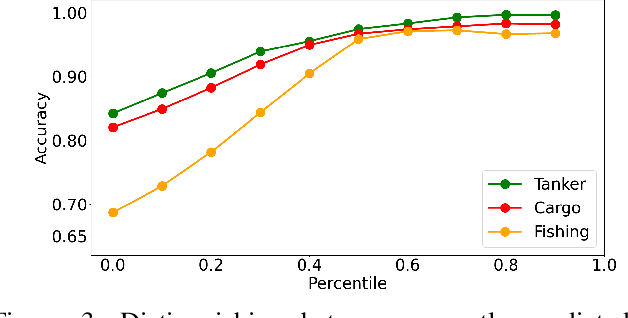
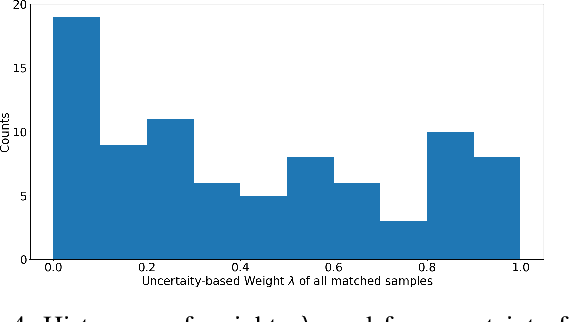
We propose a novel framework to classify large-scale time series data with long duration. Long time seriesclassification (L-TSC) is a challenging problem because the dataoften contains a large amount of irrelevant information to theclassification target. The irrelevant period degrades the classifica-tion performance while the relevance is unknown to the system.This paper proposes an uncertainty-aware multiple instancelearning (MIL) framework to identify the most relevant periodautomatically. The predictive uncertainty enables designing anattention mechanism that forces the MIL model to learn from thepossibly discriminant period. Moreover, the predicted uncertaintyyields a principled estimator to identify whether a prediction istrustworthy or not. We further incorporate another modality toaccommodate unreliable predictions by training a separate modelbased on its availability and conduct uncertainty aware fusion toproduce the final prediction. Systematic evaluation is conductedon the Automatic Identification System (AIS) data, which is col-lected to identify and track real-world vessels. Empirical resultsdemonstrate that the proposed method can effectively detect thetypes of vessels based on the trajectory and the uncertainty-awarefusion with other available data modality (Synthetic-ApertureRadar or SAR imagery is used in our experiments) can furtherimprove the detection accuracy.