 Add to Chrome
 Add to Firefox
 Add to Edge
Intrinsic Vicarious Conditioning for Deep Reinforcement Learning
May 12, 2026
Advancements in reinforcement learning have produced a variety of complex and useful intrinsic driving forces; crucially, these drivers operate under a direct conditioning paradigm. This form of conditioning limits our agents' capacity by restricting how they learn from the environment as well as from others. Off-policy or learn-by-example methods can learn from demonstrators' representations, but they require access to the demonstrating agent's policies or their reward functions. Our work overcomes this direct sampling limitation by introducing vicarious conditioning as an intrinsic reward mechanism. We draw from psychological and biological literature to provide a foundation for vicarious conditioning and use memory-based methods to implement its four steps: attention, retention, reproduction, and reinforcement. Crucially, our vicarious conditioning paradigms support low-shot learning and do not require the demonstrator agent's policy nor its reward functions. We evaluate our approach in the MiniWorld Sidewalk environment, one of the few public environments that features a non-descriptive terminal condition (no reward provided upon agent death), and extend it to Box2D's CarRacing environment. Our results across both environments demonstrate that vicarious conditioning enables longer episode lengths by discouraging the agent from non-descriptive terminal conditions and guiding the agent toward desirable states. Overall, this work emulates a cognitively-plausible learning paradigm better suited to problems such as single-life learning or continual learning.

Beyond the Class Subspace: Teacher-Guided Training for Reliable Out-of-Distribution Detection in Single-Domain Models
Mar 11, 2026Out-of-distribution (OOD) detection methods perform well on multi-domain benchmarks, yet many practical systems are trained on single-domain data. We show that this regime induces a geometric failure mode, Domain-Sensitivity Collapse (DSC): supervised training compresses features into a low-rank class subspace and suppresses directions that carry domain-shift signal. We provide theory showing that, under DSC, distance- and logit-based OOD scores lose sensitivity to domain shift. We then introduce Teacher-Guided Training (TGT), which distills class-suppressed residual structure from a frozen multi-domain teacher (DINOv2) into the student during training. The teacher and auxiliary head are discarded after training, adding no inference overhead. Across eight single-domain benchmarks, TGT yields large far-OOD FPR@95 reductions for distance-based scorers: MDS improves by 11.61 pp, ViM by 10.78 pp, and kNN by 12.87 pp (ResNet-50 average), while maintaining or slightly improving in-domain OOD and classification accuracy.
WLV-RIT at SemEval-2021 Task 5: A Neural Transformer Framework for Detecting Toxic Spans
Apr 15, 2021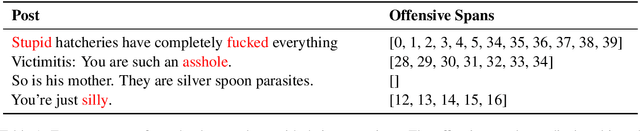
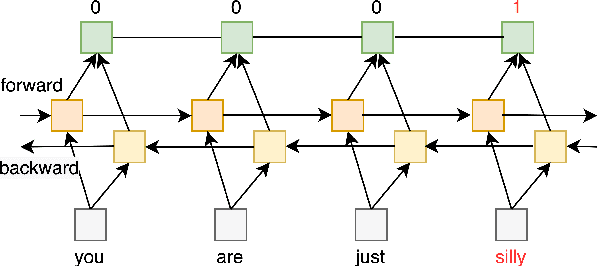
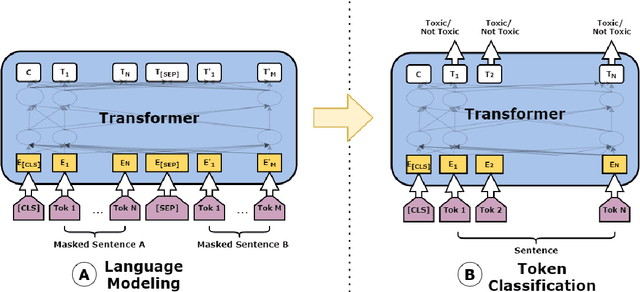
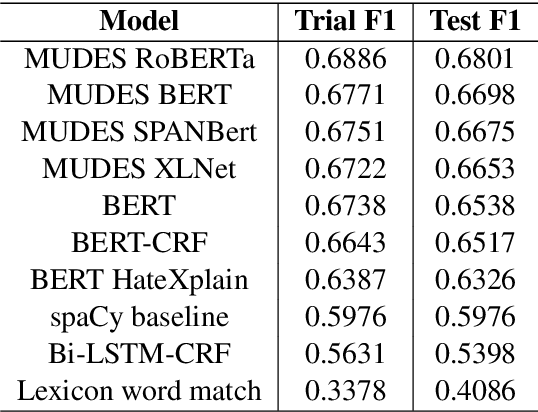
In recent years, the widespread use of social media has led to an increase in the generation of toxic and offensive content on online platforms. In response, social media platforms have worked on developing automatic detection methods and employing human moderators to cope with this deluge of offensive content. While various state-of-the-art statistical models have been applied to detect toxic posts, there are only a few studies that focus on detecting the words or expressions that make a post offensive. This motivates the organization of the SemEval-2021 Task 5: Toxic Spans Detection competition, which has provided participants with a dataset containing toxic spans annotation in English posts. In this paper, we present the WLV-RIT entry for the SemEval-2021 Task 5. Our best performing neural transformer model achieves an $0.68$ F1-Score. Furthermore, we develop an open-source framework for multilingual detection of offensive spans, i.e., MUDES, based on neural transformers that detect toxic spans in texts.
Smart Library: Identifying Books in a Library using Richly Supervised Deep Scene Text Reading
Nov 22, 2016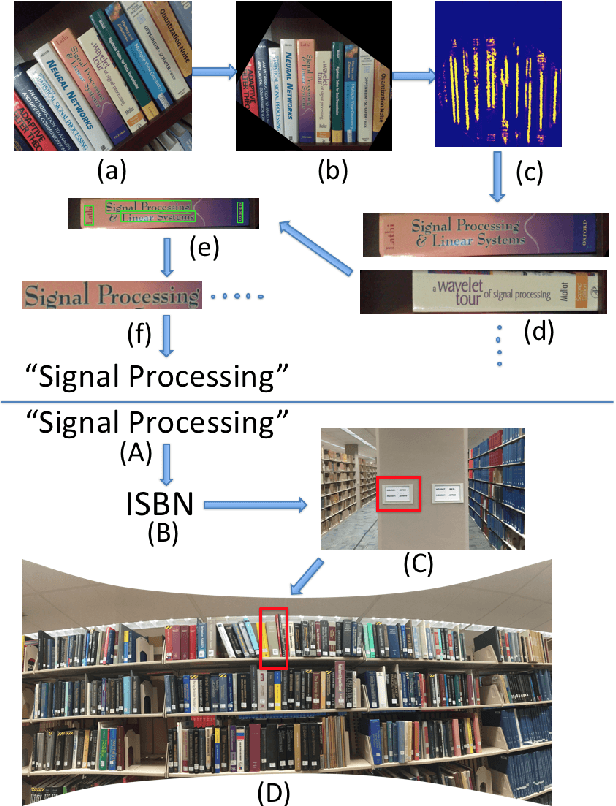
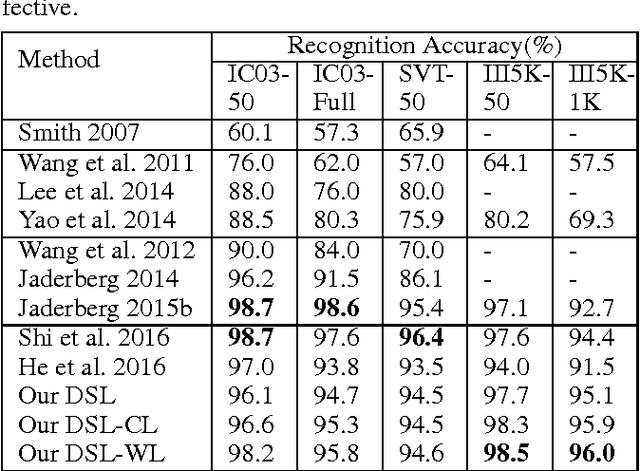
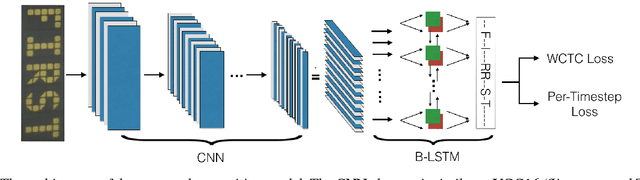
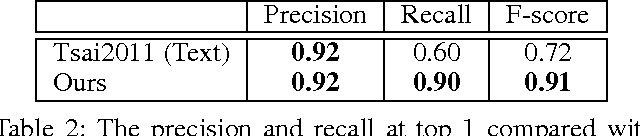
Physical library collections are valuable and long standing resources for knowledge and learning. However, managing books in a large bookshelf and finding books on it often leads to tedious manual work, especially for large book collections where books might be missing or misplaced. Recently, deep neural models, such as Convolutional Neural Networks (CNN) and Recurrent Neural Networks (RNN) have achieved great success for scene text detection and recognition. Motivated by these recent successes, we aim to investigate their viability in facilitating book management, a task that introduces further challenges including large amounts of cluttered scene text, distortion, and varied lighting conditions. In this paper, we present a library inventory building and retrieval system based on scene text reading methods. We specifically design our scene text recognition model using rich supervision to accelerate training and achieve state-of-the-art performance on several benchmark datasets. Our proposed system has the potential to greatly reduce the amount of human labor required in managing book inventories as well as the space needed to store book information.