 Add to Chrome
 Add to Firefox
 Add to Edge
Teeth2Point: A Two-Stage Dental CBCT ROI-to-Point Segmentation Framework
Aug 19, 2026
Modern deep learning architectures have demonstrated strong performance in dental CBCT segmentation. One remaining crucial challenge is accurate tooth labeling in cases with missing or malpositioned teeth, which are highly relevant for dental practice. Transformer-based architectures should in theory be able to resolve such ambiguities using global anatomical context. However, due to the high resolution of CBCT volumes and the wide spatial distribution of teeth within volumes, dense patch-based volumetric processing faces an inherent trade-off. Computational costs limit the number of patches that can be used in self-attention and thus, one can either increase the extent of the context captured in self-attention or capture fine-grained structural details by using small patches, but not both. In this work, we present Teeth2Point, an efficient point-based transformer framework for dental CBCT semantic segmentation that can avoid this trade-off. Teeth2Point first localizes volumetric regions of interest (ROIs) surrounding teeth using a convolutional model, then converts ROIs into point tokens using adaptive sampling. A transformer model predicts accurate segmentations using the point tokens, which allow capturing global context while retaining high resolution. The transformer is first pretrained using self-supervised learning (SSL), in the style of DINO but using domain-specific augmentation strategies, followed by supervised finetuning. The SSL pretraining, which includes random token masking, provides robustness to complex anatomical variations. Compared with the strongest two-stage baseline, Teeth2Point improves abnormal-case performance by 1.44 DSC points on average across four datasets; relative to the first-stage nnU-Net, the gain is 1.9 points.

Facial Image Feature Analysis and its Specialization for Fréchet Distance and Neighborhoods
Jun 26, 2024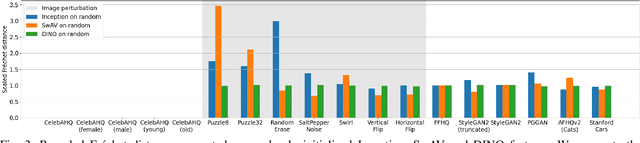
Assessing distances between images and image datasets is a fundamental task in vision-based research. It is a challenging open problem in the literature and despite the criticism it receives, the most ubiquitous method remains the Fr\'echet Inception Distance. The Inception network is trained on a specific labeled dataset, ImageNet, which has caused the core of its criticism in the most recent research. Improvements were shown by moving to self-supervision learning over ImageNet, leaving the training data domain as an open question. We make that last leap and provide the first analysis on domain-specific feature training and its effects on feature distance, on the widely-researched facial image domain. We provide our findings and insights on this domain specialization for Fr\'echet distance and image neighborhoods, supported by extensive experiments and in-depth user studies.