 Add to Chrome
 Add to Firefox
 Add to Edge
Discovering High-Quality Chess Puzzles with Offline Reinforcement Learning
Aug 14, 2026
Learning and skill mastery require extensive and deliberate practice. In many learning settings, producing high-quality pedagogical materials can require a high level of domain expertise and be very time-consuming. Pedagogical materials often need to train students to engage in different thinking patterns. In some domains, such as chess, puzzles are used to help students practice their skills in calculating the next moves and recognizing known patterns on a board. Giving students a practice set of puzzles to help them learn different modes of thinking is challenging because the teacher needs to carefully balance between different motifs and how many look-ahead steps a student needs to perform. Popular online platforms like Chess.com and Lichess offer players millions of puzzles. Unlike chess tactics puzzles procured by human experts, where chess beginners can learn valuable insights, these puzzles are automatically generated and often regarded as having low pedagogical value. These platforms also rely on a heuristic to recommend puzzles to users for practice. Using the user history data over an entire year, a total of 1.5 billion puzzle-solving histories, we learn the pedagogical value of a puzzle and how to automatically choose a set of puzzles to better support chess learners using insights from offline reinforcement learning. We show that using offline policy evaluation, our trained policy has significant impact on beginners with puzzle-solving Elo range of 100--1000, particularly for the group of beginners whose learning growth was stagnant. We also performed a qualitative analysis of the puzzles discovered by our model by collecting annotation ratings from expert chess players. The success of our pipeline shows promise for a future where we can understand the pedagogical values of practice items given general user interaction data.

Machine learning surrogates for efficient hydrologic modeling: Insights from stochastic simulations of managed aquifer recharge
Jul 30, 2024Process-based hydrologic models are invaluable tools for understanding the terrestrial water cycle and addressing modern water resources problems. However, many hydrologic models are computationally expensive and, depending on the resolution and scale, simulations can take on the order of hours to days to complete. While techniques such as uncertainty quantification and optimization have become valuable tools for supporting management decisions, these analyses typically require hundreds of model simulations, which are too computationally expensive to perform with a process-based hydrologic model. To address this gap, we propose a hybrid modeling workflow in which a process-based model is used to generate an initial set of simulations and a machine learning (ML) surrogate model is then trained to perform the remaining simulations required for downstream analysis. As a case study, we apply this workflow to simulations of variably saturated groundwater flow at a prospective managed aquifer recharge (MAR) site. We compare the accuracy and computational efficiency of several ML architectures, including deep convolutional networks, recurrent neural networks, vision transformers, and networks with Fourier transforms. Our results demonstrate that ML surrogate models can achieve under 10% mean absolute percentage error and yield order-of-magnitude runtime savings over processed-based models. We also offer practical recommendations for training hydrologic surrogate models, including implementing data normalization to improve accuracy, using a normalized loss function to improve training stability and downsampling input features to decrease memory requirements.
Detecting Neighborhood Gentrification at Scale via Street-level Visual Data
Jan 04, 2023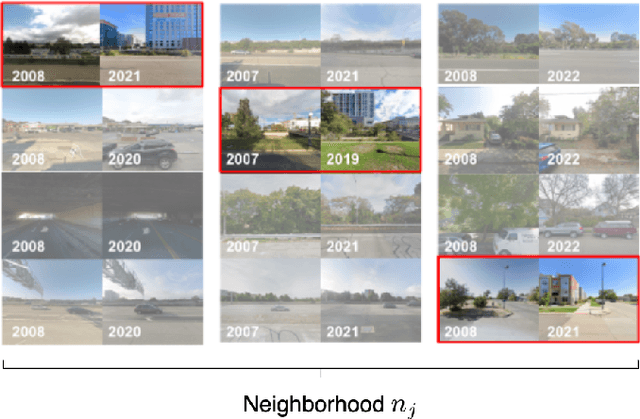
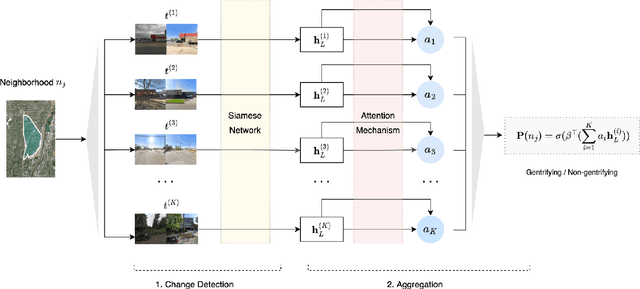
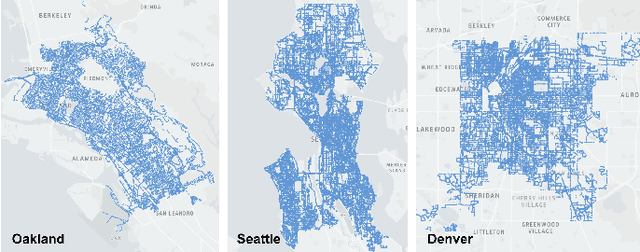
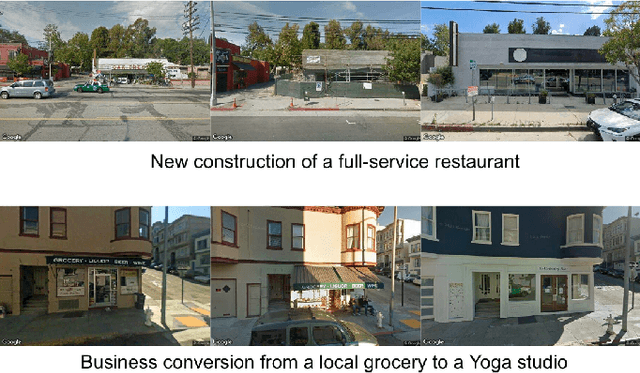
Neighborhood gentrification plays a significant role in shaping the social and economic well-being of both individuals and communities at large. While some efforts have been made to detect gentrification in cities, existing approaches rely mainly on estimated measures from survey data, require substantial work of human labeling, and are limited in characterizing the neighborhood as a whole. We propose a novel approach to detecting neighborhood gentrification at a large-scale based on the physical appearance of neighborhoods by incorporating historical street-level visual data. We show the effectiveness of the proposed method by comparing results from our approach with gentrification measures from previous literature and case studies. Our approach has the potential to supplement existing indicators of gentrification and become a valid resource for urban researchers and policy makers.