 Add to Chrome
 Add to Firefox
 Add to Edge
Discovering High-Quality Chess Puzzles with Offline Reinforcement Learning
Aug 14, 2026
Learning and skill mastery require extensive and deliberate practice. In many learning settings, producing high-quality pedagogical materials can require a high level of domain expertise and be very time-consuming. Pedagogical materials often need to train students to engage in different thinking patterns. In some domains, such as chess, puzzles are used to help students practice their skills in calculating the next moves and recognizing known patterns on a board. Giving students a practice set of puzzles to help them learn different modes of thinking is challenging because the teacher needs to carefully balance between different motifs and how many look-ahead steps a student needs to perform. Popular online platforms like Chess.com and Lichess offer players millions of puzzles. Unlike chess tactics puzzles procured by human experts, where chess beginners can learn valuable insights, these puzzles are automatically generated and often regarded as having low pedagogical value. These platforms also rely on a heuristic to recommend puzzles to users for practice. Using the user history data over an entire year, a total of 1.5 billion puzzle-solving histories, we learn the pedagogical value of a puzzle and how to automatically choose a set of puzzles to better support chess learners using insights from offline reinforcement learning. We show that using offline policy evaluation, our trained policy has significant impact on beginners with puzzle-solving Elo range of 100--1000, particularly for the group of beginners whose learning growth was stagnant. We also performed a qualitative analysis of the puzzles discovered by our model by collecting annotation ratings from expert chess players. The success of our pipeline shows promise for a future where we can understand the pedagogical values of practice items given general user interaction data.

"Mistakes Help Us Grow": Facilitating and Evaluating Growth Mindset Supportive Language in Classrooms
Oct 16, 2023Teachers' growth mindset supportive language (GMSL)--rhetoric emphasizing that one's skills can be improved over time--has been shown to significantly reduce disparities in academic achievement and enhance students' learning outcomes. Although teachers espouse growth mindset principles, most find it difficult to adopt GMSL in their practice due the lack of effective coaching in this area. We explore whether large language models (LLMs) can provide automated, personalized coaching to support teachers' use of GMSL. We establish an effective coaching tool to reframe unsupportive utterances to GMSL by developing (i) a parallel dataset containing GMSL-trained teacher reframings of unsupportive statements with an accompanying annotation guide, (ii) a GMSL prompt framework to revise teachers' unsupportive language, and (iii) an evaluation framework grounded in psychological theory for evaluating GMSL with the help of students and teachers. We conduct a large-scale evaluation involving 174 teachers and 1,006 students, finding that both teachers and students perceive GMSL-trained teacher and model reframings as more effective in fostering a growth mindset and promoting challenge-seeking behavior, among other benefits. We also find that model-generated reframings outperform those from the GMSL-trained teachers. These results show promise for harnessing LLMs to provide automated GMSL feedback for teachers and, more broadly, LLMs' potentiality for supporting students' learning in the classroom. Our findings also demonstrate the benefit of large-scale human evaluations when applying LLMs in educational domains.
Language modeling via stochastic processes
Mar 21, 2022
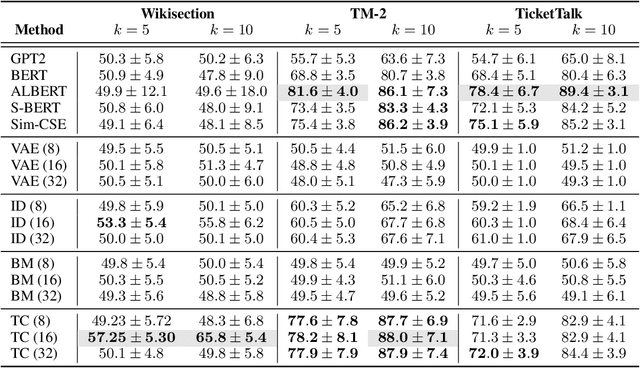
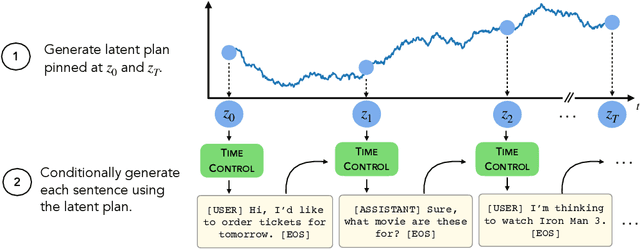
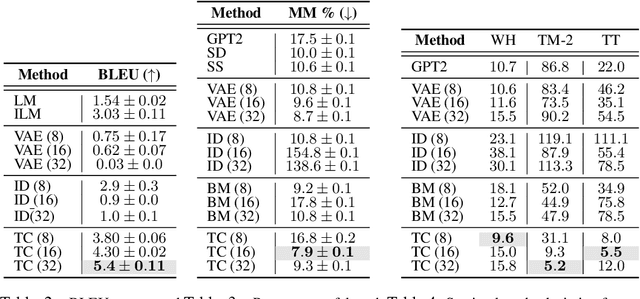
Modern language models can generate high-quality short texts. However, they often meander or are incoherent when generating longer texts. These issues arise from the next-token-only language modeling objective. To address these issues, we introduce Time Control (TC), a language model that implicitly plans via a latent stochastic process. TC does this by learning a representation which maps the dynamics of how text changes in a document to the dynamics of a stochastic process of interest. Using this representation, the language model can generate text by first implicitly generating a document plan via a stochastic process, and then generating text that is consistent with this latent plan. Compared to domain-specific methods and fine-tuning GPT2 across a variety of text domains, TC improves performance on text infilling and discourse coherence. On long text generation settings, TC preserves the text structure both in terms of ordering (up to +40% better) and text length consistency (up to +17% better). Human evaluators also prefer TC's output 28.6% more than the baselines.