 Add to Chrome
 Add to Firefox
 Add to Edge
One Frozen Simulator Is Not Enough: Simulator Collapse in Multi-Agent RL
Aug 12, 2026
Multi-agent reinforcement learning for human-AI interaction typically relies on a single large language model to simulate user behavior. We show that this approach systematically fails to generalize, and trace the failure to simulator collapse: because the simulator LLM is mode-collapsed, an LLM policy trained against it overfits to narrow strategies that exploit the simulator's dominant mode, and such a policy transfers poorly to unseen simulators and real users. We formalize this collapse theoretically and propose two complementary solutions, one at inference time and one at training time. The inference-time solution, Verbalized Sampling, broadens the simulator's behavior by sampling from a verbalized response distribution, reducing mode collapse. The training-time solution, Co-Training, jointly optimizes the policy against a population of trainable simulators, preventing it from overfitting to any single simulator's mode. We validate both solutions on three multi-turn benchmarks: Persuasion for Good, $τ^2$-bench, and CooperBench. Verbalized Sampling improves held-out success by up to 9% over single-simulator RL, and Co-Training pushes gains further to 14%; the human study shows similar gain on real users. Both solutions preserve the policy diversity that collapses under single-simulator RL. To support further work in this direction, we release SCOPE, an open-source framework for Population Co-Training multi-agent RL. More broadly, our results suggest that the diversity of the training environment, not only the policy, is critical to the generalization of multi-turn RL to real-world deployment.

Shepherd: A Runtime Substrate Empowering Meta-Agents with a Formalized Execution Trace
May 11, 2026We introduce Shepherd, a functional programming model that formalizes meta-agent operations on target agents as functions, with core operations mechanized in Lean. Shepherd records every agent-environment interaction as a typed event in a Git-like execution trace, enabling any past state to be forked and replayed. The system forks the agent process and its filesystem $5\times$ faster than Docker, achieving $>95\%$ prompt-cache reuse on replay. We demonstrate the model through three applications. First, in runtime intervention, a live supervisor increases pair coding pass rates from 28.8% to 54.7% on CooperBench. Second, in counterfactual meta-optimization, branching exploration outperforms baselines across four benchmarks by up to 11 points while reducing wall-clock time by up to 58%. Third, in Tree-RL training, forking rollouts at selected turns improves TerminalBench-2 performance from 34.2% to 39.4%. These results establish Shepherd as an efficient infrastructure for programming meta-agents. We open-source the system to support future research.
Detecting Label Errors using Pre-Trained Language Models
May 25, 2022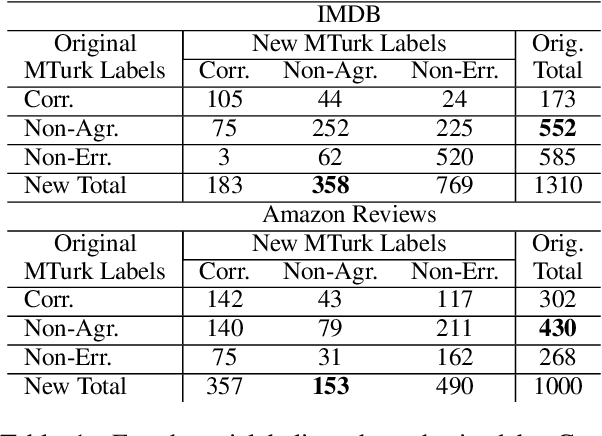
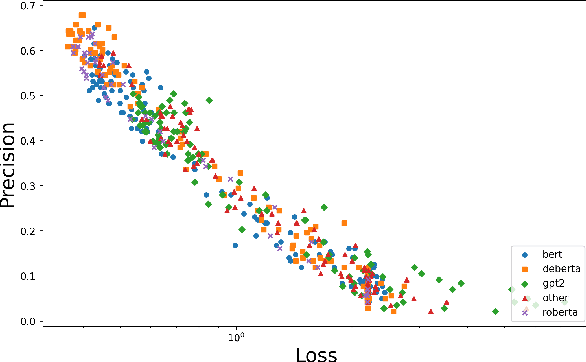
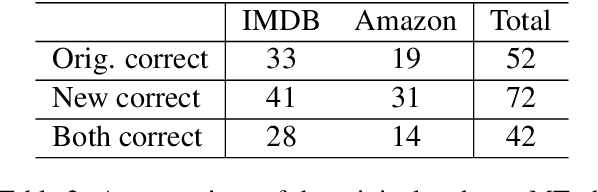
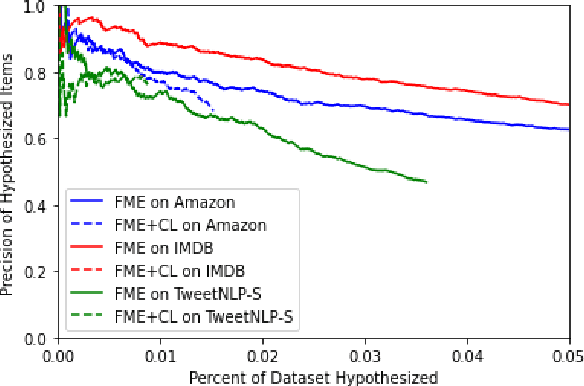
We show that large pre-trained language models are extremely capable of identifying label errors in datasets: simply verifying data points in descending order of out-of-distribution loss significantly outperforms more complex mechanisms for detecting label errors on natural language datasets. We contribute a novel method to produce highly realistic, human-originated label noise from crowdsourced data, and demonstrate the effectiveness of this method on TweetNLP, providing an otherwise difficult to obtain measure of realistic recall.